
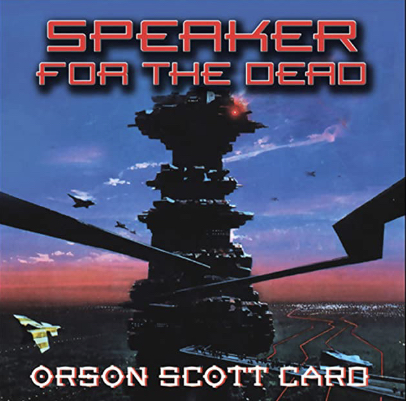
Finished: June 3, 2023
Why I read this
Honestly, I am a sucker for a sequel. It doesn’t matter how bad the reviews or how many books there are once I am invested in a series or a world I have a compelling need to read the next and the next to see what happens to those characters I know. Luckily for this one, the book was a joy to read!
What I learned
In Ender’s Game we were challenged with how we should handle an alien species that is a known threat, is extremely advanced, and with which we have no method of communication. In The Speaker for the Dead, we are faced with the exact opposite problem, how do we properly communicate with a budding species with all of the moral and ethical dilemmas associated with this. On top of this were the cultural challenges associated with meeting a species. I am excited to see how they will progress with these questions in the next books of the series.
One thing I particularly liked was the interesting and constant classification of species that, in my opinion, really sparked a lot of thought for any two societies meeting. The Utlänning, or another human from the same planet, the Främling, or another human from a different planet, the Ramen, species that can be treated as a human, or the Varelse, or such distant species that communication cannot be determined, that may be sentient or not. These distinctions made me think of how we classify people in our lives and how we see things generally, for example how in sociology it is known that humans can only have so many meaningful relationships at once (200-300 depending on the source), so once someone is not in that circle how do we classify them? How are our emotions changed towards them, are they people, are they animals, are they objects?
What I didn’t like
A challenge with space opera genre that I have always had is the continued rabbit hole that is required to requires a greater and greater emphasis on science fiction themes to progress the plot. In this book, they’ve begun down the path that is for now ok, but is treacherous of making more and more scientifically complicated relationships. For example, in the first book the ancible was invented and not explained. Now in the second book the ancible has a person who lives within it. Who knows where the third book will take this inexplicable technology. Not so much a criticism as an observation, but we will check back in with the next of the series soon.
Questions I asked
What is our position to help or hurt a developing group?
How do we classify the people and creatures around us? What level of sentience earns what level of respect from the society?
In the future once we achieve interstellar travel (if we do), what is our responsibility to leave spaces for possible other future species?
My Favorite Quote
“It’s ok to die sometimes as long as you keep getting born.”
Ender Wiggin
Books I liked like this one
God Emperor of Dune by Frank Herbert (For its philosophical perspective of humanity in a multiplanetary system)
The Long Walk by Stephen King (For the indomitable will of young people)

 Book Reviews for Mom