
Finished: July 30, 2023
Why I read this
I have had this book earmarked for my list for a long time. It seems pretty universally acclaimed and it seems to be the type of knowledge that everyone should have. Recently, a conversation with a few of my colleagues over lunch showed that I was one of the few that had not yet read this book! I of course could not be the one left out of the conversations so I picked it up next and a couple weeks later it was done!
What I learned
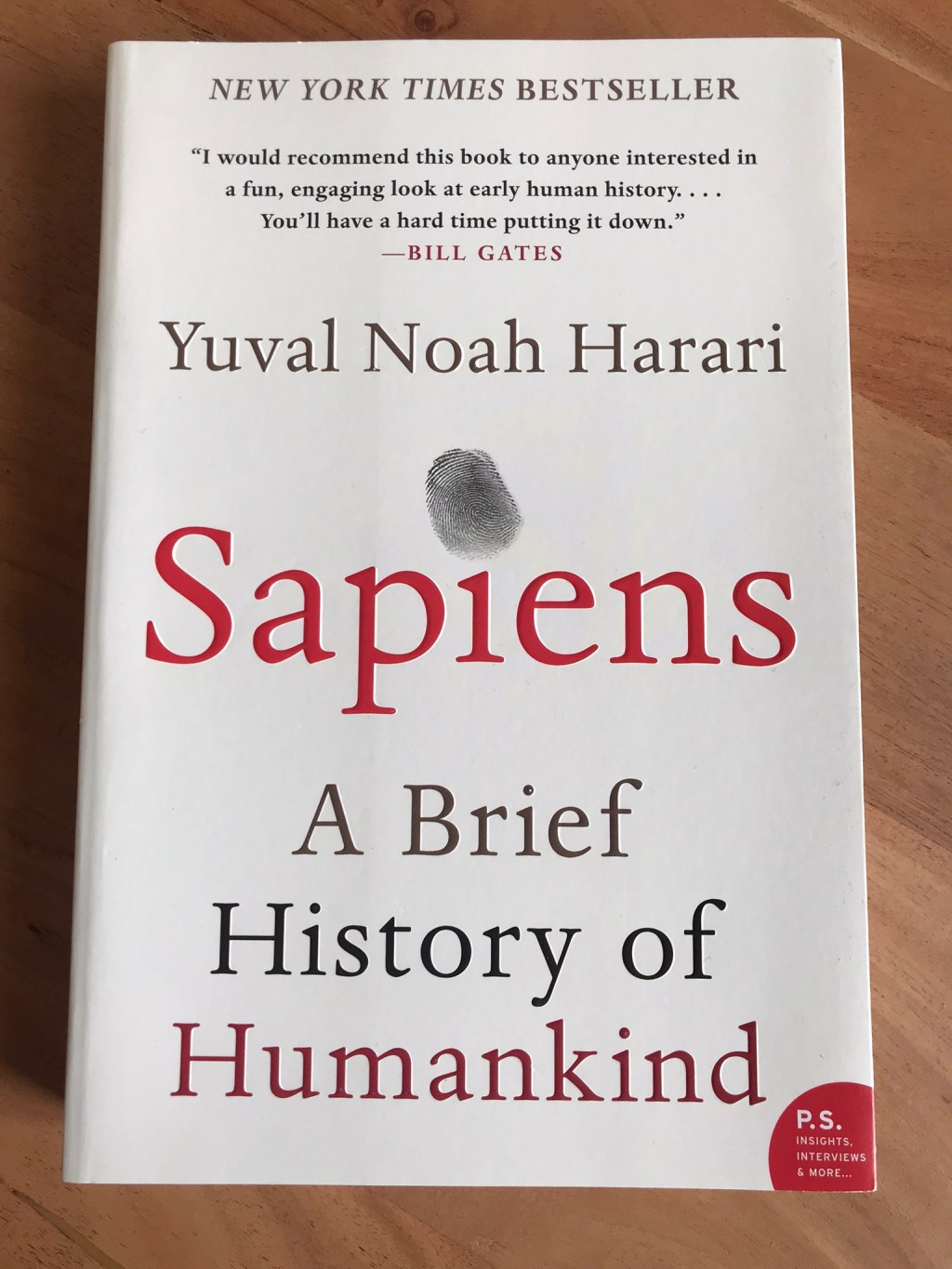
Maybe I missed the key points of this book, but my takeaways were a bit bleak. The review of Bill Gates that this is a “fun and engaging” book was only half true to me. Engaging yes, fun…. not so much. The first half of the book is concentrated on early history discussing our transition from just another Homo species to being the dominant global species. In this section it is mentioned over and over how wherever we went we killed everything in our path, animals, plants, other human species. Fun right? Then going into the agricultural revolution it is shown over and over how our quality of life dramatically dropped from our hunter gatherer past, how the lives of animals were reduced to horrid conditions, and how our new lives were trapped by the agriculture that we created.
In the middle of the book things lifted up a bit with the review of several systems and changes to society that brought us to where we are today. Religion, imperialism, money, capitalism were all chapters that were interesting and I could see lots of relationships with other books I had read. So of course since I saw how smart I am the book was now interesting! Points about innate talents being the same across the world reminded me of Mindset by Carol S. Dweck. Points about the origins of money reminded me of Debt the first 5000 years by David Graeber.
Finally, I was exposed to some ideas that were very interesting about the non-theistic religions such as Buddhism. Having hardly ever learned anything on the topic I found the idea of these religions to be super engaging and insightful. Moreover, the ideas of Buddhism go well with human psychology. In Thinking Fast and Slow by Daniel Kahneman, the relationship between the experiencing self and the remembering self are very similar to the Buddhist ideas about living in the moment and avoiding craving to avoid suffering.
Overall lots of interesting ideas, and a nice summary of human history to today with lots of topics to dive deeper into.
What I didn’t like
The biggest point that continuously annoyed me throughout this book was the authors consistent and strong insistence to push their own points. Over and over it is mentioned that the institutions and religions that we have created are just figments of our imagination, even if they have power. To me this is a very unbiased statement and is very interesting. Then Harari goes on to put tons of heavy influence into topics like animal rights bring up point after point that animal are wasting away under our rulership in consistently strong and biased language. Frankly I understand and agree with his point a bit, but this type of book isn’t the place for making a plea for animal rights, especially when Harari mentions many times about how human rights are just a well constructed lie.
Questions I asked
What are the modern problems that are currently radically shifting our society?
This book was written almost 10 years ago. What would be the changes the author would add for today?
Harari asks at the end of the book “who do we want to be?” and “what do we want to want?”, these questions tie back to my topic of values and minority vs. majority view points. If the majority now wants to see the world a certain way, what obligation does the minority have to adapt to that? If for example a minority population believes we can and should create super humans, once they are created it will change humanity forever regardless. Does this minority group have an obligation to not create this super human groups because a different majority disagrees?
My Favorite Quote
“Equality can be ensured only by curtailing the freedoms of those who are better off.”
Yuval Noah Harari
Books I liked like this one
Thinking Fast and Slow: Daniel Kahneman (For how established human functions govern our decisions and actions)
Debt the first 500 years: David Graeber (For the sociology and history behind early human systems and how they impact the modern world)

 Book Reviews for Mom