
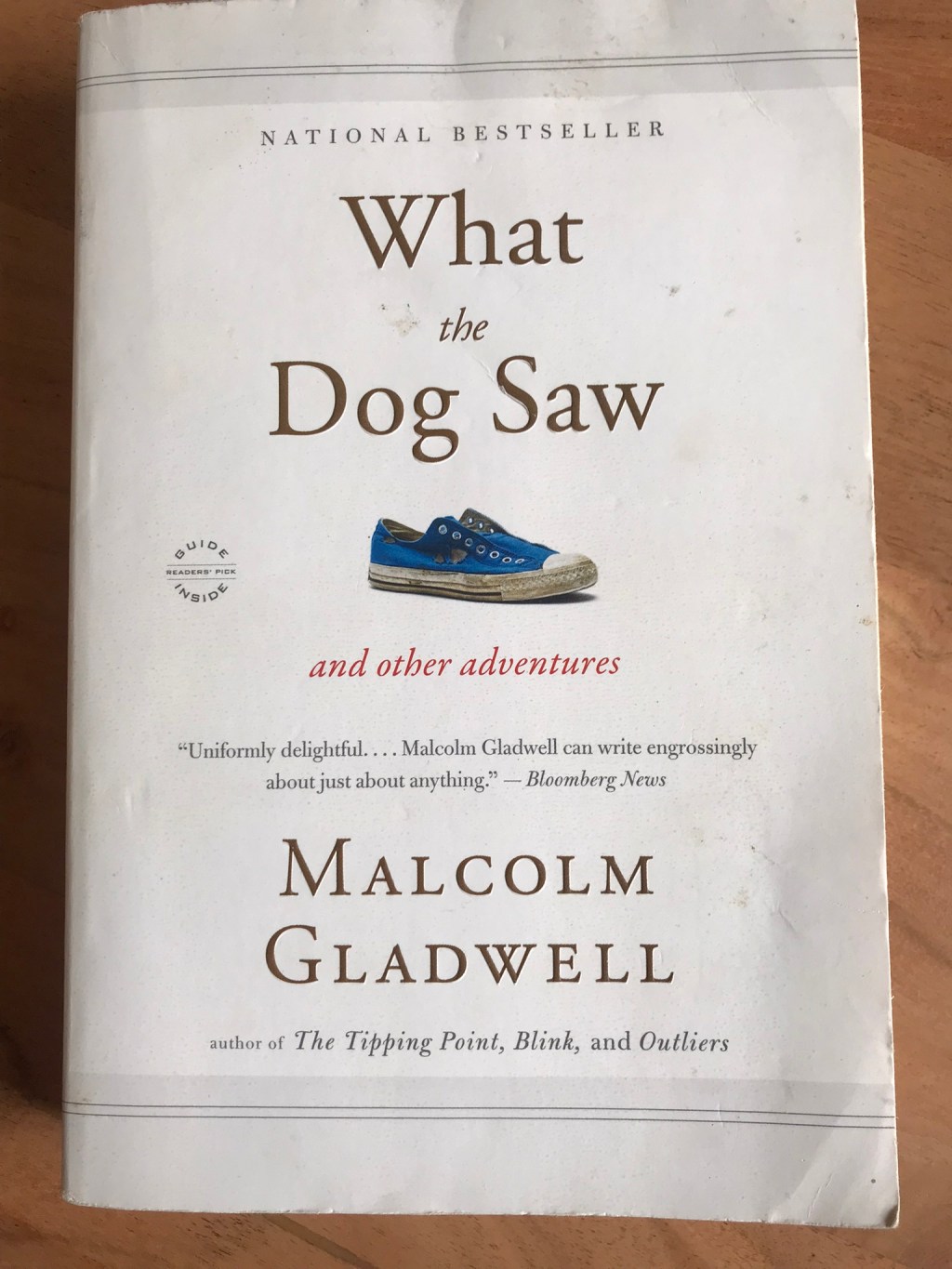
Finished: August 28, 2023
Why I read this
After reading Talking to Strangers by Gladwell I realized that I really enjoyed the writing style that Gladwell has. His mix between journalism and scientific articles allows for easy understanding of complex subjects, while at the same time retaining enough depth to keep the weight of his arguments. Knowing I liked the author helped to allow me to overcome a bit of apprehension to read journalistic content, since normally I like to focus on longer works. I’m glad that this was another of the books in the major book drop of my mother that was not asked for, I never would have read it, and I will now never regret having read it.
What I learned
Unlike lots of my recent reading, this was a series of journalism pieces as opposed to a real novel. This being so I will find it hard to write something succinct about what I have learned, because each article could easily be expanded into a short book so that each section felt rich and entertaining. The focus on minor geniuses allows the reader to see many sides of the story you would never be exposed to. To me this is the mark of great journalism, and may inspire me to read much more of this type of content in the future. However, for now I’d like to share some of the parts of the collection I found the most interesting/applicable to my life/funny/or surprising to show just a few ways you can learn from this book.
Similar to many books on psychology/decision making the ability of experts in our society to make better than random decisions on their own expert subjects continues to be challenged. Obviously, knowledge and experience in many fields is crucial, but the questioning of stock market portfolio managers, FBI profilers, accounting executives of multinational energy conglomerates, etc. shows that our systems of judging successful people, companies, or processes should be constantly re-evaluated, and a focus on our human incapacity to be perfect and omnipresent should be continuously considered. I greatly enjoyed the quote of Karl Popper what said that “you could not know with any certainty that a proposition was true; you could only know that it was not true”. People speak far too often about what they think they know. If we all accepted a bit more that we don’t know everything (or really anything), we might be more open to the adaptations required to improve our processes.
Having read Talking to Strangers I loved to see how many of the themes in the articles of the third section appeared to announce the later released book. Things like default to truth were interesting in the chapter about mammograms, raising questions such as if doctors should impose testing on most patients when in reality most patients have no need for the testing? Or such as the connecting the dots section where the chapter begins with a discussion about how things can appear so obvious in hindsight, such as is discussed in Talking to Strangers where it requires a strong stimulus for someone to break out of default to truth. Or finally, how about discussing that from an interview we cannot see if someone is honest or not? We assume that they are, and for most normal people they are, but we are easily tricked with our default to truth for those few that are not normal (either malicious or mis-aligned) and we cannot easily see truth, even if we are an expert in the activity.
Also the idea of judging things objectively has recently become a major challenge in my life that I found echoed in this series. A quote in the section on interviews was infinitely relatable. “The only rigorous way to assess performance, according to human-resource specialists, is to use criteria that are as specific as possible”. But how on Earth do you apply these to people? The book suggests a robotic interview that is performed the same for each participant could produce the most consistent and objective results. Another section from Talking to Strangers suggests that an algorithm can beat human judges for judging criminals chances to jump bail. Various other examples from Thinking Fast and Slow, or Checklist Manifesto, or even Atomic Habits/The Subtle Art of Giving a F*ck all suggest that concrete systems are better than emotional ones at objective improvement. Hell, even the spiritual book The Four Agreements suggests the reader to never take anything personally and be more objective. So, if all of these things combine together to show time and time again that the best way to do something is to be cool and mechanical, why do we never do it? Why are so many people who succeed in life charismatic instead of calculating?
What I didn’t like
The way these pieces have been collected and published is great, and of course could only be done after the fact. However, after reading the collection and seeing the themes that Gladwell has continued to encounter time and time again in his career, I think this could have been improved by adding a few pages of writer summary and context here and there, just like in the introduction, but more for each section to wrap up the common themes and come away with some group conclusions.
It is a challenge, because I find that I simply want to read more of Gladwell’s content, so my only critique is there is not enough of his writing in the book! I am looking forward to my next read by him (a great motivation to move quickly through my current book list!)
Questions I asked
Is it beneficial in a company to provide some overlapping responsibilities between team members so that there is an element of competition to drive them to perform better?
How can create systems to judge things objectively? What is a better kitchen appliance? What sales/marketing approach is better? What qualities provide the best employees (and how do we measure them)?
Are complex systems better than simple systems? How can you know that a system is too complicated?
My Favorite Quote
“The only rigorous way to assess performance, according to human-resources specialists, is to use criteria that are as specific as possible”
Malcolm Gladwell
Books I liked like this one
Talking to Strangers: Malcolm Gladwell (For a deeper dive on specific challenging topics from these journalism pieces)
Checklist Manifesto: Atul Gawande (For the focus on the improvement of systems as opposed to simply finding talented people)

 Book Reviews for Mom