
Finished: September 3, 2023
Why I read this
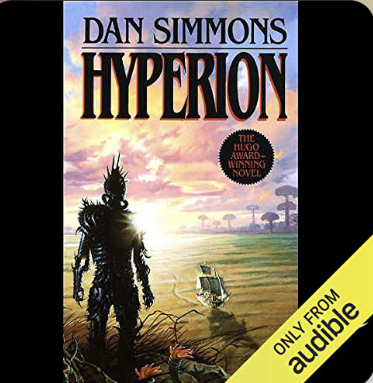
Honestly what can I say other than that I love a good Space Opera? Dune, Enders Game, Star Wars, Star Trek, on and on I love these books. There’s just something about a long series full of world building with recurring characters, places, and plots. It is also a genre that I feel fits exceptionally well for audiobooks. Generally the plot is not based on small details and there are not technical themes beyond some sci-jargon. When I think of reading something like Sapiens in the audio format I can’t believe I’d be able to focus at all. Regardless, Hyperion and it’s sequels continue to fall on many of the lists for best sci-fi books of all time so it was time to test it out!
What I learned
Each character in Hyperion exposed the reader to a new and intense serious or moral and philosophical questions and I loved it for that. Father Hoyt left me thinking deeply what would be the effects of discovering one religion that truly developed the same on a different planet with different histories. The rises and falls of the fortunes of Martin Silenus begged the question of when does madness begin and at the same time debating about the true power of language (a conversation I have regularly with my fiancée). The story of Sol Weintraub and his daughter Rachel made me feel so empathetic that you nearly cry. How on earth could anyone, especially a parent handle that situation? Even the rather standard story of the Consul made me feel very connected with him. He reminded me deeply of Roland Deschain in The Dark Tower series, who through their experience in life is cool and collected and prepared for any situation. So although some tropes were old, they are classic and we see those characters time and time again because they work so well.
Moreover the world building in this book reminded me greatly of Enders Game (although faster than light travel had not been solved for most of the Enders Game series) where each world took aspects of original Earth cultures and developed them even further. A major question I’ve had comparing this to some other books about culture like The Culture Map, or history like Sapiens, is whether we as humans would ever do that. If we took a hyper specific culture like the French, Japanese, or Brazilians and placed a large number of those people in an isolated world, would those cultures remain dominant after 1 generation? 2 generations? 500 years? Honestly I would think not. I think it would be much more like Dune where the culture changes rapidly and constantly based on many factors. I’d love to know what experts would think on the topic.
Finally I found many of my favorite quotes centering around the story Sol Weintraub and his relationship with religion. I myself have had various problems deciding how I feel about the existence of a higher power, and what role that power should play in the daily life of myself and others. Reading this did not change that point, but I did find two quotes particularly instructive and engaging. First: “Any allegiance to a deity or concept or universal principle which put obedience above decent behavior toward an innocent human being was evil”. And secondly: “Can any creator, even a limited one, play a significant game with their own creation”. Both of these quotes challenge whether and creator can really play a benevolent role in our daily lives and I agree fully that if they don’t do just that then they should not be welcomed with open arms.
What I didn’t like
If you have to invent an entire world, obviously there are going to be some new words, technologies, and a slew of proper nouns to invent. Each world needs names and places and cultures to build the personalities of the characters found there. If done well you get the Fremen of Dune, or the Xenomorphs of Alien. In Hyperion Simmons does excellently with this, mostly. There were however, two ways I found the book to be a bit off putting. First was the extreme overuse of technological terminology. Talking about the technocorps or the weaponry used in combat by the various factions repeatedly felt forced like a bad Dungeons and Dragons campaign where words are thrown together to produce complex descriptions that don’t leave the reader with a powerful feeling of the effects of this technology since they are stuck on the complex (or sometimes ridiculously simple) names of the technologies.
Secondly I thought the character design and history for each story to be extremely compelling. I love the relationship to poetry or the discussions of god that came from Father Hoyt’s story. All were great for me, except Brawne Lamia’s story. The detective who works alone, carries her fathers gun, is rough and tumble and only plays by the rules sometimes is such a played out trope that it made the hours of her story tough to listen to. And of course her story resulted in the most of the technological jargon of any person just multiplying my frustration. Adding a played out trope to unintelligible scientific terms is not a winning combination for me.
Questions I asked
If we discovered traces of any religion that developed independently on multiple worlds, how would it shape our society?
How long do groups of people of the same culture need to be isolated to create new cultures that are unrecognizable from the original?
Why do safety standards not seem to exist in sci-if universes ? (Funny question, but the first description of the Tree-Ship and the hundreds of meters above and below the walkways with no railings made me laugh at how unrealistic it is)
My Favorite Quote
“Can any creator, even a limited one, play a significant game with their own creation”
Sol Weintraub
Books I liked like this one
Song of Ice and Fire: George R.R. Martin (for intertwining of various stories)
Ender’s Game: Orson Scott Card (For the excellence as an audio book in a similar genre)

 Book Reviews for Mom