
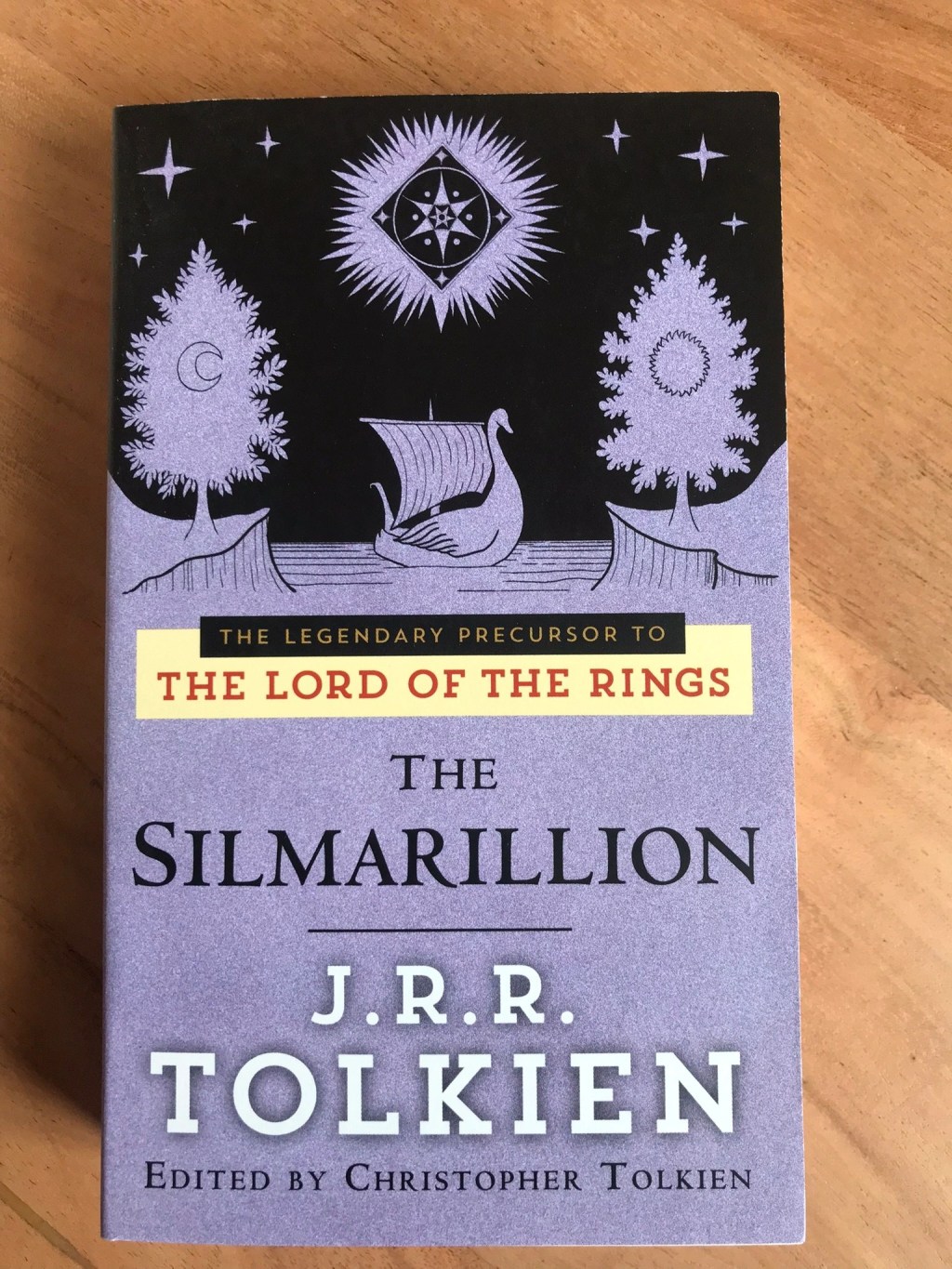
Finished: September 16, 2023
Why I read this
In mid October there will be a new and hopefully incredible video game in the world of Lord of the Rings. This game should combine the survival and crafting aspects of Minecraft with the rich lore and history of the world of Middle Earth. In short it should be perfect. However, to fully appreciate this type of game the more I can know about the worlds of Tolkien the better it will be!
But beyond having some details for an upcoming game to give me a few of those wonderful moments of finding an Easter egg from the small additional facts you know, learning more about these wonderfully detailed worlds and histories I’ve always found extremely satisfying. Having read this year The Hobbit and The three Lord of the Rings books, I was happy to revisit the same world and characters and see the skill that Tolkien had to create a thoroughly populated and consistent universe.
What I learned
I never thought that a biblical document for a fantasy world would make sense and if it did, it definitely wouldn’t be engaging. For the most part Tolkien managed to make just that, an engaging fundamental text and history of his imaginary world. The depth of imagination required to create these details and make them so coherent and balanced is absolutely incredible, and frankly just technically challenging trying to be sure the thousands of names and places and times and events are consistent from each telling or perspective.
I also learned that creating something like this is a life’s work. The forward discusses that Tolkien worked on linguistics from a very early age, his notes and maps were taken from decades of thinking and writing, and even the letter he sent to his friend was just a first draft to the works discussed in The Silmarillion. The only way he was able to create something that has been so lasting and globally known was to put constant effort into its creation for decades and decades. It reminds me of the classic saying that nothing worth doing is easy.
Finally, I agreed with the old saying of my English teacher from high-school when I was reading this that being a generally educated person increases your appreciation of culture. I think this principle is utterly apparent in this book. Although many of the details are absolutely superfluous and will be forgotten almost immediately, many of the other parts of the book create a rich and diverse setting for all the other content by Tolkien. With this background and these details you constantly get rewarded for being educated and being able to connect the dots yourself which I loved.
What I didn’t like
Regardless of the number of indexes maps or family trees, The Silmarillion will always be complicated to understand. However, one thing that could have really helped this book would have been more intermediate, and more complete maps. For example, the regions of Middle Earth are mentioned hundreds of times, Valinor too. Neither one appears on any map in the text. Of course these regions are constantly changing and many spots have many different names over the ages, but a complete map at the beginning or end of each age could be really helpful to understanding the actions of each chapter. The chapter in the locations of Beleriand was greatly improved by the intermediate map showing the locations of Beleriand based on the regions conquered by each lord.
Questions I asked
When a friend or family member is doing what you consider to be a mistake, what is the right obligation or level of insistence to correct them?
Should we continue writing and producing content for universes created by authors who are dead? Dune, Middle Earth, even recently with Berserk.
When should we let a story finish? If people still enjoy the development of the world and stories of the same characters do you continue indefinitely?
My Favorite Quote
“It may be the part of a friend to rebuke a friend’s folly”
Olwë
Books I liked like this one
Fire and Blood: George R.R. Martin (for its similar historical aspects of a fantasy world)
Tale of Two Cities: Charles Dickens (For eloquent writing and large complicated storylines)

 Book Reviews for Mom