
Finished: October 27, 2023
Why I read this
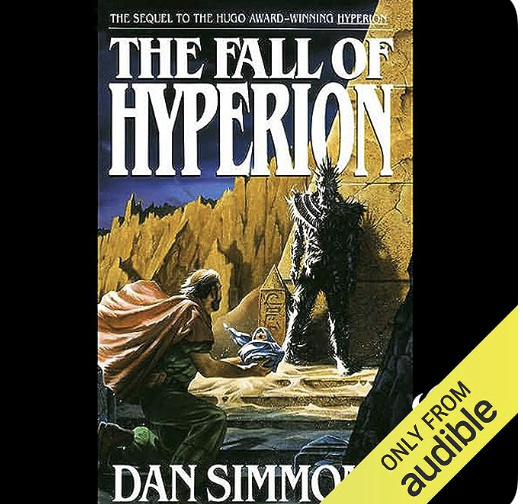
Considering the first book Hyperion was little more than an introduction to the main characters it was clear that I needed to continue reading this series, not to mention the drive to understand more about the mysterious Shrike and the fate of the Web, the Ousters, and all the rest of the details. I’ve always found that it is very hard to abandon characters that you like and care about. Often times it has led me to spend far too much of my time with stories or scenarios that aren’t worth it for the few golden moments with those characters (think the continuing new Star Wars content that although generally “meh”, contains a few moments with the classic characters that remind you why the series could capture your attention in the first place). In this case, I was happy to continue with this world and these characters, and was relatively happy with the ultimate conclusions and resolutions of the mysteries.
What I learned
I am always interested to see how sci-fi seems to build on itself. Written in the 80’s/90’s this series clearly builds on some of the earlier sci-fi tropes and themes, notably from Dune. The AI cybrids of the TechnoCore are reminiscent of Golas and the ultimate threat of the AI’s is a concept seen in Dune and almost every other sci-fi series ever made. That’s what makes the genre special to me. You often receive new characters, stories, and ideas embedded in a new world or setting, but at the same time it can feel intimately familiar. It would be interesting to see a futuristic story in which you remove many of these tropes. How could a futuristic society function in which we never figure out how to move faster than the speed of light?
Moreover, the mix of mysticism and technology is always a challenging thing to get right for science fiction. If you go to far towards technology you are forced to create technical concepts and explain them in a way that feels convincing even though they aren’t real. On the other hand if you go to far towards mysticism it feels too convenient for the characters and “magic” solves everything which is also not very satisfying. However, in this universe Simmons does a pretty good job with the balance often explaining many fantastic ideas with scientific ideas while still leaving good mysteries such as the Shrike unexplained.
The most thought provoking idea of the story however was the relationship with the stagnation of the society and the reliance on the TechnoCore. Firstly, the juxtaposition of the society filled with farcaster portals and the ability to be interconnected across hundreds of worlds and that of the space voyaging Ousters provoked many questions about the values of interconnectivity and the goals/path of our species. Are we here to make progress economically and numerically, or are we here to grow, evolve, and improve our society? How can you continue to challenge society while at the same time developing methods to avoid all inconvenience? I imagine these ideas were extremely relevant in the 90’s where things like the internet and cell phones were either magic devices of human progress, or a trap to infantilize humanity into lives of comfort and ease. These questions have only gotten more relevant since the writing of this book. Social media, interconnectivity, smartphones, the media in general, modern medicine, etc. all come with these types of moral dilemmas. What level of tools will make us better as a species, and what level will cause us to cease to progress? More importantly, at what point should we cease to progress if ever?
Secondly, the threats of society related to artificial intelligence felt extremely relevant where we have begun to develop AI at a frighteningly quick pace. Just like Jane in the ancibel networks from Ender’s Game Dan Simmons’ TechnoCore knows everything and controls everything. This has allowed the human race to expand at an incredible rate and learn and do things impossible without this type of aide. At the same time this type of reliance can lead to disastrous consequences, especially once these AI systems begin to do things that cannot be done without them and they are built into our society as fundamental technologies. Once this happens, and should this AI ever (which in the span of forever seems likely at some point) become hostile you end up with situations like this series where humanity can be attacked by their own systems. Terminator, IRobot, 2001 A Space Odyssey over and over we have seen how AI can threaten our society, yet we continue to develop it with little to no controls. Another scarier concept is whether or not that is the logical steps of evolution. We create AI that is smarter, faster, better than us, then like we did with our competition of Neanderthals, they eliminate us and the natural cycle continues.
What I didn’t like
With such a raving review so far you may ask but then why only 3.5 stars? Despite the very good moral questions presented in the series, and the rich world in which they are placed, the book was not the easiest to follow. To be fair I listened to this one on audio version instead of a physical copy so I had it on and off often and with many distractions. However, I found many of the situations difficult to follow and explain, where too much was going on at the same time. For example Fedmahn Kassad’s voyages to the future and past along with his battles with the Shrike were terribly complicated and difficult to understand what was going on and why. Another situation with Brawne Lamia where she battle the Shrike and saved Martin Silenus was very unclear what happened, and why.
Also, like many fantastic series a smaller complaint is the ability for humans to endure pain and battle. I understand there are stories of people doing amazing things under duress, but continue to have a fight where something like an Achilles tendon is torn is absolutely ridiculous. As always, when writers make situations or characters that would not work the way they would in reality it always gives me a bit of trouble. But I think most people who know me well would just tell me “its a BOOK”, and insist that I stop being so serious. I will politely respond that I will not.
Questions I asked
Is our current hyper-connectivity slowing down our innovation, thinking, and evolution?
Is god the starting place of evolution, the end result, or both?
What is the right level of discomfort to continue progress without provoking stagnation?
My Favorite Quote
“We, like you, destroy that which we don’t understand.”
Ummom
Books I liked like this one
Enders Game (Series): Orson Scott Card (For heavy moral concepts in a sci-fi setting)
Dune: Frank Herbert (For the same reasons)

 Book Reviews for Mom