
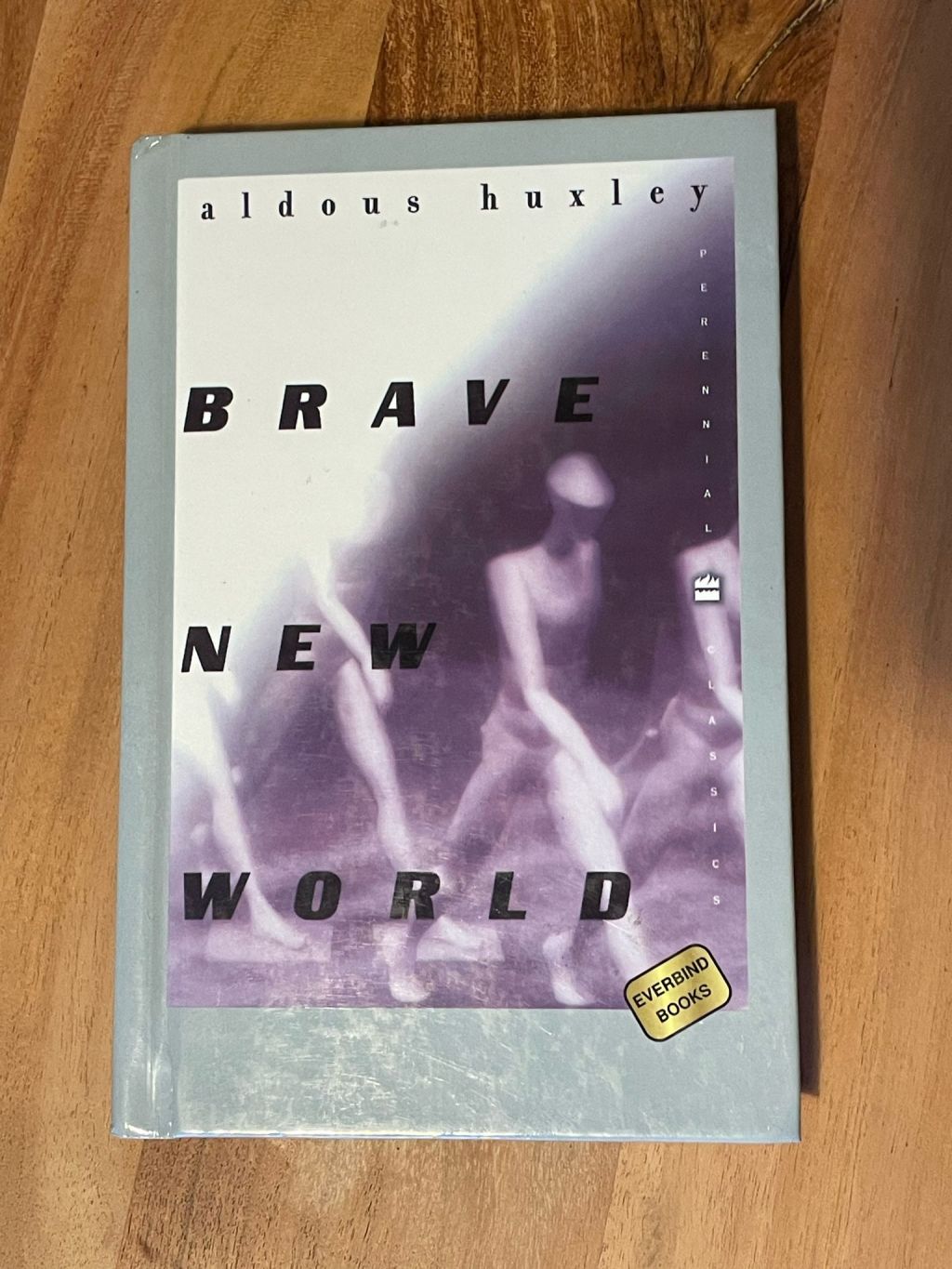
Finished: February 6, 2024
Why I read this
I remember reading this book back in high school and like To Kill a Mockingbird and 1984 I had forgotten almost everything about the story other than the absolute basics. I remember it being interesting, and counting it on the list of books I read instead of finding a summary analysis, so when making my list for 2024 I thought it would be a good addition. Moreover, I’ve had a handful of discussions with people recently about different cultures and how they can define what is right vs. what is wrong, and also about whether or not there really are universal human rights. Knowing a bit about the premise of this book I thought that it would be a good continuation on this topic and despite the fact that I have more questions about the subject than before I read this, I was definitely right.
What I learned
The very first lines of the book let me know that I would enjoy this read. “Chronic remorse, as all the moralists are agreed, is a most undesireable sentiment. If you have behaved badly, repent, make what amends you can and address yourself to the task of behaving better next time. On no account brood over your wrong doing. Rolling in the muck is not the best way of getting clean”. Man that resonates! I may even adopt the last line as a new personal motto. In one way it touches a common idea about failure and that it happens to everyone, and all you can do is learn from it, while at the same time it sets the stage for many of the main themes of the book, and many heavy questions of life. Among these, the subjects I found most interesting including whether or not we must experience the negative aspects of life to enjoy the positive ones, what does being natural, or even sain, really mean, and finally, from the back cover of the book “what price is a society willing to pay for such a social order”?
The first question here reminds me of a moral question that I feel I have never gotten a sufficient answer to. If someone, or something, is raised in absolute ignorance of an improved possibility of living, will that someone or something be miserable? For example, if a cow is raised in a box never knowing the sun, other companions, free space, etc. will it miss these things? Do we have a natural instinct that must be satisfied, or else are we 100% subjects to our collective experiences? And further, if the person or animal subjected to abject conditions is not unhappy because of this ignorance do we have a moral obligation to change the conditions in which it lives because we are not ignorant of what could be a better life for this creature? The question echoes heavily in the idea of creating an entire caste of workers who will be both genetically and socially conditioned to enjoy their station in life. If they are happy because they do not know better (or have been created where they simple cannot appreciate better conditions), is it morally wrong to subject these people to worse conditions? And interestingly enough this is not simply science fiction, real examples of this can be found in the real world. I remember remarking on my last trip to the US that a Chic-Fil-A restaurant hired mentally challenged people to assist with some of the menial labor jobs of cleaning and serving. The majority of people in this world would not be content with this activity, but it appeared that these people were very happy in their positions, are we wrong to give them these positions knowing that there are more rewarding and satisfying things they could be doing?
More importantly, can a world even work without this stratification of different profiles? The thought of a world of “alphas” that would not work because no one wants to do the hard jobs is something that is immediately relatable to our modern world. I’ve noticed in coming to Europe that the access to education is almost unlimited. In France almost everyone goes through what is equivalent to a master’s program in the United States. At the same time, most jobs in France will not even look at candidates with the equivalent of a bachelor degree, yet most of the training is still on the job for many fields such as project management or engineering. So the majority of young people are being encourage to continue in school, go to college, get a masters degree, and the number of people remaining to perform the essential services of our society, plumbing, electrician, garbage collector, farmer, repairman, on and on, is continuing to decrease. At the same time the classification of people at the top levels is remaining strongly defined, just the percentage in the middle is increasing. If we change our society so that a majority of people are well educated middle to upper middle class profiles, what will be the consequences? Already we see that there is a large challenge in finding craft labor, repair services, construction labor. Will we see this shortage of labor continue to cascade into even more important services such as sanitation or public transport? How will this enormous educated middle class function without the support of a larger lower class to perform the services required of our society?
Next I found very interesting the battle throughout the book about what is sane and what is natural. Both of these words are a bit subjective, yet they both remain in our society as almost universally accepted “good” things. To be natural or organic adds the the value of food, cosmetic products, even educational institutions (“it’s not natural to sit in a chair for 8 hours per day”). The same with sanity, on the one hand it can imply whether someone is mentally ill or not, but on the other it can also just mean “reasonable” or “sensible”, but those are obviously so reliant on the rules, culture, or local norms to define, so the word is instantly vague, yet everyone uses it as if the meaning is obvious and easily grasped. Already we see in our society a bit of a shift to allow the “insane”, people are becoming more open to alternative lifestyles and the status quo is being challenged in ways that people today would be considered absolutely insane by those of 100 years ago. However, our connection with what is natural is much more complicated and I struggle to understand why. Many people idolize things being natural or organic while at the same time living behind blinders that the way humans live is decidedly “unnatural”. We drive cars on roads, live in complex buildings made of thousands of materials, we eat a diet of a variety that is incomprehensible, we wear clothes woven from plastics distilled from plant matter of millions of years ago. While at the same time, many things that are natural are shunned or unacceptable in our societies. In nature polygamy, abandonment of the weak to die, murder of mating rivals, cannibalisms, and an absolute lack of empathy are commonplace. Why is it that our society continues to use the word “natural” as a universally good thing despite our insistence to cherry pick the parts of nature we like? Should a future where all of our needs are processed from the bounty of nature and modified to serve our bodies and minds be delayed or abandoned in respect for an indifferent and often cruel natural world?
Finally, the key question of the book of what price we are willing to pay to have a certain level of society is obviously impossible to answer, but always interesting to think about. More than once in history science has been progressed through experiments that are considered now (or even at the time) to be horribly unethical. For example the electrocution of certain animals to understand what kind of electrical current is dangerous to humans and at what quantity. Are the lives of a few animals, however cruelly treated, more important than the creation of safety standards with scientific data that may have saved many more human lives over the course of history? But that is just the cost for creating a society. There is also the aspect of maintaining a society. Do we get rid of art to keep the people from feeling? Do we take from Daniel Kahneman and his book Thinking fast and slow and focus our whole lives on our experiencing self and ignore our remembering self like in this world where all pleasure is immediate and unremarkable. Do we take away the independence of people through conditioning? It feels immediately wrong, but what if we could condition people so that things like rape or murder were universally repulsive to everyone? Would that imposition on free will be acceptable for the outcome that no one has to suffer these things?
At the end of the day none of these questions have answers that aren’t subjective, but I think it was well said in the book in a discussion about whether someone was being abused in their situation or not it was stated that, “of course if you choose some other standard than ours, then perhaps you might say he was degraded. But you’ve got to stick to one set of postulates.” Or in other words, in the rules of our society, it is acceptable, you cannot judge our society by the rules of another. If this is true, universal human rights do not exist, just those of the dominant society of the moment.
What I didn’t like
One thing I’ve seen in a lot of these books is that in these Utopias everyone is physically fit, beautiful, and happy, except for the main character. Normally this main character is smaller and weaker than the rest of the main society. I wonder if this is often a reflection of the authors. Aldous Huxley had serious challenges with his eyesight, is it possible that the only reason the physically abnormal main character is the first one to be disillusioned with the society in question is because they are representing the feelings of the author who see’s themselves as more insightful or as a response to society being unfair to them due to their own disabilities?
Questions I asked
Would being biologically identical to one (or many) other people stop you from finding differences with them? I think it can be seen with twins that experience is much more important in this regard than biology, but would there be a notable difference if we were all identically similar?
Why are books like this encouraged for high school students? Is a person really capable to understand and relate to all of the implications without having real life experiences to compare them to?
Do we already have a caste system built on the conditioning of individuals in their families? The families that raise their children to adapt to the system that exists succeed, those that do not do this leave their children at an enormous disadvantage. Does this make child raising unequal, and if yes, is that inequality is a bad thing?
My Favorite Quote
“That is the secret of happiness and virtue – Liking what you’ve got to do”
Mustapha Mond
Books I liked like this one
1984: George Orwell (For a similar future with heavy philosophical question about how a society can function)
Thinking Fast and Slow: Daniel Kahneman (For the sociology behind why people act the way they do, it is incredible that Huxley saw many of these things and put them into his futuristic society)

 Book Reviews for Mom