
Finished: February 13, 2024
Why I read this
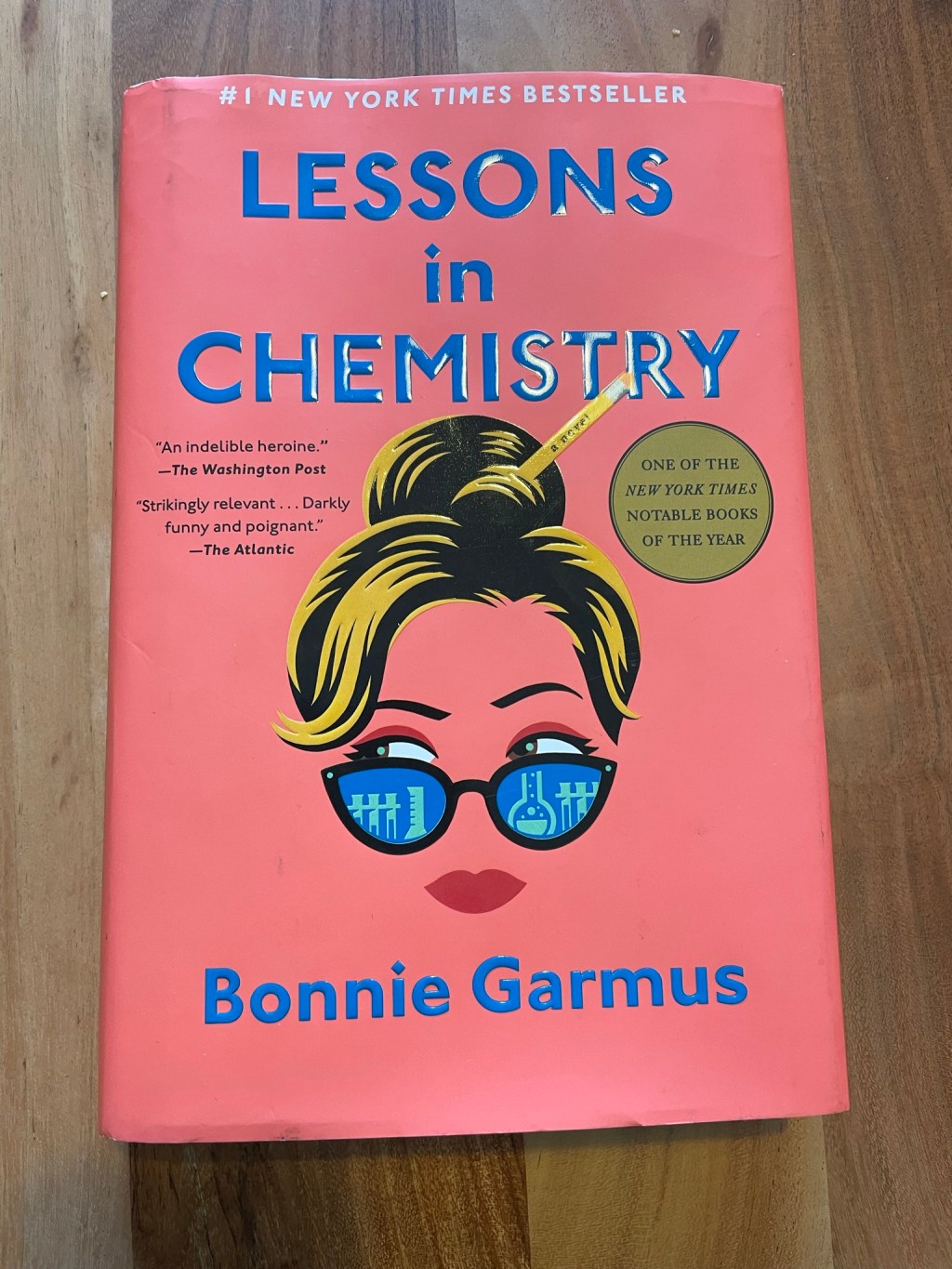
With the bright pink and yellow highlights on the front cover you can’t help but notice this book. At a bare minimum you take a quick book at the inside lapel. Then when you realise you had seen it before on the best selling lists for the New York Times and it’s only a few dollars from the second hand book store what else can you do but buy it and put it on the list?
What I learned
I’ll admit that recently I’ve been reading a lot of things that are pretty heavy, I was hoping this might be a bit lighter for my review than the previous few. But despite expectations, it turns out that systemic discrimination of women in science isn’t such a fun topic. It’s just a bit too real that as our stoic heroine tells us a few times, it’s not supposed to be “fun”.
Although full of tragic events and “it’s a small world” coincidences, I found myself focusing much more on the real life similarities from the imaginary 60’s that Zott inhabited and our still challenged 21st century. For example the topic of how the two characters split the rent as percentage of income. I’ve always found that to be a fair way to do things, it makes the same financial burden (rent) cause the same impact on life for each person, and I think that’s fair. But in the novels case, a big reason for the discrepancy was for a difference in wages and this in the same industry doing very similar activities. I won’t go into specifics (because honestly I don’t know them), but in similar fields and similar activities our word has improved on this, even if there is still further to go. However, when talking of different industries this book made me think about whether or not female dominated industries pay less than male dominated ones. I don’t have research, but I’ve got some anecdotal evidence. Tech, finance, engineering (all male dominated in my experience) appear to pay a lot more than luxury goods, editorial, communications (in my experience dominated by women) pay much less. These examples obviously have different functions and gender is not the only variable to consider when discussing variations in wages, but I would find it very interesting to know a bit more about other fields of similar social impact maybe a comparison between mall security guards (mostly male) and mall cleaning staff (mostly female), or high paying jobs such as different types of doctors. The problem for me though lies in the fact that I already know the answer. If you put a gun to my head there’s no doubt I’d say the men are paid higher.
Switching to something a bit lighter I did enjoy a lot some of the references to science and some of the little quotes or sayings built in a more STEM structure as opposed to a moral or even theological structure we see often in those types of sayings. Things like “On the other hand, wasn’t that the very definition of life? Constant adaptations brought about by a series of never ending mistakes?” or “We both know food is the catalyst that unlocks our brains, binds our families, and determines our futures.” made the story really relatable while keeping with the theme, and frankly just appealing to my nerdier nature.
Moreover, some themes appealed even more to me and some of my recent personal experiences. I really enjoyed the quote that “Idiots tend to make it into every company. They tend to interview well.” because god knows we all have that coworker who we have to ask ourselves far too often “how the hell did they get here?” (I wonder how many people say that about me as well?). Or the idea that underemployment is just as bad as being over worked made me remember some of the worst days in my career that have not been the busy ones, but the ones where you have nothing meaningful to work on. From Malcolm Gladwell’s Outliers he said it best when he said that “Those three things – autonomy, complexity, and a connection between effort and reward – are, most people agree, the three qualities that work has to have if it is to be satisfying.” I like to think Zott would agree with that. And speaking of Outliers I think that Lessons in Chemistry also helps to highlight the idea that no one achieves anything alone. Whether it is through opportunities, or simply direct aid I agree with the author when she had Zott’s lover describe what he thought of her “I’ll do it all by myself” attitude. “It was a form of naïveté, he thought, the way she continued to believe that all it took to get through life was grit. Sure, grit was critical, but it also took luck, and if luck wasn’t available, then help.” I can think of more than one person in my life (myself chief among them) that could work a bit on that lesson.
The last item I wanted to mention here is again a bit more sober and was something that struck a bit more near the end of the book. The idea that Zott felt a wonderful connection with her partner because he was the only one who saw her as an equal, that he was the only one who saw that her work was as meaningful as that of his own and treated her as an equal despite the social norms and stereotypes of men vs women of the time. Reading this I could realise that I’ve been guilty of this on more than one occasion with people in my own life. We all have different vocations, passions, hobbies, interests etc. and although I believe strongly in my own, it does not mean those of others are not equal. Certain examples in my own life where I have not enthusiastically supported a family member or significant other came to mind with more than a bit of discomfort. Regardless it is a good reminder for myself, and for others to do better about this.
What I didn’t like
I’m ashamed to admit that I did not realise this was a fictional story until about halfway through. From buying it and saying I was starting it I think I told several people it was based on a real story. I will have to track them down and correct myself. This fact in itself of course isn’t a critique of the book, and could honestly even be an appraisal to say that the first half or so of the book was so realistic that I didn’t even question myself. I even took note that I thought her life was a bit similar to that of Tara Westover in Educated and wondered if it was possible they had met. So despite my ignorance of the origins of the story and my belief in the first half of the book, I quickly understood in the second half that it definitely fiction.
The focus on her career and what must have been the all too common place mistreatment of women in both mundane and extreme ways in the 1950’s was excellent, however the depiction of the public reaction to her show stretched truth to a breaking point. I about lost it when I read a scene describing two women casually discussing Zotts chemistry based cooking show. One says, and I quote, “didn’t she say cast iron required zero-point-one-one calories of heat to raise the temperature of a single gram of atomic mass by one degree Celsius?”. I wasn’t alive in the 50’s, maybe things were a bit different when there was only one or two channels to watch on TV so sure she could build an audience, but never would anyone, even today, speak in such over the top scientific language. At a minimum the author could have made it a more casual exchange, maybe one woman asks why the other is switching from cast iron, and the other consults her notes from the show and directly quotes Zott. That would have worked! This did not. It was distracting and unnecessary.
Another example of exaggeration that detracted from the point was the intelligence of their four-legged friend. Dogs can be very very smart and can feel very human. Totally believable. Even adding a personality to certain parts and unreal anecdotes like him knowing 400+ words was cute and at worst a bit of historical fiction. Then later the author does it again. The dog, finds his way to a TV studio he had never been to before that is 9 miles from the house including a hitchhiking scene like Marty McFly holding onto the bumper of an unknowing truck. It’s cute and all, but for a book so concentrated on science and reason this simply felt out of place.
Questions I asked
Are female filled industries generally paid lower than male filled industries?
How can I help a bit more in these challenges in my industry? Outside of my industry?
How many words can a dog really learn?
My Favorite Quote
“Real change only ever arose through the application of kinetic energy.”
Elizabeth Zott
Books I liked like this one
The Goldfinch: Donna Tartt (for the uncanny linking of characters in small world type connections)
The Coward: Jarred McGinnis (for something that is not quite fiction, yet not quite false)

 Book Reviews for Mom