
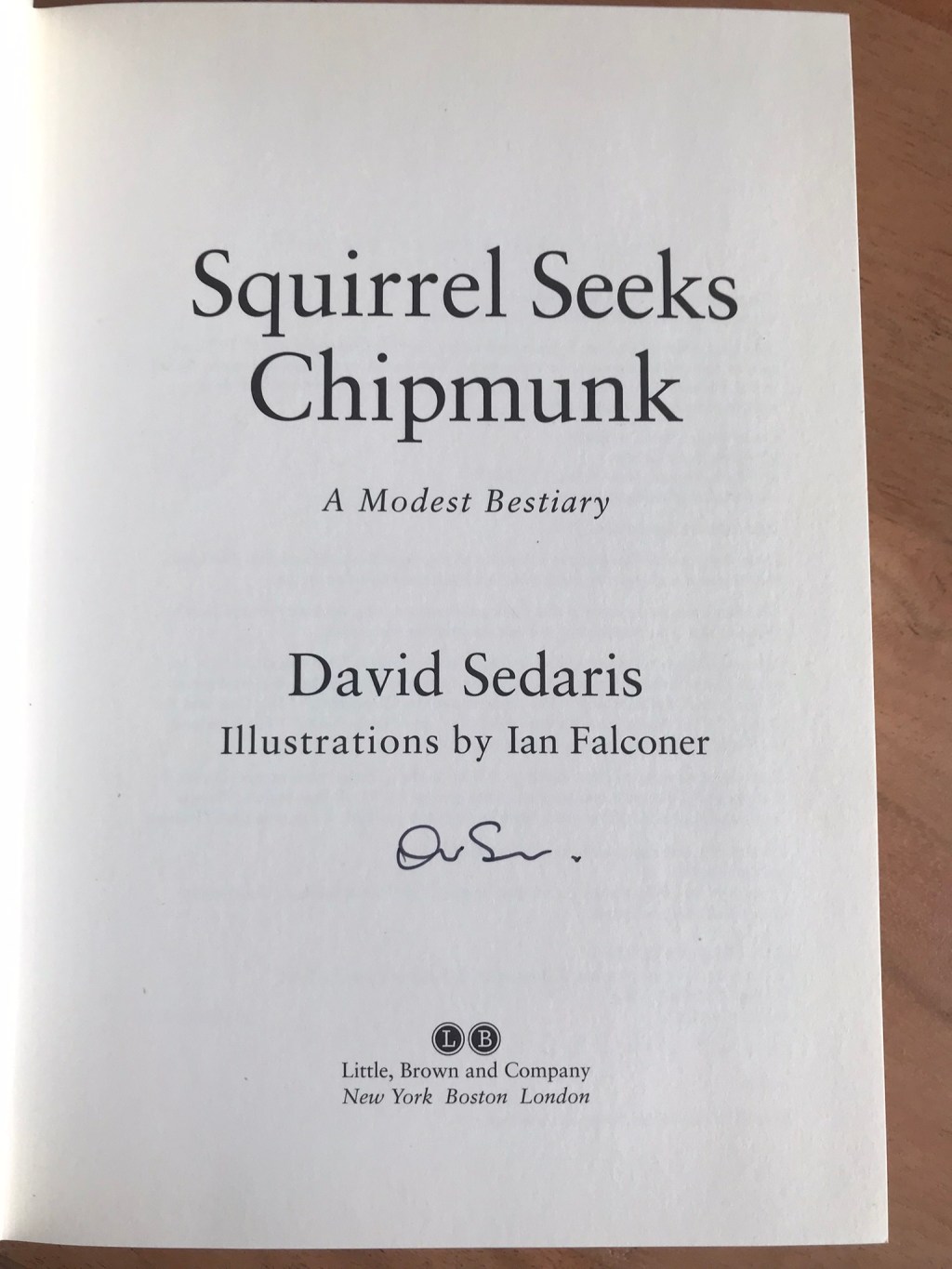
Finished: February 15, 2024
Why I read this
In the large book drop that started this whole idea of having a blog there were a handful of books in a bit of a different category. There were the classics, and the science fictions, and the other books on my list, but there were also just a few that were special additions by my mother. This was one of those books. Very much her style, it is quirky and relevant and ultimately light-hearted, reminding me a bit of a written Wes Anderson. Which has been a wonderful break from some of my recent heavier reading. I feel like these little gems were hidden in the stack to make sure that I do some reading sometimes that isn’t so serious.
What I learned
I actually started this one almost two months ago despite the fact that it is very short. It’s a collection of (very) short stories full of humoristic, absurd, and often rather dark details that always have a nice little moral in them. Originally I had planned to read straight through it since it was quick and relatively easy, but the more I read it the more I thought that isn’t the right way to do it. After about 5-6 of the stories in a row I decided to stop reading it and instead to read just a story or two before bed whenever I had the time. This proved to be a much more accessible approach, since if you just stack morals on morals on morals I don’t think you get any time to focus on the real meaning of them.
I also started out this read with an idea to write one key lesson from each story, much like you would ask school children to perform for their homework. This was homework that was now self-imposed and I was more than happy to do! But as I read more I felt like I was missing the point, and about half-way through the book it clicked that I was doing exactly the opposite of the point! Sedaris wrote this in a funny and ridiculous manner because we should all strive to find some humor in serious subjects and I was trying to find serious subjects in the humor! So instead of sharing some of the “lessons” I was trying to extract for the funny stories I thought it would be more interesting to share some of the more absurd ideas that have crossed my mind lately.
For example, after reading this book I saw a menu advertising slow cooked beef. It seems that the longer something is cooked the better it seems to come out, but wheres the limit, 7 hours slow cooked is good, 24 is better, but how about 72 hours, or 8760 hours? Maybe there is a function for each meat and method of cooking where there is a true optimum value of taste and texture. Maybe we need much more science in cooking (shoutout to Lessons in Chemistry). I even saw something the other day of 100 hour brownies (spoiler, they just chill in the fridge for 3 days). So as X (cooking time) approaches infinity what is the value of quality of meal?
It’s like my idea of “let’s eat all the cows” instead of eating less cows to stop the climate impacts of beef farming. It sounds (and is) a ridiculous idea, but the more I think about it, it’s not only a funny anecdote. It shows a bit how the system really is and forces us to think a bit creatively. If this idea were to work, what else would have to be true? Then you start thinking about market factors, and subsidies, and finally you can build a story that sounds a loss less ridiculous than “let’s eat all the cows”. I think this was one of the things in The Personal MBA where they discussed doing thought experiments where you assert something as true and then build all the steps required to make it true. So maybe that’s similar to some of these ridiculous stories shared here, you start at the absurd and you slowly fill in the parts between normal and absurd and finally, the absurd seems pretty reasonable.
Finally, I found it funny that there really was a story here that connected with a personal experience. There was a quote of “nothing irritated her more than these high-and-mighty vegetarians who eat meat sometimes and then decided that it didn’t really count”. Twice in the past couple of months I had conversations along these lines. There was one where a vegetarian had tried some meat just to see if it really was as good as all the hype, and another where when someone was asked if they were a vegetarian they said “mostly”. How can you be mostly vegetarian? To me it is a pretty binary thing! You are or you are not, but in a world where you can be shamed about your consumption of meat I guess it adds some moral value to be “close” to vegetarian.
At the end of the day, I think the point is just to not take ourselves so seriously. We are all imperfect results of our environment, culture, upbringing, and a slew of internal/external factors. Life is complicated, do your best, and lighten the fuck up (directed at myself as much as any others).
What I didn’t like
Honestly I’m not a huge fan of reading just bits at a time. I’ve got a Marcus Aurelius book that has been sitting on my shelf ready to read for months, but I just hate the idea of opening and closing the book over and over as you give yourself time to think about something a bit deeper. Squirrel Seeks Chipmunk was a bit like that. Each story I would begin to develop a relationship with the characters then 5 minutes later they were gone. It isn’t necessarily fair to the author to say that it is a bad book because of it, but I can confirm that this style of writing isn’t really my favorite.
Another small criticism was the interesting use of profanity in the stories. Don’t get me wrong, I don’t mind a bit of profanity and I think it can add a lot to a conversation or a story, but the way it was done here it often came as a big surprise. It was just all of a sudden like when a seagull shits in your ice cream. Maybe I’m being too harsh here, but it was something that I marked for sure.
Questions I asked
Is humor an appropriate way to handle serious subjects? Are some subjects off limits to a humorous approach (for example racism, the holocaust, genocide, etc.)?
Is shorter content more impactful than longer, how many repetitions does someone need to truly grasp a subject?
Can shock factor make a message more meaningful? If it sticks with you longer and you remember it does that mean it is more effective?
My Favorite Quote
“What changed things, albeit slowly, was learning.”
The Owl
Books I liked like this one
The Personal MBA: Josh Kaufman (Surprisingly for its relationship of simple lessons that apply to life)
The Subtle Art of Not Giving a Fuck: Mark Manson (For an irreverent perspective to life)

 Book Reviews for Mom