
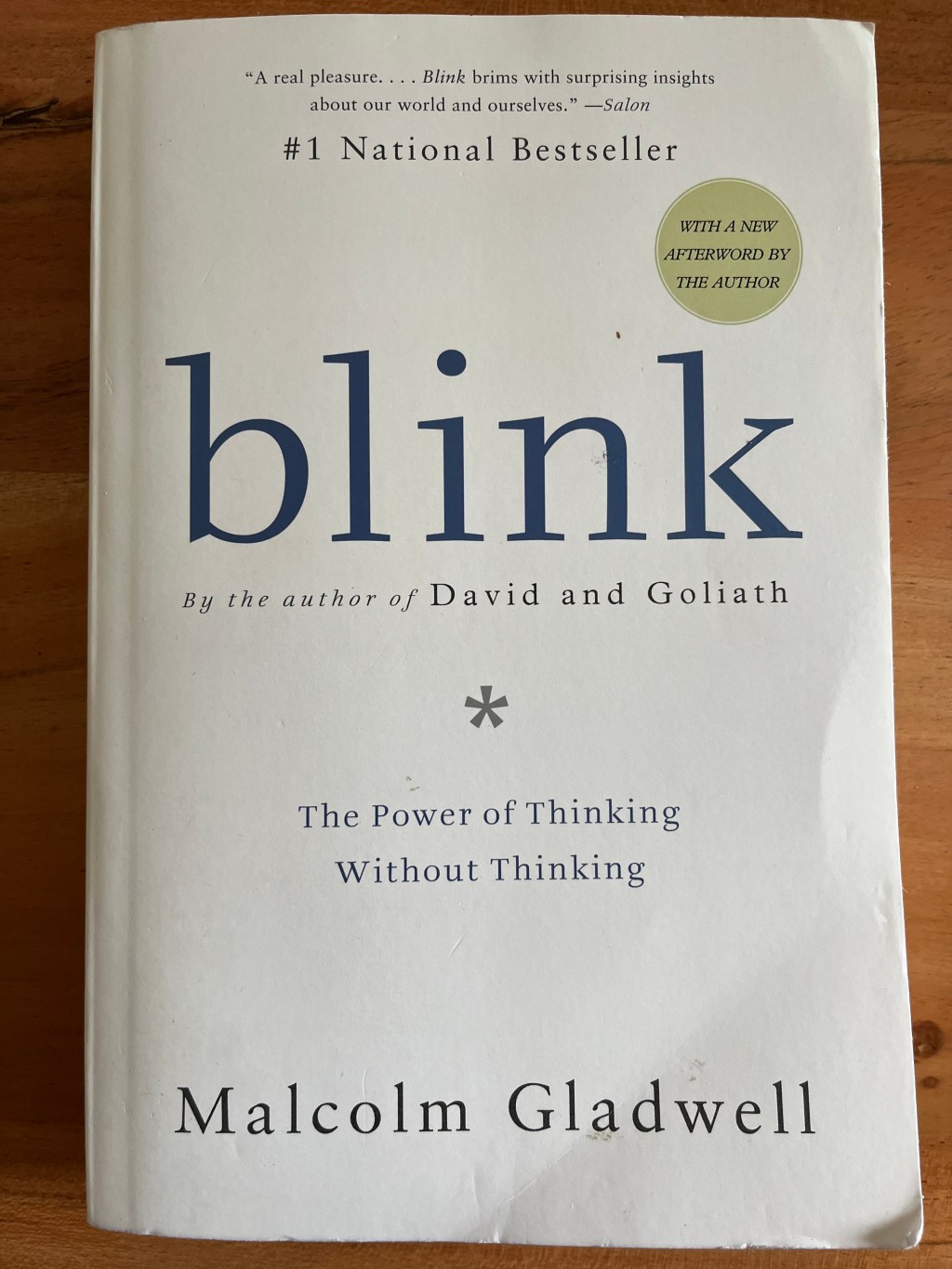
Finished: March 4, 2024
Why I read this
I’ve never in my life completed the entire works of an author, but it’s always been something that comes with a bit of reverence. To be able to say that yes you know all of the stories by a major author, or that you have seen all of the shows or movies related to something, and the bigger the pool to read or watch the bigger than feeling of accomplishment of having gotten through it. That’s how I’m starting to feel with Malcolm Gladwell, this was the fourth of his books that I’ve picked up and the last three had each made me think more than most anything I’ve read in recent years, so I was really excited to dig into this one. Once this is done I’ll be over halfway finished with the major works he has done. Maybe after I’ll have to get a subscription to the New Yorker to read his articles!
What I learned
From the very beginning of this book it felt familiar. Not just because I’m fairly used to Gladwell’s writing style, but also because the ideas are very similar to those presented in a handful of other (and often more recent) works I’ve read. The ideas of priming or an immediate jerk reaction by your unconscious are heavily discussed in Nudge and Thinking Fast and Slow. The idea of systems being better than humans because they remove the human biases and risks were heavily discussed in Checklist Manifesto and in Talking to Strangers (a clear extension of Malcolm’s writing here in Blink). Even many of the experiments or studies that were mentioned in this book were ones I’d seen before and was familiar with. So since this was not my first time with this material it was a perfect chance to test the theory from The Know-It-All that regarding knowledge the richer get richer, to say that if you read a book about something you know well you might pick up more than someone reading it the first time. With that I’ll dive into some of the things I found remarkable in this read through!
Throughout this book there were two main topics that I felt Galdwell built off of one another. First, there was the fact that we as humans make rapid decisions, and this is a good thing many times and a bad thing many other times. The second idea was that if you want to eliminate this reflex you need to remove extraneous information.
Going into more detail on the first idea, it was amazing how many things we make snap judgements on that we don’t even realize. The parts about experts being able to see that a sculpture was fake in a couple of seconds, or a tennis instructor that could always tell if someone would miss their serve were of course incredible, but they build off of what I would call abnormal expertise. You only achieve this if you are extraordinarily specialized and even then it is tricky. What I found much more interesting were the every day ways that we have reflexes about things that turn out to be correct. Such as how the experiment of showing extremely short clips of professors with no sound, or color to normal people allowed them to guess with extremely high accuracy (when compared with students that took an entire semester with that professor), how good of a professor that person was. That is truly incredible. And even further into the more day-to-day with examples like doctors who are likeable don’t get sued, even if they make mistakes. It all has to do with the impression that the doctor makes on their patient. A doctor who has read How to Win Friends and Influence People could be less likely to get sued for malpractice than a doctor with 10,000 additional hours of training or practice, all because people make snap judgements about their doctors based on their attitude, not on their expertise.
I remember when I had my tonsils removed at 22 and I went to the Ear Nose and Throat doctor and the appointment was at most 5 minutes long. I walked in, sat down, and said “ahh”. He looked in my throat and said, “yep those need to come out”. Then the rest of the appointment was scheduling a surgery. It had also cost me like $200. Needless to say I felt a bit cheated, he didn’t ask for my history, he didn’t want to know how I felt, he wanted to sole piece of information (how my tonsils looked) that he needed to make the next decision and he wanted to waste no time on anything else. Honestly, I should have thanked him for being efficient and saving me time, but still I think if he had made a mistake during my surgery malpractice might not have been far from my mind.
Also the studies about how we treat other people on essentially sub-concious factors were fascinating. The fact that tall people are enormously over represented in positions of power or authority was incredible to me, and made me think back to Outliers. Having a positive character trait such as being tall, or having genetics that are classically attractive can start a snowball effect from early in life. Small benefits like being chosen more often in an elemetary school classroom, or having the attention of the opposite gender at a young age might change their level of confidence, and that confidence inspires people to do more that then build into real skills and capabilities. So maybe tall people are more often CEO’s because they are simply selected more often for promotions by their bosses, or maybe tall people become CEO’s because through their entire life they are given additional opportunities associated with their height that translate well to developing the skills needed to be a CEO. Probably a mix of the two. Also fun comment, in my job in France the leadership is decidedly short. French people are normally shorter than Americans to begin with, but I found that the majority of the upper management in my group is well under average height in France. Maybe it has something to do with Napoleon.
The other side of this looks bias though is a bit more disturbing. For example the racism that has been built into essentially all of us through a lifetime of miniature exposures, actions, events, etc. The tests where even black people in America would more readily associate black people with negative words than white people was incredible. Even Gladwell scored well into the “biased towards white people” category, and his results didn’t change when he tried again. It goes to show that our society has a long way to go until people of color, women, or other minority groups will receive a truly equal treatment as tall, white, males.
This leads me to the second idea that focusing only on the crucial information allows us to make better judgements. This idea reminded me a lot of the scene in Talking to Strangers where Gladwell discussed the error percentage of judges that see inmates before deciding their bail. He had shown that having the additional information of seeing the person before making the decision actually made the judges worse than an unbiased computer would have been. It shows that we are bad at eliminating our biases and we need help to do it. The final example of the musicians and the screens proved that we can implement some systems to be more inclusive.
A final point I wanted to develop was the duality we see here in whether we should trust experts. On the one hand we cannot be expected as humans to know and understand everything, and often we are even bad at understanding ourselves. As Gladwell says I agree that “We have, as human beings, a story telling problem.” His multiple examples throughout the book just continue to confirm that often we don’t know what we want or what we like. That’s why it is better to ask for the recommendation of a sommelier at a restaurant. They know wine, and as much as you may think you do as well, you do not. Same with chefs, interior designers, or marketing professionals. Often we don’t understand what we do or do not like, and therefore we cannot put it into action to choose things we really want. This is where experts can be extraordinarily helpful, and valuable. That’s why a Michelin restaurant is so expensive, because you are asking an expert to make almost all of the decisions for you, and honestly the very few times I’ve had this level of experience I’ve never been dissapointed. The same is true for media. Despite performing intense market research, TV shows or Rock stars might be found by experts and promoted, but the research groups they are presented to might find them to be average or even worse. But sometimes, an expert even pushes the idea knowing that the people don’t know what they will like and pushes something out despite poor market research. The examples in Blink included the Mary Tyler Moore show about a working woman that was released in the 1960’s. It was poorly noted by market research, but was run anyways. It became a commercial success, because the expert producer decided to ignore what the market said (I like to think this is one of the real life examples of the show in Lessons in Chemistry).
But on the other hand with experts there is the problem of over confidence. Just like in Checklist Manifesto and the checklist for whether to send a baby to an ICU, there was a story in Blink where one doctor did a ton a research and found the main factors that determine if someone is having a heart attack. His main factors eliminated much of the testing and allowed for a dramatic increase in proper diagnoses and processing time. Yet, still doctors resisted these ideas. They believed that they were experts in the field and that a simple formula or checklist could not replace their expert judgement.
So when should we trust experts? When should we take our gut feeling? When should we prioritize market research and the feelings of the masses vs. the feelings of the few? I’ve always thought for things like the stock market or the economy that you must be an expert to succeed. I always criticized people that would say things like “I’m voting for X person because they will help the economy.” because it is such vague nonsense. First of all, if you aren’t a PHD economist, you probably have absolutely no idea how a certain policy change is going to effect the macro or micro economics of a country. Secondly, the person you are voting for is nota PHD in economics, so they don’t understand either. Third, that person probably will have some economic advisors that will help them with the majority of economic topics (we can hope), but the information is never published or advertised. But maybe at the end of the day even complex systems like the economy can be reduced to tracking key factors, like debt, GDP, unemployment etc. and the rest of the information is just noise. Or maybe it really is something where an expert knows best. That will be the challenge after reading Blink, finding the right categories for “gut reaction or expert advice is the best way to go”, vs. “heavy research and key performance indicators” for decision making. Maybe I can make a big excel file for it!
What I didn’t like
There is one drawback to reading something on material that you are familiar with, you become much more critical. Frankly I think that Thinking Fast and Slow and Nudge were significantly more thorough, recent, complex, and supported than the findings in Blink. It’s not to say that Blink was bad, but it was in the unfortunate position of being compared with works by real experts in the field and not by a journalist dabbling in the content. Normally Gladwell makes tough concepts accessible, and I think if I read Blink first I would have loved it, but when it is side by side with sociologists who can also make their efforts relatable enough for the general public it is weakened.
Another comment that is more key to the actual work and not the fact that I found something else a bit more interesting is that the lack of visual material really harmed the book. For example the 20+ page section on facial expressions did not include a single photo. Instead the author chose to discuss in minute details all the functioning and arrangements of the facial muscles using heavy scientific words. It made it almost unreadable and very hard to follow what the actual point was beyond “it’s complicated”. Some simple photos or diagrams would have dramatically improved the section.
Questions I asked
When in my life has the Warren Harding Error (the error that people who are taller, or more physically attractive have the benefit of the doubt), played an effect (specifically for being tall, since I am a decently above average 6’3″)?
When learning similar information from a new source, do you enhance the previous information, or replace it with the more recent information?
What ways in my life can I change a system so that I can reduce my biases? for example, if I perform an interview can I ask candidates to do a phone interview with a voice mixer?
My Favorite Quote
“Our world reqires that decisions be sourced and footnoted, and if we say how we feel, we must also be prepared to elaborate on why we feel that way.”
Malcolm Gladwell
Books I liked like this one
Thinking Fast and Slow : Daniel Kahneman (for the deep analysis of the conscious versus unconscious brains)
Nudge : Richard H. Thaler and Cass R. Sunstein (for concrete applications, good and bad, of sociology concepts)

 Book Reviews for Mom