
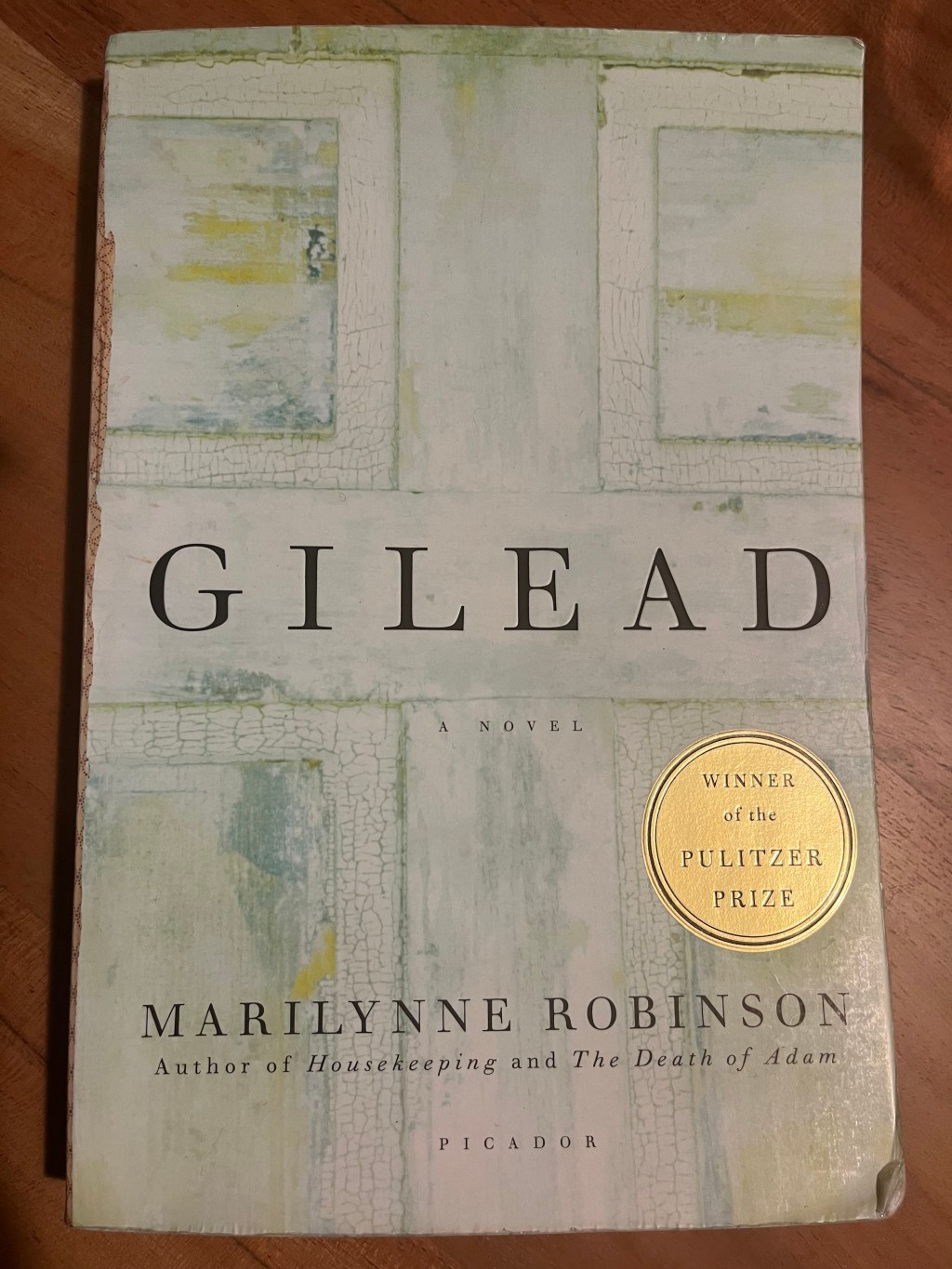
Finished: March 26, 2024
Why I read this
I’ve been slowing moving through all of the Pulitzer Prize winners because it feels like a bit of a requirement. How can you be a serious reader without being well versed in the winners of the most prestigious prize in literature? And with just under 100 books on this acclaimed list, I should be able to go through the entire list rather quickly (if 5 years or so can be considered quickly!). but if we ask more specifically, why Gilead? I will have to be honest that I knew absolutely nothing about the plot or the author before starting it (which I normally like to do), but it was selected primarily because of the shared name it has with the home of Roland Deschain in the Dark Tower series, one of my favorites!
What I learned
I have never been a huge fan of stream of consciousness writing. I’ve always found it hard to follow and a bit disjointed, which I am sure is a lot of the point. Regardless I think this was the first time that I recognised the difficulty and skill involved with this type of writing. It’s kind of like when you watch a movie and an actor has to pretend to be someone being someone else (my favorite example of this is in Harry Potter when characters used Polyjuice Potion to turn into another one of the characters. So you have one actor who needs to imitate how they believe another actor would pretend to be their own character. Confusing, but impressive!). To write stream of consciousness the author needs to be so much in the mind of the character that they can write the constant stream of their thoughts. I would have trouble writing this way representing my own feelings and emotions, I cannot imagine doing it for another person’s, and worse a fictional character that you need to make realistic and consistent. Reading this I really understood why so many Pulitzer Prize winners seem to be written this way.
Beyond just the writing style, the character of Ames is incredibly well written. He is simply human, with all the pros and cons that go with it. He has dreams that are unfulfilled, he has human desires despite being a priest, he has unbalanced appreciation or disdain for relatively normal things, he doubts himself, and he doubts those around him. I honestly struggled to believe that this was not a true story, it felt so much like a personal diary.
The realism of the characters and their perspectives really helped me to relate with the text. I found quotes like “I read so many books in those days, and I was always disputing in my mind with one or another of them”, that felt like things I had already thought before, but failed to write down anywhere. This quote specifically, helped me to explain some of the feelings I’ve had throughout my experiment to read more often, when I’ve crammed so much stuff into my head into such a short time that I find it hard to say if I agree or not. Recently I’ve more and more frequently found myself not reading or writing on the metro or in some free time because I already have enough disagreeing ideas rolling around in my head I’m not sure if I should spend my time reflecting on them, or adding new ones.
I was even able to make connections to book you would think to be very far from the themes in such a spiritual book. The quote that stated “To be useful was the best thing the old men ever hoped for themselves, and to be aimless was their worst fear” reminded me immediately of Outliers where the author had discussed that a major portion of job satisfaction is the ability to feel useful, to link your personal effort to meaningful outputs. It also made me think of my father, and many adults like him (imagine that a book about father son relationships making someone think about their father) that simply cannot take a break. He has to be doing something pretty much all the time, and there is always a work project or a personal project or a second business project or any number of other things going on in his workshop. I think the quote hits the nail on the head with him, he has to feel useful, and to be relaxing aimlessly is almost as much a punishment to him as hard labor might be to another. As a note I am beginning to see this side in myself somewhat. I find that days when I intentionally do nothing and spend too much time watching TV, or playing videos games and I come away with nothing to show for it that it is extraordinarily dissatisfying, and the days I feel the most exalted are the days where my checklist is completed and I can look back and say “here is what I did today, it was useful, and productive, and I’m a better person for having done it.”
What I didn’t like
As much as the writing style might be impressive, I will admit that the first 50-100 pages where nothing much seemed to happen except for the ruminations of an old man were exceptionally dull. I think it is quite a good thing that we cannot see into other people’s heads and see what they are thinking all the time, if I was subjected to this kind of monotonous and repetitive information that I am sure each of us produces non-stop for the entire duration of our lives, for just a day or two I am confident that I would go insane, from overload or boredom I am not sure which. What’s worse is that after finishing the book I believe that this challenge could be easily overwhelmed simply by changing the structure of the book. Explain the parts of the plot that move a little and allow the reader to connect with the story earlier, and add the depth and development of the character’s history more evenly throughout the book.
Questions I asked
What is our personal responsibility to our character? We are a collection of memories and experiences that have formed us, most (if not all) of which we had almost no control over. If I see parts of myself or others that can be improved, who is responsible for the improvement? Myself, or the society that created me in such a way to be flawed?
Why are people able to read the same books, watch the same movies, do the same things and take dramatically different lessons from them? Why can one person read the bible and think it is gospel while another will believe it is hogwash?
Why do women seem so able to make realistic male characters, but men seem to struggle so much to make realistic female characters?
My Favorite Quote
“Every single one of us is a little civilisation built on the ruins of any number of proceeding civilisations, but with our own variant notions of what is beautiful and what is acceptable.”
John Ames
Books I liked like this one
Tinkers : Paul Harding (for stream of consciousness and our reflections on life once we are at Deaths door)
The Road : Cormac McCarthy (for the relationship between a father and a son)

 Book Reviews for Mom