
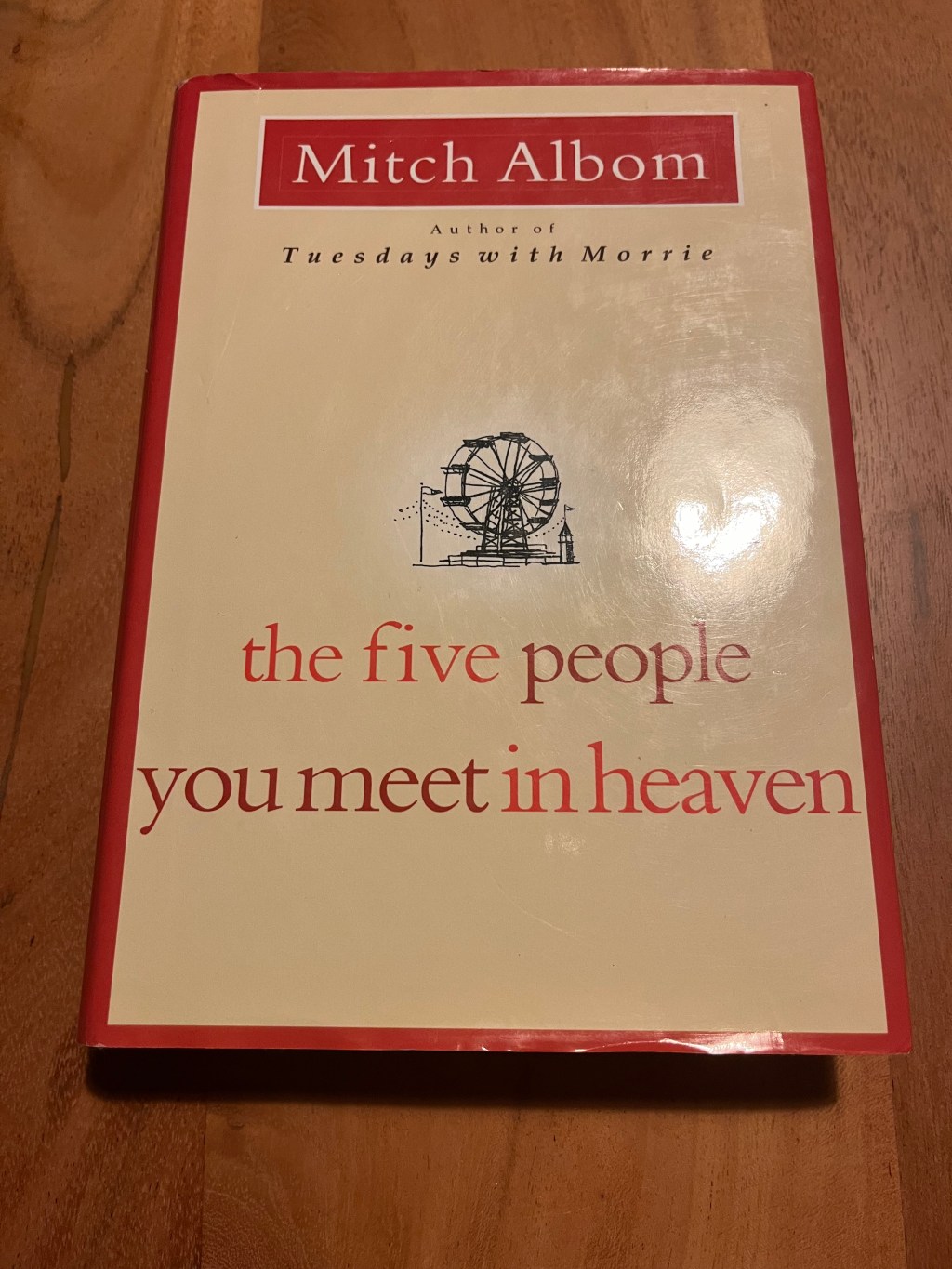
Finished: April 14, 2024
Why I read this
3 posts in 3 days?! The people who regularly read this will think I’m crazy. Honestly I expected this one to take a bit longer, but the font on each page was a lot bigger than I’m used to and the pages just turned so easily! Regardless, my pile of English books to read is quickly dwindling before my next trip to the US and the majority of what is left are heavy and long, so I decided if I was going to have a big weekend of reading (I always do when I travel some, trains are the best place to rack-up some pages) then I’d like to have something a bit easier, and this ended up being just the ticket!
What I learned
For a book that focuses on the subject of death it is incredible how Albom managed to keep it light. It felt a lot like A Christmas Carol, even with heavy themes and lessons it never made me feel sad or upset. It kept the ready hopeful and content, always knowing that the main character was in heaven, things would be ok. Even dark scenes such as war in the Pacific Theater, or the death of a loved one felt like bittersweet lessons instead of gross injustices, like they so often are in real life.
The overall theme that heaven existed as a place where you learn about your life, where you can grow until you are ready to live in peace for eternity felt fresh, and uplifting. I can’t imagine how it must feel to understand at a deeper level all of the traumatic experiences of your life. To be able to see into the lives of others, for things that were never seen or spoken and to heal wounds that would persist for a lifetime. To know that each event was indeed planned and made you who you needed to be at just the right time.
But the read also helped me to cope with some of the questions I’ve had in my life recently, for example the question of at what level to live in the moment versus plan for the future. One quote stuck with me particularly well “Had he known his death was imminent, he might have gone somewhere else. Instead, he did what we all do. He went about his dull routine as if all the days in the world were still to come.” because at first pass it feels like a critique. Like we need to live our lives to the absolute fullest, and if you don’t you are at risk of wasting the precious little time that we are allotted. On a second thought, it could also mean that we need to do our best to find joy in the dull routines, in the everyday, because that is what is waiting for all of us, you can’t escape it, so you should appreciate it as if you have all the days of your life ahead of you. A third reflection upon finishing the book was that maybe it even means that the dull routine, the everyday life is exactly what we are supposed to have, nothing more, nothing less, and they will lead you to where you need to be. Personally, I liked the second interpretation the most of the three, and I think that is more how life needs to be led, with a bit of the first philosophy thrown in for some variety. You don’t have to build something every day of your life (even the biggest construction sites have holidays), and don’t be afraid to build something a bit different, but you want to build nonetheless. That’s how I want my life to be. Where I build something, but being sure to spend the time here and there to enjoy the moment. It will be a hard balance.
I appreciated that for the first time in a while this book did not fill me with little “dings” about other works or pieces. Parts of the story seemed familiar enough, but not much familiar enough to distract me into thinking about another work. I was for the first time in a while able to simply read, and enjoy, and enjoy I did. I need to work on finding the balance between reading to learn, reading to produce (my blog here), and reading to enjoy. Frankly I should probably spend the most time on the third, but I know I will probably spend the most time on the second.
Finally, I think it has been a while since I thought heavily about death since reading this book. Each character presented had a very different situation, and a very different death. Some were accidents, some were tragic illnesses, some were peaceful passings, and some were heroic events of redemption. But all of them were final, all of them ended a life finally and definitively. Like in Brave New World, death is simply a fact of life and isn’t something to shy away from. It is the natural end to the natural process of our life, and although scary, maybe it isn’t all so bad. Maybe even from death good things can come. It was a cool comparison with The Brief and Wondrous Life of Oscar Wao where death was the result of a curse, where here death was part of a plan, the only difference was in one it was a malevolent god, the other benevolant. Regardless, I think that as I age I come more and more to terms with the idea of mortality. I still hate it, I still think living forever would be cool, but it is less terrifying that it felt some years ago when I first thought deeply on the subject. I wonder what other, older people in my life might think about it.
What I didn’t like
Although the spirit of the story was extremely uplifting and I enjoyed it a lot, I’m not sure if it captured the difficulty that someone might have with experiences such as your father not speaking to you for the majority of your adult life. Even if I found out that he had regretted it in the end, I would struggle to forgive my father if he ignored me for 20 years. Humans also just don’t act like that. They hold grudges, they are petty, they don’t have perfect empathy and so they can’t understand someone else’s perspective when they are grossly wronged by said person. Maybe the only reason Eddie got to go to heaven is beacuase he could be a person like that. Maybe having the ability to forgive/empathize/learn is what earns you your place in heaven, and not what actions you took during your life. If you were a miserable jerk your whole life, but you felt bad in yourself, and you had the capacity to learn to be the person you should be, then just maybe you will be welcomed into heaven and earn your paradise. Wouldn’t that be great if that was the case?
Questions I asked
Have I ever been directly, and unknowingly responsible for a tragedy? If not, what degree (action causing an action causing an action etc.) were my own actions away from a tragedy?
Did the author name his character Eddie on purpose so that when his name was cut between lines it would say “die”?
Was this a Christian book, or would it work for other religions as easily?
My Favorite Quote
“Fairness does not govern life and death. If it did, no good person would ever die young.”
Mitch Albom
Books I liked like this one
The Know It-All : Author (for a refreshing narrative that makes you think without being heavy.)
Sapiens : Yuval Noah Harari (for questions about why we are here, what does it mean to be human, even if Harari is much more pragmatic about it all)

 Book Reviews for Mom