
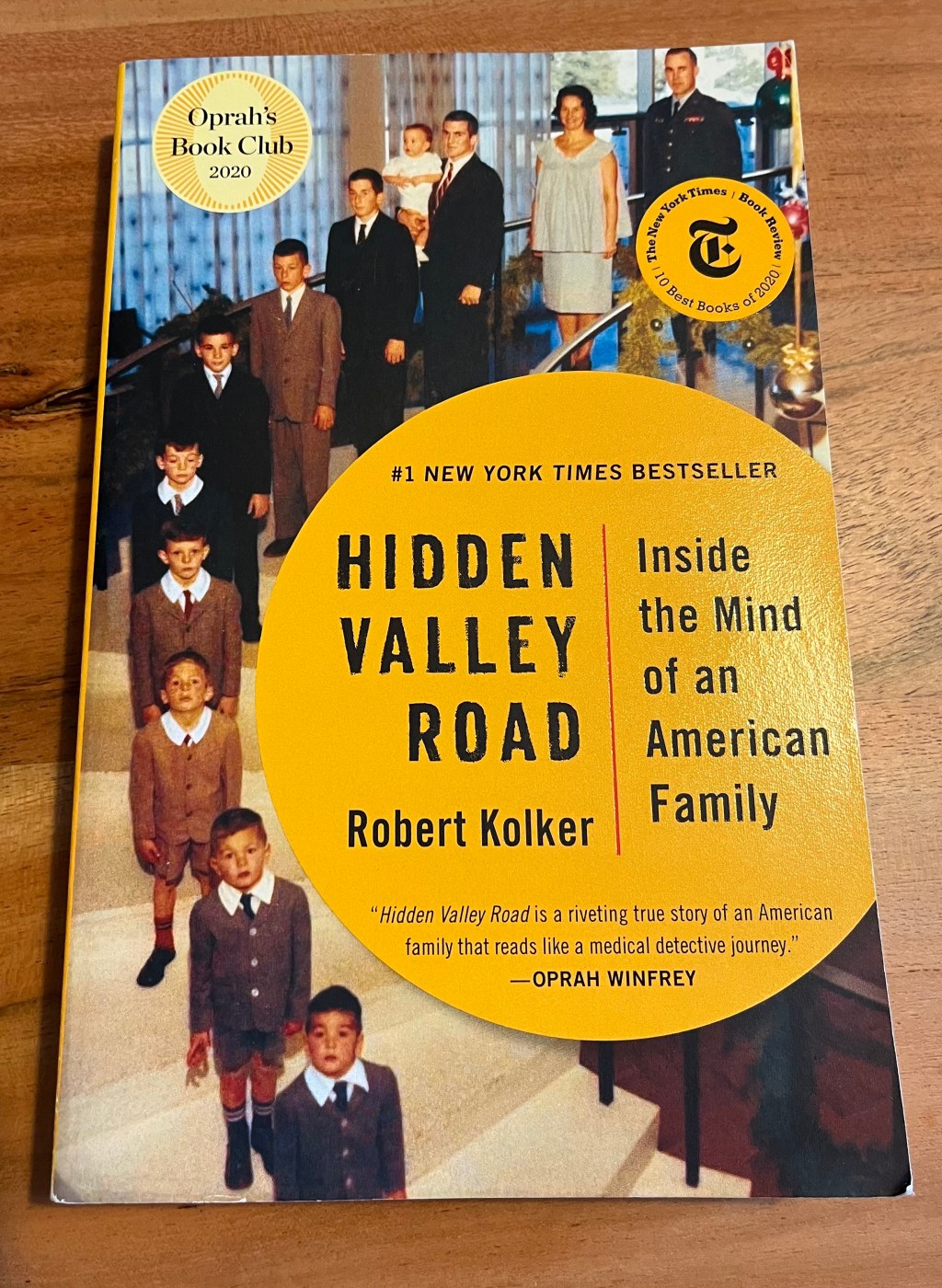
Finished: May 7, 2024
Why I read this
Almost two years ago, sitting at the counter with my sister in her New York City apartment I asked her for a handful of book recommendations. It included various genres ranging from non-fiction/productivity with Checklist Manifesto to teen beach read with Bones and All to spirituality from the Yucatan Peninsula with The Four Agreements and finally to the non-fiction medical drama of Hidden Valley Road. Her first suggestion was spot on for my style, despite my squeemishness at the graphic depictions of intense surgical procedures, but the next two were emphatic misses for me. I remember texting her that Bones and All was one of the worst books I’d ever read, railing about the plot holes, and I laughed after her declaration “well I liked it!” Now, with an approaching trip to visit her in just under two months I was determined to check this one off the list and avoid having to tell her that, no I still had not gotten around to it.
What I learned
Set in, post-world war USA, the book began with a short, and more challenging to connect with section describing the back story of the parents of what was to be an extraordinary family. This section was the standard melodramatic description of many similar stories of many similar families, but once the babies started to come, the book picked up. The chapters, which were perfectly sized to read one each way on the metro going to and from work, fell quickly one after another, and in no time all 12 of the Galvin children had been introduced and the transition to nearly a horror story plot was complete. To date I had thought about insanity only when it appeared in popular fiction, and the realities of caring for affected people had not really been expressed to me. Even the brushes with mental illness I have had in my life were absolutely nothing compared with the challenges of the Galvin family.
So how this family dealt with all of these, insurmountable challenges, amazed me. In all my time searching for the right ways to act, the right ways to treat people, the right tools and methods to help you smooth interactions with other people I have never considered how these processes might be simply ineffective for a family where almost half are schizophrenic, and the rest have borderline PTSD from dealing with the sick half. What do you do when all the normal rules of interacting with people are tossed out the window and all of your effort needs to be put into simply controlling the situation? I am not sure, but somehow the stronger members of the Galvin family managed to do it. Despite all this trauma and drama over a life time, the only one person (the most sick of them all) was ever sanctionned by the family. The incredible ability of this family to forgive, adapt, and accept, even through years of brutal experiences puts my own life into perspective. I am not very close with some members of my family, and it is for reasons so banal in comparison with the Galvins that it would be embarassing to even write it out. It is strong motivation to try and do better on my end. At the same time I saw many normal human dysfunctions in the group. Once, Lindsay, the youngest daughter of the twelve member family said that “I’ll work myself to the bone and not ask for help, and then I’ll be resentful”. I saw myself a lot in the phrase. I often take on a lot, and then I sometimes find myself comparing the things I forced myself to do against the things others haven’t done, and feeling upset about it. Another normal human behavior was described in the mother who was “strong enough to have endured any number of horrible tragedies and yet utterly averse to self-reflection.” I think self-reflection is one of the things humans are the worst at. Rarely, if ever will someone admit that their actions were in the wrong, and then usual at prompting. We all have weaknesses and make mistakes, why are we so against accepting our imperfections?
The scientific side of the story also began boring and ended engaging. I never really thought about how little we know about brain diseases until I read this book. In much of science we discuss the ideas that have been established by people centuries ago and are often laws rather than theories. No one argues about how to calculate the angles of triangles, or how electromagnetic rays work anymore. Most new discoveries in these fields are so far from a normal human’s experience (for example Stephen Hawking’s work, which is now fairly old, is still way above my head), that they don’t relate to the daily lives of many people. All of this contrasts with the highly relevant and serious study of the human brain and people with mental illness. In this study it appears we know very little, and many of the key studies moving forward may not even yield results until near the end of my lifetime. How can we be so advanced but understand something so poorly? Not even 80 years ago people were still blaming mothers for mental abuse that caused insanity, at the same time Oppenheimer had created a nuclear bomb and we were well on our way to creating nuclear reactors. Even the discussion of the Human Genome project amazed me. It was completed when I was very young and I remember hearing about it, but I never understood it at all until reading this book (I don’t understand it now, but more than before). With multiple doctors in the family I will need to add more discussion of modern medicine into my future reading!
Another thing I noticed as I read this, was that I kept coming again and again to the story of Educated and the life of Tara Westover. Even the scenary of rural Idaho was described much the same as Hidden Valley Road was in Colorado. Where the beauty of nature was simply the backdrop of a highly dysfunctional and tormented family. Like the Galvins, Tara was part of an abnormally large family, and like the Galvins, Tara and her siblings experienced an incredible level of abuse and trauma. Since the Westover family feared and hated the government and modern medicine, they did not search for this type of help, but I can’t help but wonder if they had, would there have been another family with multiple cases of Schizophrenia to aid in researching a cure? They discussed that Tara’s father was likely bipolar, but it felt so much more extreme than that. How many families have resisted assistance, and in the end hurt others along with themselves?
What I didn’t like
Something I found a bit strange in the book was the overdramatization of certain aspects of the story. When I thought of how the family must have thought of the book once it was written and before it was published I was surprised that much of it got into the final cut. For example making it a big reveal that the grandmother had also been sexually abused and not explaining it in the opening made it feel like the twist in a dramatic television show. To me that wasn’t the point of this book, and it would have added clarity into all of her actions making it more easy to connect with her throughout the book if they had revelead it at the beginning.
Questions I asked
Is it right to dramatise a family history like this? What would my family have looked like from an external view like this?
How would I handle a diagnosed insanity of a member of my family? What would be the consequences on our relationships?
If schizophrenia is more like a spetrum of intensity, how many people are living their lives undiagnosed, but under severe mental handicap? How can they be identified, and how can they be helped?
My Favorite Quote
“He, like many of the men in his generation, had come to trust that if you did all the right things in all the right ways, then good things would come to you.”
Robert Kolker
Books I liked like this one
The Know-It-All : A. J. Jacobs (for a memoir that is lighter, but with many unknown facts about the world)
Educated : Tara Westover (for the tragic circumstances that can surround a family frought with mental illness if they don’t get help.)

 Book Reviews for Mom