
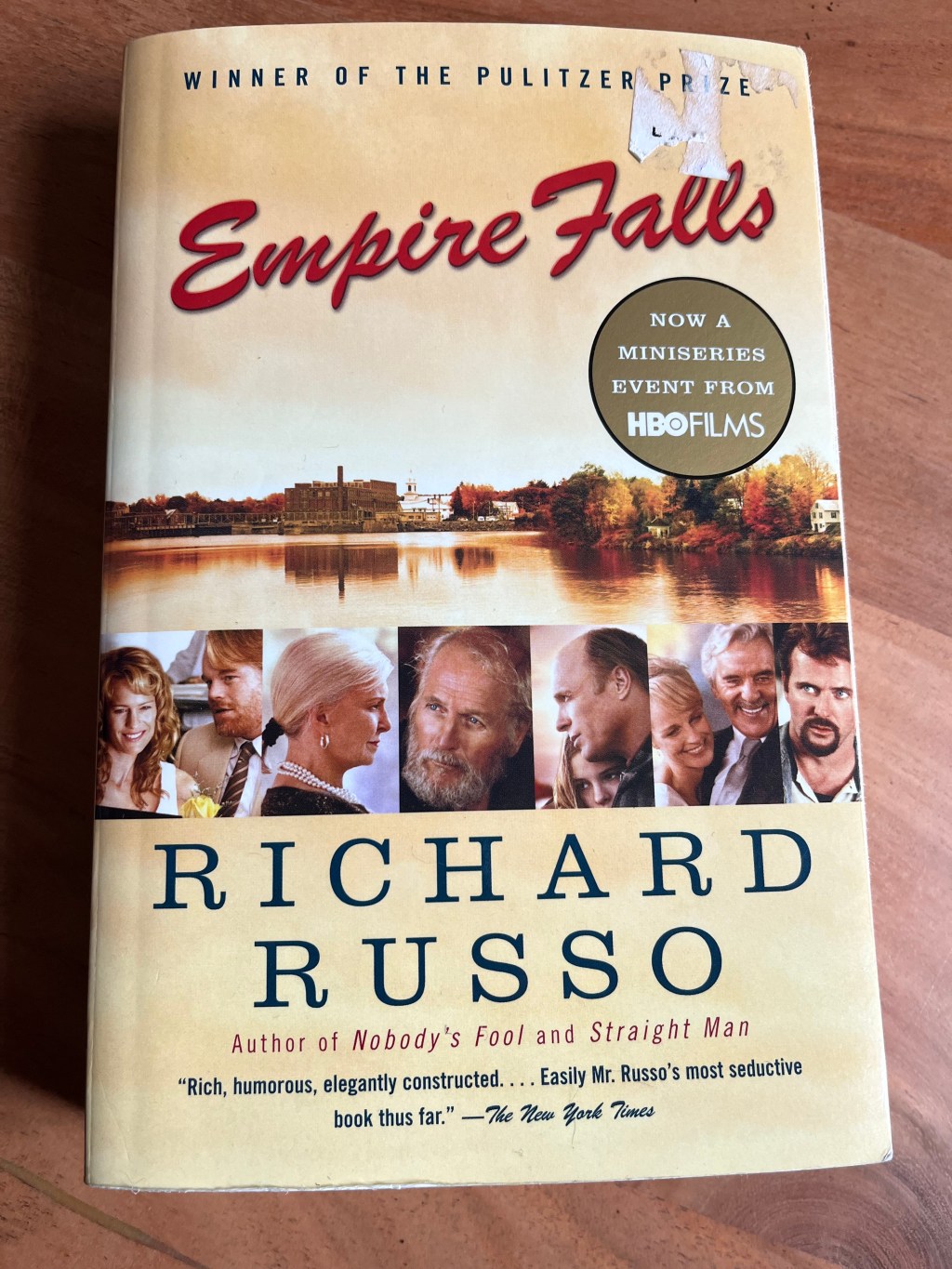
Finished: May 25, 2024
Why I read this
Before picking this book up I had started The Old Curiosity Shop (a book by Charles Dickens). The return to old English was hard, and the writing was dense and difficult to follow, so for one of the first times in my life I abandoned a book and started a new one. I still feel a bit bad about it, but there is simply not enough time to spend any of it on something that I’m not enjoying. I’m not in high school anymore and I need to be better about making my reading habit something I enjoy, and not something that is a chore. That explains why I didn’t read 400 pages of Charles Dickens, but it does not explain the choice of Richard Russo as a replacement. The problem is that I don’t have much of an explanation, I’m down to just a half a dozen English books and it won a Pulitzer, so naturally it had to be read.
What I learned
The sleepy rural town of Empire Falls in Maine brought me back to the many Stephen King novels set in the region. What surprised me was that where King relies on supernatural horror to liven the streets of Salem’s Lot, Russo is able to do it with normal humans. Frankly, exceptionally normal humans. The characters were faced with mostly normal problems, but the writing engaged them in such a way that it was fun and entertaining. These everday issues and challenges were then able to build into a handful of exciting and shocking concluding events that brought the story together as a whole mastering the character development to make those same events all the more impactful.
The themes so common to small town America, the values of close relationships vs. exposure to outside ideas, the deteriation of the community after the closing of the primary industry, the romantic webs of a limited group of people, all felt so natural, yet also more broadly applicable. As if the ideas worked for other communities as well, that for example, the loyalty that Miles had for the small town grill was applicable to how many people have excessive loyalty to their jobs, lives, places, relationships, etc. in almost any community. In this way I was able to find many things throughout the book that reminded me of how people really act, and as usual this fact made the book immensely enjoyable.
One of the first times I recognized this relationship to real life was when the characters were gathered in the titular Empire Falls grill and one character Walter is being just intolerable. He’s being arrogant, intrusive, rude, and extremely annoying, yet he is joined later by his soon to be wife Janine who justifies all of his negatives by the plain fact that each time he see’s her he is genuinely happy to see her, thrilled even. It’s so simple, but I believe it’s very true that many, if not all, faults in a person can be forgiven if they are simply glad to see you. I have been known to stew and sulk in my life about people who have annoyed or offended me (whether or not I was right to sulk is besides the point), and I have vowed many times that I was completely done with this or that person. However, I found that I could never fully extricate myself from someone if they were nice to me. Even if they are obnoxious and rude and mean, if you get a personal invite from someone to go get lunch together and they show genuine interest in you and your life it is hard to hold onto these negatives. Even a simple smile and a couple questions about how your weekend was is often enough to dispel the negativity of several interactions.
Next I found highly relatable the contemplative nature of the Roby family. Our main hero Miles is clearly intelligent and thoughtful, yet he has done nothing but maintain the status quo in his management of a small town grill for his entire adult life. His challenge was well summed up by this quote that “the problem with the contemplative life was that there was no end to contemplation, no fixed time after which thought had to be transformed into action.” I find this to be very true for many people in my life that are clearly thinkers. I have one friend specifically that is a serious homebody, but absorbs tons of information and really reflects on it. He’s big on philosophy, and science, and dables in politics and is one of the few people I’ve met who seriously considers both sides of arguments before deciding which he agrees with. So now he has strong opinions that are well justified, but he prefers his world of contemplation than to action. He believes part of the world is incorrect, yet he makes no effort to aid in the correction. However, maybe it is the problem that we have too many people trying to correct everything so that no one ends up with the power to fix anything. Who is right, I’m not sure.
Tying into this point was a funny line from the teenage daughter of Miles Roby, Tick. She was discussing how her art teacher did not like her painting in her class, but that it was ok, because she understood “the value of the endorsement of a fool”, which is to say, zero. It reminded me of a point made in Hidden Potential by Adam Grant that discussed receiving advice from people. He said that you should only consider advice from people who are knowledgable on the subject, aka, ignore the opinions of those who do not know what they are talking about. I think far too often we accept the negative opinions of those around us who aren’t aware of our lives or our situations and let them bother us. I know that I am exceptionally receptive to negative feedback from almost any source. I remember in high school getting so so mad about comments made on Facebook posts where people just argued about stupid things. It will be an objective going forward to make sure that I reduce the value of endorsements from fools. How I define if someone is a “fool” or not, will be a trickier question.
Finally, there are several times the book goes over quick ideas that I think we all feel from time to time in a way that was insightful, but did not insist to the reader. It made it even a challenge to choose which concepts I wanted to discuss here, because I felt there was an interesting note on every page. From the crippled high school student for whom “the poem had made her feel inferior so she wanted nothing more to do with it,” (when she was being tutored and struggled to understand, to Tick’s desire to acquire a whole new attitude when she found that she could not change how she felt about certain subject, each new observation was realtable and enjoyable. The last item I found particularly touching was Miles’ observations that when he left Empire Falls for college he found that each day he felt more as if the world at the college was home and less like Empire Falls was home. He felt alienated upon returning to the little town, his new normal had changed. It struck home for me with my relationship now with the US. It is home, but at the same time it feels a bit different each time I go back. I think many people who have immigrated must feel this way, and it leaves you with a certain nostalgia that is hard to shake. However, this description of college is probably the first time I’ve found something more globally relateable to express this feeling, it’ll be nice to have this comparison in my pocket for future discussions.
Honestly, at the end of this read, I struggled a bit to define why I enjoyed it so much. It was just a great book. It hit so many themes, but lightly, letting the reader explore them and think about them on their own instead of defining each detail and hitting you over the head with it. It was impactful, yet enjoyable, meaningful yet lighthearted. Generally just a joy to read, and I’m that’s what won it it’s Pulitzer.
What I didn’t like
If anything my complaint for this book would come from my ability to understand than the ability of the story to convey. The web of character interactions is complex and discusses various points of time far in the past to modern day. This left characters performing things years before the current events and leaving the reader to understand how the previous actions affected now. It was brilliantly done, but ultimately many of the strings are left unexplained. There are clues in the text for you to construct an answer to many of the mysteries, but my problem is that I will never know if my interpretation is the same as that of the author.
Questions I asked
Why do some people stay in small town America happy and content to see very little of the world, while others feel their small town is strangling them and they can’t wait to escape?
Can it be a correct attitude to avoid suffering now (putting off a hard decision), even if it will come with further suffering in the future? Should you enjoy the moment now, even though enjoying it will bring twice the trouble later?
Do people really know what they want?
My Favorite Quote
“Odd, though, the way other people saw you. Miles had always thought of himself as the model of tolerance.”
Miles Roby
Books I liked like this one
Lonesome Dove : Larry McMurty (for extremely likeable characters
The Coward : Jarred McGinnis (for an engaging story about relatively normal people in relatively normal events)

 Book Reviews for Mom