
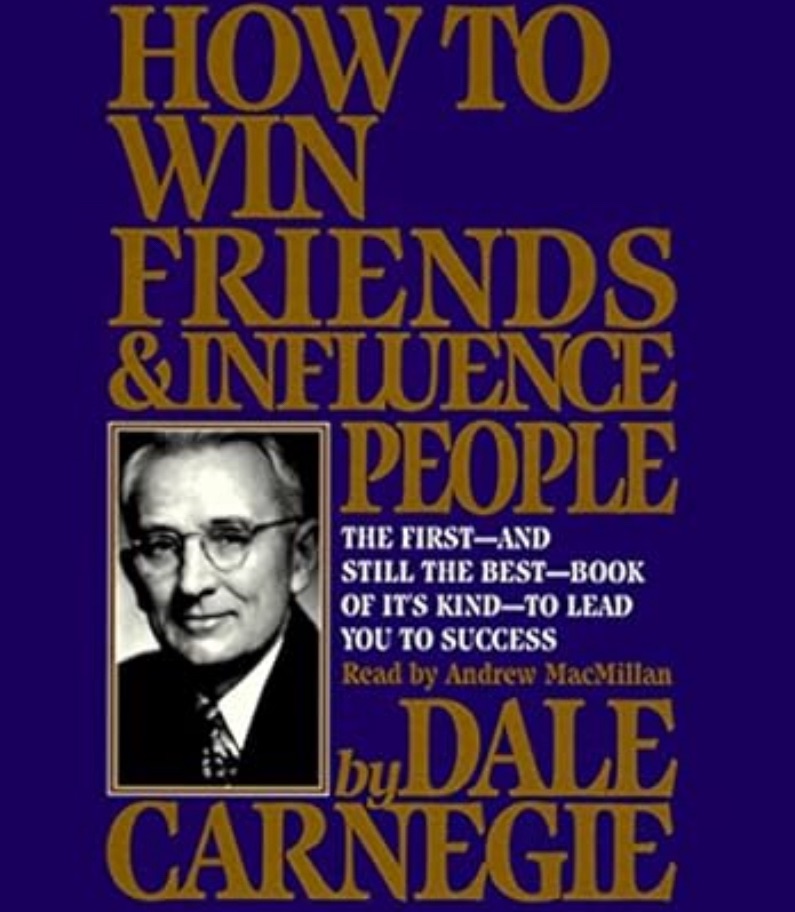
Finished: May 30, 2024
Why I read this
This now marks the third time that I’ve read (listened) to this book, and each time I’m happier with it than the time before. The first time I read this was probably 5 or 6 years ago now and I got it because frankly I had trouble getting along with people. My sense of humor and attitude were hurting me more than helping me and I decided I was going to work on it. Since then I’ve probably read a dozen books in the same vein, but I’ve yet to find anything so simple yet so impactful as How to Win Friends and Influence People. For anyone looking to get along better with people, and improve their life, I imagine this will stay my first suggestion forever.
Despite the simplicity of the suggestions here, it’s amazing how quickly we forget these things. The human mind needs constant reminding. That’s why I read this a second time when I moved to France to help me with finding a new group of friends since I knew nobody. Now this third time was inspired by my new job where integration has been another new challenge. With each read the ideas have seemed more clear and helpful, giving me a scaffolding to work on improving my relationships. Knowing all of this, I have a feeling it won’t be all that long until I read it again.
What I learned
My challenge here is not to write out what I learned, but to separate out the things I found worth repeating, without rewriting the entire book. From the introduction alone I had noted more comments that I had for all of my last read Empire Falls. Obviously since this book is a self-improvement guide it’s going to (hopefully) have more directly applicable life lessons than you would find in a normal fictional novel, but still I am gripped by how relevant many seemingly obvious facts are. Take for example the observation in the introduction that only 15% of financial success comes from technical ability, the remaining 85% comes from the ability to handle people. Although it was potentially more true before the invention of the internet and remote working, and the sources used to make such a claim are questionable at best, I can’t help but acknowledge that an enormous portion of an individual’s success comes from their intereactions with people, and not from just being good at something. We all know someone who is in a position more because they knew someone than because they were the perfect worker for that specific job. But I think the best example to demonstrate the point comes from a more recent book, Malcolm Gladwell’s Outliers when he discusses people with exceptionally high IQ’s struggling to be successful because their emotional intelligence and ability to work with people is lacking. All of this is a long winded way of saying that each little observation in this book was insightful and interesting, so instead of repeating each fact and figure I wanted to focus on the broad themes addressed in the book and how I think they are still relevant today.
The first and largest major theme is simply to be incredibly more empathetic. This includes such classic ideas as “everyone you ever meet is able to teach you something”, but other ideas are less mainstream. One of my favorites is the story of Two Gun Crowley, who killed several people in a crime spree over three months in the 1930’s. He wrote a letter during a shoot out stating that he was a good person and simply mis-understood. There is a similar letter that exists from Al Capone who stated he was a public benefactor. If these men who are undeniable villains believe they are good people, what must normal people think? I agree with the book in the idea that 99 times out of 100 people will not criticize themselves for anything. I am sure that on a daily basis I do things that others criticise in their heads that I am completely unaware of. So if others don’t think they are in the wrong it goes without saying that you will not succeed in life if all you can do is find fault in others. Instead you’ll fair far better by constantly put ting yourself in their shoes and trying to understand why they are doing something. Because afterall, people are created mostly by experience, so it is more than likely that you would do exactly the same if you were them, with their history and their experiences. The empathy idea goes further to say that there is only one way to make anyone do anything, and that is to make them want to do it. This means putting yourself in their place to understand what kind of information, or action would make them want to do whatever it is you want them to do, otherwise you will not motivate them to do anything. In my professional life this is by far the hardest thing to try to apply. For example I want a colleague to share his contacts for a certain group of subcontractors with me, how can I phrase that request to get him to want to do it? What’s in it for him? On daily actions like that it is a constant challenge to think of things from the other’s perspective and ever more difficult to adapt an action to get what I want out of it. I think it will be an interesting game for the rest of my life.
Secondly, related to empathy is the idea of regularly talking or seeing things in terms of the other person’s interests. This is the most easily applicable idea, and one where you can see the immediate difference. With many of my new colleagues I have seen instantly a change in the friendliness of the conversation just by expressing an interest in the other person’s life. Where this becomes very hard is when the other person is interested in something that you have no interest in. For example this was really easy for me the other day when I met someone who grew up in the Ivory Coast and moved across several countries in his early life. Asking about different cultures, places, times is really interesting to me, so I could ask question after question without the conversation dropping. However, another colleague loves to golf, but I struggle to motivate myself to even think up a question to ask about golf, much less to try and get him to talk about it for any real amount of time. The book is filled with instance after instance of people being incredibly amiable when someone simply expresses a genuine interest in their own lives. Again, the idea is simple, but the word genuine makes the application nearly impossible with certain individuals. So either I need to adopt a greater interest in various subjects, or maybe I’d be better served with some acting lessons.
The last main theme I saw was simply being generally friendly. It sounds so silly, but things like smiling often and knowing people’s names really makes a difference in how you are seen by others. I know just trying to smile more often in France I’ve found that even mundane interactions on the metro are more pleasant when you smile. I get a “pardon”, much more often when I do my best to be smiling than I do when I am not. Another part related to this is admitting you are wrong quickly and emphatically. This may be one of, if not the best lessons, in the entire book. It honestly works magic. A great example of this was the other day I used the wrong name in an email to a supplier (I was copy pasting emails too quickly trying to get a lot done fast), and when I realized my mistake I immediately emailed back with an apology that was probably much too formal for the error, but almost immediately I had a call from the salesman telling me it was not at all a big deal and we had a pleasant conversation for the next twenty minutes. This example is light, and not a big deal, but I think it works for nearly anything. I know personally, I can forgive someone for just about anything if they really seem to regret doing it. It is just too difficult to deny a person’s apology unless they have done something utterly unforgivable. It also shows a humility that I feel most people can relate to. It is disarming to have someone come to you and tell you emphatically how they were wrong. If everyone would just do this more often I think the world would be a better place, but coupled with the idea that few people believe they are ever wrong it might be a rather large expectation on my part.
Ultimately, this book teaches a goldmine of life lessons and strategies of working with human beings. They are often simple, if not even infantile. The problem is even the most childish of ideas, such as simply similing to be happier, are incredibly hard to consistently practice. You try smiling on a crowded metro ride when it is blazing hot, there’s a crying baby, and someone smells terrible. That is why I think the next step here is to combine these ideas with the ideas presented in another book Atomic Habits. With the ideas presented in both, maybe it is possible, even simple, to apply these principles fully and dramatically improve your life. Anyway, there is no way to do it other than trying!
What I didn’t like
Throughout this read there was just one thing that nagged at me over and over. Everything in the book concentrates on making others happy. The author believes that the success you will have from working with people effectively should give you all the feeling of importance you need to be happy. It’s kind of like the idea that you should eat spinach every day non-stop if you want to grow big and strong that parents teach to children even if they hate eating spinach. The difficulty I have with this is two-fold. First, it means eating crow your entire life, or turning the other cheek to be more positive. It means never criticizing, never correcting, rarely talking about yourself, and only discussing topics other people are interested in. It means that to a degree you must sacrifice some of your individuality to succeed in human relationships, if only a little. It means if you have that lunch with a colleague you’ve got to smile and nod when they share their bigotted political views, or you’ve got to hold you tongue when someone is being an asshole in the street. The second part of this is that if you practise this perfectly you may very well cause a problem with surpressing your emotions. It is fine and good to say to never criticize, scold, or condemn, but if you simply swallow all of these negative comments your whole life what kind of stress and negative impact might that have on your own well being? Is financial, or personal success worth that? I believe the answer is to change your life so that you do not surround yourself with people that make you feel this way, and to share criticisms with people who are close to you in a different way (constructive commentary instead of insulting statements), but even then that is not always possible. Maybe being likeable is hard work just like everything else.
Questions I asked
Do these suggestions work in France like they work in the US? Do they still work the same way as they did when the book was released or has our culture changed enough that they don’t have the same effect?
Would Dale Carnegie only be against criticism directly to the person, or would he be generally against criticism about anyone?
How can these ideas be measured so that they can be consistently applied?
My Favorite Quote
“Education is the ability to meet life’s situations.”
Dale Carnegie
Books I liked like this one
The Subtle Art of Not Giving a Fuck : Mark Manson (for a concentration on simple rules to change your attitude)
Humankind : Rutger Bregman (for a more positive look at human nature)

 Book Reviews for Mom