
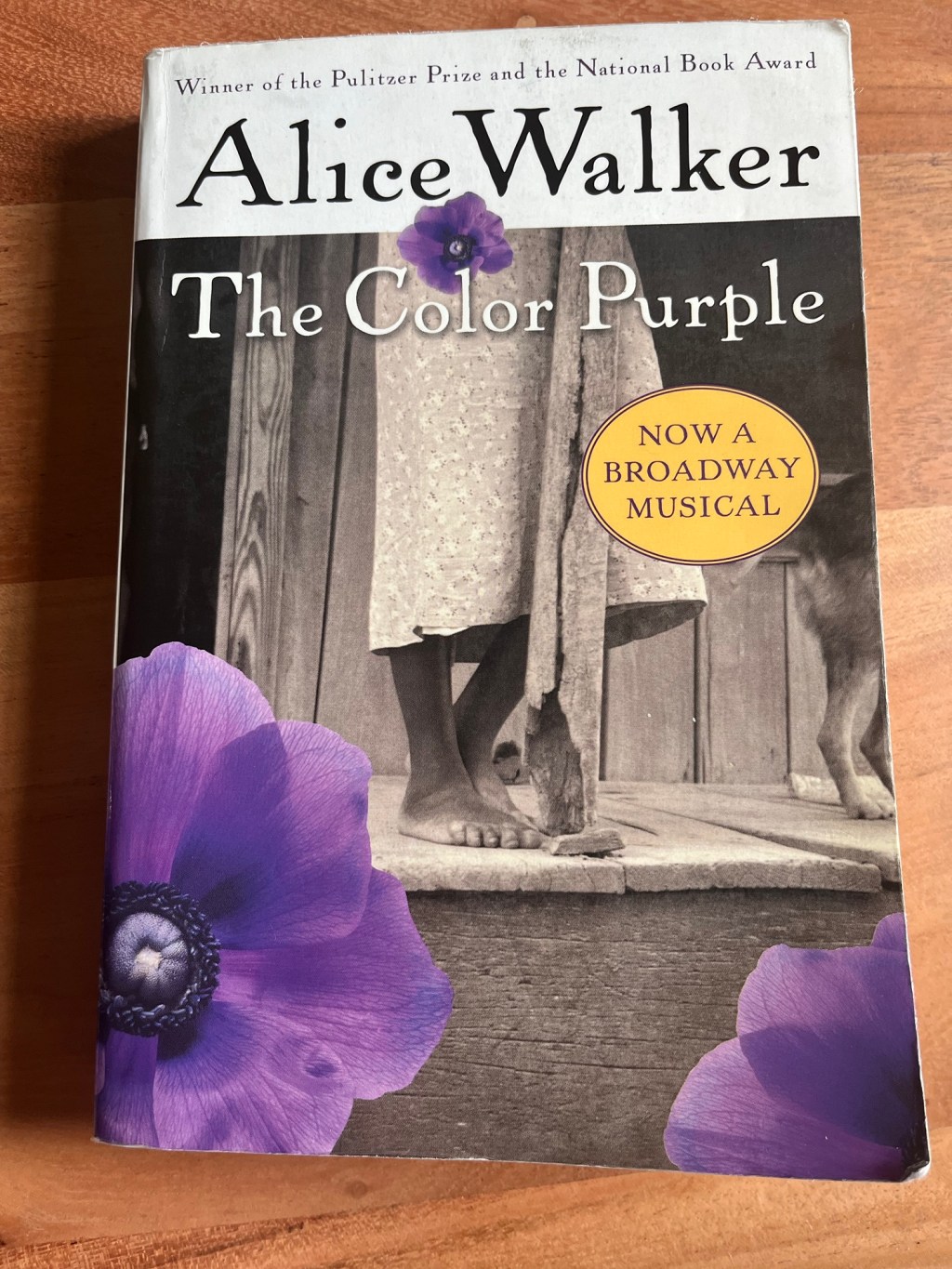
Finished: June 6, 2024
Why I read this
Chopping away at the Pulitzer prize winners and my list of English books I’ve finally fallen upon The Color Purple. If I am speaking truthfully, if it had not been a prize winner I am not sure I would have ever read it. And it is for that reason exactly that it ended up on my list before the other 80 or so Pulitzer Prize winners I still haven’t read. I know that in my life diversity is lacking. Most of my friends are white, same with almost all of my family. At work we are probably 70+% Western white males, with the rest consisting of a few women, and a respectable amount of people from Western and Northern Africa (kudos to my boss for at least that good step). Knowing this I really have to make an effort to include reading from a variety of sources. I also learned from Blink not too long ago that all of us have challenges with all groups of people of which we do not belong, whether the lines of the groups are drawn over race, sexuality, gender, or even favorite sports team. So adding this book to my list and prioritizing myself to read it (even if that prioritizing was only to include it in the last list of English books I brought with me from the US) is my effort to expose myself a little bit more to diversity (female and minority authors specifically), in the hopes that the ideas presented can help me challenge just a bit more that inherent xenophobia that we all have.
What I learned
For a book filled with spaces and short chapters it took me a surprisingly long time to read. I think it is a bit like reading philosophy or poetry, if you go through a story like this all in one go you don’t give yourself the time to think about anything and you wind up missing most of the main points. Placing days, or at least hours, between certain letters of the narrative (the entire story is written in the past tense in letters between two main characters that are sisters) made the passing of time in the story a bit more relatable.
That part of the style to the book I really enjoyed (although I’ll admit I expected the second sister to come back into the story much sooner than she did). It felt very personal and secretive, like the reader has a personal window into the thoughts of the main character Celie. This is something that is true for all things written this way as a journal, it’s probably a reason for the success of many like The Diary of Anne Frank. So, what was most interesting to me throughout this book, was this private perspective of someone so vastly different from me. A poor, uneducated, black, lesbian, woman with serious childhood trauma is about the furthest possible a character can be from my personal experience. The only thing I thought we shared at the was the American South. That was what I thought at the beginning.
However, by the end I realized that despite these differences in background there is a lot more that we have in common than I thought. Like her, and most people, I have similar reflections about my self-worth, about what being happy means, and questions about whether my feelings, or desires, or emotions are “normal”. That is probably what makes the book so impactful and relevant for a lasting time. I imagine many, if not most, members of the LGTQ have grown up feeling the same way Celie did with confusion and a feeling of abnormality. Many people who have grown up in religious contexts probably still have similar challenges in the discovery of sexuality as Celie or their relationship with god as both Celie and her sister Nettie had. And I imagine many victims of domestic violence ask themselves far too often what a “normal” amount of beating a wife should expect from their husband.
To me, all of these challenges scream for (among other things), the value of education. The education that gives you a benchmark for what you should expect out of life, when, and where from. Without it there is no reference to understand that something is right, wrong, attrocious, or blessed. I believe that this one factor, education, affects us more than any other in our lives. But I don’t just mean school. I mean all of the learning that we are exposed to our entire lives by our parents, siblings, friends, coworkers, mentors, teachers, and more. The culture that we are given from those who we surround ourselves with teaches us all of these things and more, and as we saw with Celie, as she opened up herself to new experiences and more people her life became more and more enriched and she more and more content.
Finally, I was impressed at the level of forgiveness shown by Celie throughout the book. The things that happen to her are nothing short of unforgiveable, yet she manages to persevere and accept most of the people who have wronged her. From lovers, to husbands, to fathers, to son in laws, each person that treats her poorly, she eventually accepts in a maternal forgiveness that would be hard to find in any real world examples outside of religious texts. That would be my second lesson from this book. Turning the other cheek, letting go of past wrongs, and forgiving people really does release you from the responsibility of a grudge that requires you to pay taxes each time you think of that person.
What I didn’t like
I understand it is maybe a bit against the spirit of the the whole book, but I cannot stand reading heavy dialects. Each word is a challenge and it can be hard sometimes to even understand what the character is trying to say much less understanding broader themes. So right off the bat, the story had a challenge for me to really like it. Secondly, it is a bit exhausting to read something that is so heavy in a subject like the state of African American culture and racism in the American South, so making it inaccessible in language just adds to the challenge. I realize now that this may be contradictory to my review of Invisible Man where I thought the high level of language made the subject matter inaccessible. Maybe this is precisely the problem and I have shown it here. Writing on these subjects is simply uncomfortable. It makes you feel bad, plain and simple, and it does so by showing the truth. It is not fun to see that your race, your sex, your people (this being white men) have been the cause of so many challenges and that there is so much more work to do on a personal and societal level.
There was another thing I noticed the other day that I found relevant to share here. I was having yet another fictional debate in my head with a very real person with whom I don’t always get along. I do this often (healthy or not), where I imagine an argument and try to support my side and discredit the other. This habit is often on subjects that are controversial in nature and go back to what cause to support, how the governement should opperate, which political candidate is correct, what are the right ways to act with people etc. All of this is fine and good, until I realized for what was, amazingly, one of the first times, that I don’t do anything that gives me the right to say someone’s cause or opinion on a subjective matter are wrong. I don’t canvas, I don’t volunteer (I used to, but to be fair it is hard to do it in another country, although that’s just an excuse at this point), I don’t donate hardly any money to any cause, I don’t go to marches or rallies, I don’t even understand the platforms of my local ellectorate (again hard when I don’t have the right to vote in France, but still). If I don’t do anything in my life to promote these ways of living that I believe the be right, then I don’t deserve to tell someone else that their cause, candidate, ideas aren’t correct. There are already too many keyboard warriors in this world who have developed intolerant philosophies about any subject you can imagine, yet they do not help one single cause in a real concrete way. So in the future before I decide that I have an opinion on a subject I’ll do my best to contribute in a real way to that cause before I decide to tell others they should do the same (to be clear I do not advocate for people to be able to just donate to a cause and then have the freedom to be really annoying about pushing their ideas, just that maybe we should be a bit more active in our support and a bit less erbally inflammatory, that’s reasonable right?).
Questions I asked
As a child, did I question the fact that God was black in Bruce Almight?
How can I balance the enormous quantity of literature that exists with the need today diversify authors?
What is at least one cause that I’d really like to contribute to, in a real way?
My Favorite Quote
“Well, I say, we all have to start somewhere if we wants to do better, and our own self is what us have to hand.”
Celie
Books I liked like this one
Their Eyes Were Watching God : Zora Neale Hurston (for a representative book written in dialect)
Invisble Man : Ralph Ellison (for a internal and complex look at Racism in America)

 Book Reviews for Mom