
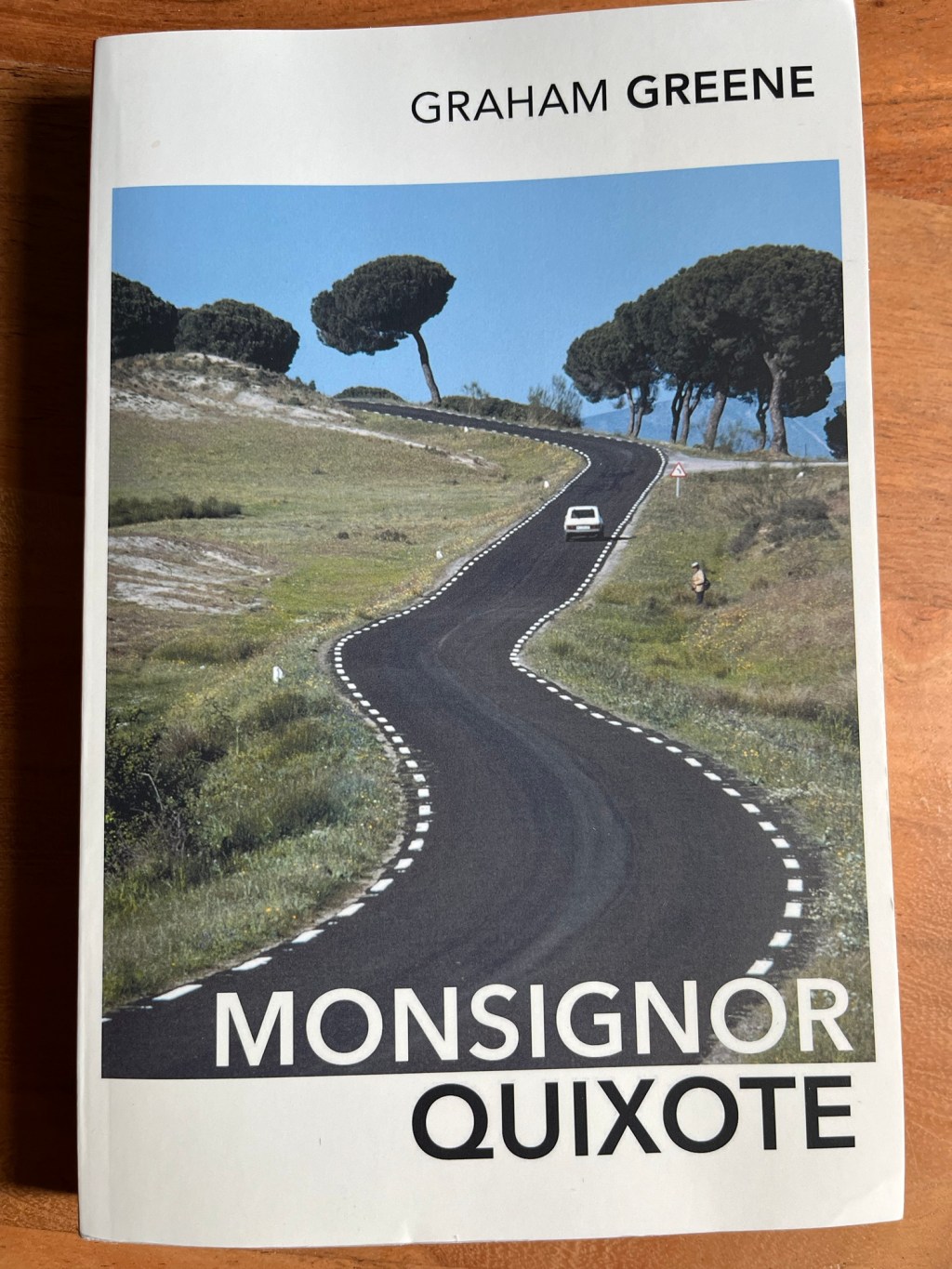
Finished: June 10, 2024
Why I read this
This one was a completly unpredictable. Being almost a month after my birthday a friend of mine and I got lunch and she gave me, as a bit of a surprise, this book at the end of our meal. I had never heard of it or even the author (who after a few google searches I found to be someone actually quite famous). Now, with a thoughtful gift like this you can never let the book sit for too long, and it is always so fun to spontaneously add a quick and unexpected read into the rotation. So with that I was glad to dive into the pseudo world of Don Quixote circa the 1980’s.
What I learned
From the first page I could tell this was going to be a winner. The quiet Spanish town of El Toboso (its funny how so many famous books seem to revolve around little towns) and its simple priest and communist mayor was too good of a setup to possible arrive at any other conclusion. I am not sure if I would have noticed it without the introduction (although I like to think I would have), but I agree that it was incredible how realistic the scenes felt with so little description. Greene does not weigh you down with page after page of description like you’d have with a Dickens or the baine of my 7th grade existant The Picture of Dorian Gray, but instead allows the simple act of conversation drive the plot of the book. Conversation, that is above all friendly and humble. An early quote sets the tone for these exchanges for the duration of the story. “I am as ignorant as anyone in the parish. I have read more books, that is all, when I was studying, but one forgets.” If only we could all be so humble.
These conversations, often sparked by the lightest of events, succeeded at diving down some dangerous moral rabbit holes while maintaining a jovial spirit making the subjects ultimately very palatable. Religion and politics, normally two of the most taboo subjects, are discusses lightly over cheese and wine in the country-side. The magic being that the two ideologues have enough doubt in their own rightness that they are able to talk without animosity, since, as Monsignor Quixote observed, “it is strange how quickly a bottle can be emptied when one debates without rancor.” A phrase that I agree deeply with in spite, or because, of its alcoholic implications. I believe there are few things more enjoyable than a good long discussion about a subject that matters, surrounded by people you can be 100% yourself around without fear of overreaction, aggression or judgement all sped along nicely by a few glasses, or bottles of a nice wine.
Moreover, the simple days, often limited by the speed of Rocinante, the priests rickety old car, exemplified the virtues of a slow life, in stark contrast the first quickenings of the non-stop modern daily life. With a release just before the advent of the internet, Greene was prophetic to emphasize the simple life, with simple virtues as opposed to rushing around pushing your personal agenda. Even the priest’s simple appreciation for his horse steaks promotes a modest life over the more expensive, less satisfying luxuries you can spend a life chasing. In my Parisian life where we are always rushing to the next thing I found the slow drives through the Spanish countryside stopping when you are hungry, and navigating at your own speed at your own course (no GPS, no destination, no pre-defined restaurant stops, etc.) were immensely appealing. Even how I read the book was a bit different than normally. It read more slowly, taking more time and I felt like I was reading for the sheer pleasure of it, instead of for the idea that I should be reading. I didn’t watch the time passing, or count the hours it took to flip through the pages. I just enjoyed. I forget far too frequently these days to stop to smell the roses, and I was so glad for this reminder to do so more often.
The final idea that I enjoyed (not to copy that of the introduction), was the idea of a doubtful conviction being more valuable than a blind, but complete conviction. I think we are brainwashed these days with polarized ideas, with perfect right, perfect wrong. Whether it is politics, or religion, people who are convinced without the smallest self-doubt quickly become zealots, social justice warriors, or intolerant bigots. Having this doubt keeps you grounded with your own imperfect humanity, and allows you to see that others are imperfect as well. Ego set aside, conversation, pleasure, friendship can be had between two dramatically different parties and we can all improve together.
What I didn’t like
This one was a real 5 out of 5, so I am not sure I had anything that I disliked about it. The one comment I would make however, to another person looking to read the same book is that maybe the story could be improved with a read of the original Don Quixote or at least the spark notes version of it! Otherwise amazing book, that will be on my niche suggestions list for the forseable future!
Questions I asked
Are characters improved by not detailing them? Are people able to relate more easily because they can build the character how they would like, instead of how the author imagined them?
Are motives important or are results all that matter?
Where can I get a horsemeat steak to try?
My Favorite Quote
“How can I pray to resist evil when I am not even tempted? There is no virtue in such a prayer.”
Monsignor Quixote
Books I liked like this one
Life of Pi: Yann Martel (for a religious/spiritual book hidden in a engaging narrative)
Vol de Nuit : Antoine de Saint-Exupéry (for deep reflection on the world and how we fit into it)

 Book Reviews for Mom