
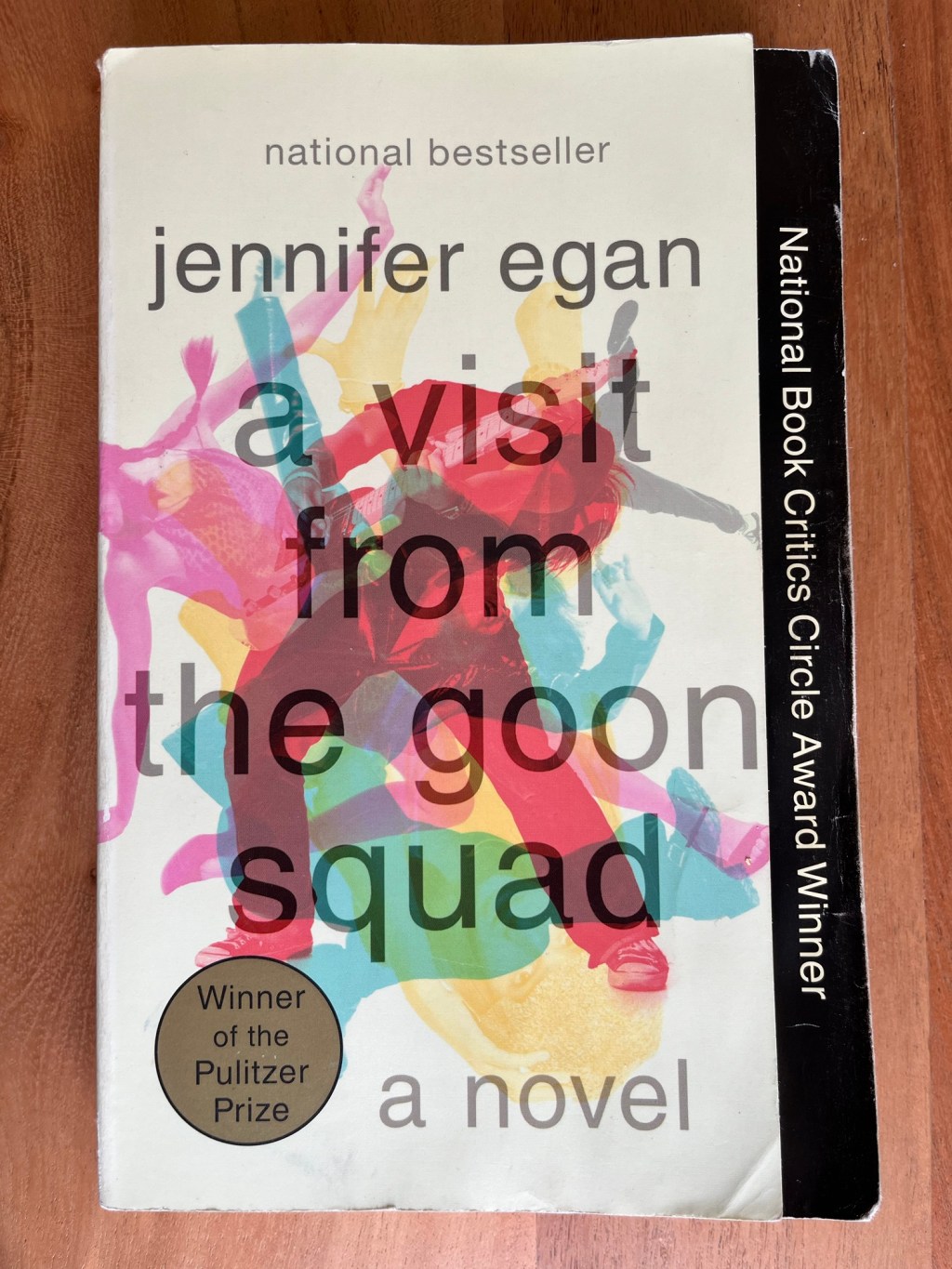
Finished: July 21, 2024
Why I read this
Honestly the reason I read this is that I thought the title was really fun and modern. Maybe goon squad had a slightly different meaning in punk rock circles in the 70’s, 80’s and 90’s but for me and my friends it’s just a stupid thing we say about our own friend group when we’re acting dumb. Playing games together we joke about how anyone who is unfortunate enough to be automatically paired with our losing team has been matched with the “Goon Squad”, and we will proceed to “goon” by ignoring the games rules, objectives, or missions to simply goof off, normally at the enormous frustration of the paired teammate. So with that background, regardless of the subject of the book, it was necessary that I read a Pulitzer Prize winner with such a funny and light name.
What I learned
Starting out in the life of Sasha, the kleptomaniac assistant to Bennie, the record company executive quickly falling from grace, this book was a normal and appealing fiction. The characters didn’t feel forced, and there was not that taste of “this is a attempt at a pulitzer” I’ve found in the prose recently of many of the many winners I’ve gone through. Kind of like how you can see a trailer for a film, and say “there’s an attempt at best picture” even if you don’t think it looks very good. So it was refreshing to start here and think I was going to follow in the typical style the normal lives of a small group of main characters. From the second chapter onward I realized that this would not be the case.
Flipping from chapter 1 about Sasha, to chapter 2 about Bennie, to chapter 3 about a childhood friend of Bennie’s and so on and so forth, I realized after about 4 or 5 chapters that the book was never coming back to our title characters. Instead, it would follow a twisted line through the lives of the people around Bennie and Sasha providing tangential observations of the key characters from the vantage points of their own lives. Here was where that famous “ok yea its a Pulitzer” feeling came back into play (not to mention the 80 page chapter written in graphs). This waterfall style of character development was unique in that, unlike many other authors who switch frequently between character perspectives, Egan descended down the line to relation after relation never flipping back to the originals, truly telling 13 individual stories about 13 loosely related individuals. So, being structurally similar to both Empire Falls and Olive Kitteridge (having a wide cast of characters that have their own individuals lives, wants, desires, etc.) I had many of the same observations here, where it bears reminding that we live in a huge and complex web of lives and experiences and the ways in which we are interconnected can be banal or extraordinary. Thankfully, beyond what I’ve said before with these other stories, A Visit from the Goon Squad left me with a handful of remarks that I felt were truly original.
The first character that resounded with me beyond a general liking was a college study Mindy who was related to Bennie as the muse of the man (Lou) who discovered Bennie and got him into a record label position. On an African safari with Lou and his two children Mindy regularly applies her university perspective (she is currently a grad student) to the world around her in an amusing, yet deeply relevant manner. For example, she discussed how she knew on this trip, whose luxury would not have been common for a college student, would change the path of her life forever through what she labelled as “structural dissatifaction” or “returning to circumstances that once pleased you, having experienced a more thrilling or opulent way of life, and finding that you can no longer tolerate them.” In doing so she creates a self-fulfilling prophecy and is no longer able to stand her college lifestyle upon returning, therefore changing her life forever and dropping out. Regardless of the misfortune of Mindy’s experience with it, I felt the concept to have a lot of truth and I frankly related pretty well to it. In making comparisons to my life almost 10 years ago when I first lived in Europe as an exchange student, to now living here permanently working is night and day, and I regularly find myself asking how I could have survived the way that I did. I remember travelling as a poor college student (frankly not that poor because my parents helped me a lot), and living in hostels, eating at train stations, walking everywhere, taking flights at 4am to save 20€, on and on. Then once I came to Europe I came as an expat where travelling was a major part of my role. Travelling in business is of course a different animal, and I can conciously recognize that my perspective when travelling personally has changed because of it. I have such a craving for the nice hotels and expensive restaurants that are par for the course in business travel that it is hard to resist things I know I shouldn’t be buying when it is my own money at stake. Even for things that I know don’t make sense, such as paying hundreds of euros more for a plane ticket just to have a few more inches of leg room can be tempting to me now because I am used to flying in a class higher than economy. In Thinking Fast and Slow Kahneman discussed heuristics as well about how quickly humans can adapt to something, and it is the last taste that is left in your mouth that is remembered above all. It’s a funny concept when you think about it because it puts humans in a race to the top which is nothing but a trap. Each step up you take you lose your ability to appreciate the steps below while approaching the ceiling of the best things can be. If one day you become accustomed to only eating at 3 michelin starred restaurants every meal that becomes normal, quotidien, and then nothing is ever exceptional again (because frankly there is nothing better to go with), which ultimately feels very sad for those who’ve now become accustomed to all life has to offer and have no where left to go but down. A descent, that due to their elevated reference point, will feel absolutely terrible.
Another, point that I noticed was the relationship that the characters in the 90’s had towards politics. They had mentioned going to the inauguration of Clinton and discussed how it felt life changing. As if there were an energy in the air predicting that the world was going to change, that nothing would ever be the same. I’ve heard of this idea often before with the charasmatic leaders of the 20th century. You hear it for FDR and JFK, for Eisenhower or Johnson, that despite their politics or opinions people in the past generally seemed well liked and their approval ratings all had highs in the upper 70’s or even 80’s. It is a style of politics that we do not see very often anymore, and the current political turmoil and consistently low approval ratings of the US candidates shows that times have changed. It is such a stark difference the hope present in these characters watching Clinton come into office when compared to the “lesser of the evils” that American politics has felt like since Obama left office (which is pretty much all of my adult life). Maybe I am just too far removed from the political scene, or I do not have the right temperment, but it has been a very long time since I have seen anyone, anywhere (other than online or on the news) who was really truly excited about their candidate, or at least on the democratic side. On the Republican side it is true that their is a strange zealotry with Trump where at least a reasonable portion of his followers appear absolutely enamored with him. Where he can do no wrong and commit no error, where felony convictions and uprisings do not convince people that maybe another candidate would be a good idea. But to me that isn’t really a hopeful outlook, it’s a strange defensive mechanism where these people feel attacked and outnumbered by those who disagree with them and they are reaching like a drowning person to anyone who can prevent the world around them from changing. We can hope that after this next election cycle, where there will be no more Trump (one way or the other, this should be the end of his political career) things will calm down a bit in the US and maybe a candidate can come up that can give people some hope for something better.
Finally, I wanted to point out the extreme intentionality of the book and how artistic it felt. The way the book was laid out there were many stories that the author had to track and intertwine and each one had several connections to several other characters, that were sprinkled throughout the text almost as easter eggs instead of plot supporting materials. Such as a reference in an early chapter about Sasha’s kids and one being autistic, then a child appearing in a later chapter that clearly had an obsesive disorder, but was never directly named as special needs. The world building even left me with a feeling at the end that I wanted to go through and read the book over again now that I would have novel insights into each character from the outside perspective of their older or younger selves. It was these things together that made me really see the artistry of the book and made me think about how the AI movement is probably, quickly moving into the literature field, and how compared with books like this, I think there is still a long way to go before AI can overcome the human creative spirit.
What I didn’t like
Again, just as I thought in Olive Kitteridge it was a good story that I feel was lessened by the lack of continuity in this style of chapter by character writing. The first chapter made me interested in the life of Sasha, the second made me interested in the life of Bennie, the third featured neither of these characters besides a extra-like presence by teenage Bennie, the fourth included neither of them, and so on. I appreciated how the book spun through several characters, but I felt like it could have been significantly strengthened by returning every few chapters to one of the central characters and explaining more about them. That way the best of both sides could be kept.
Questions I asked
Are certain fields of work associated with higher rates of divorce? Are people who are more likely to get divorced attracted to those fields or do the fields make them less loyal to their partners?
Do humans typically get less optimistic as they age?
Why do interesting characters always seem to be people with traumatic lives? Does living a traumatic life give you greater depth than someone who has never suffered tragedy?
My Favorite Quote
“Such universal, defining symbols made meaningless by nothing more than time.”
Jennifer Egan
Books I liked like this one
Olive Kitteridge : Elizabeth Strout (for a similar writing style and web of characters/stories)
The Goldfinch : Donna Tart (for troubled youth and their struggles in the world)

 Book Reviews for Mom