
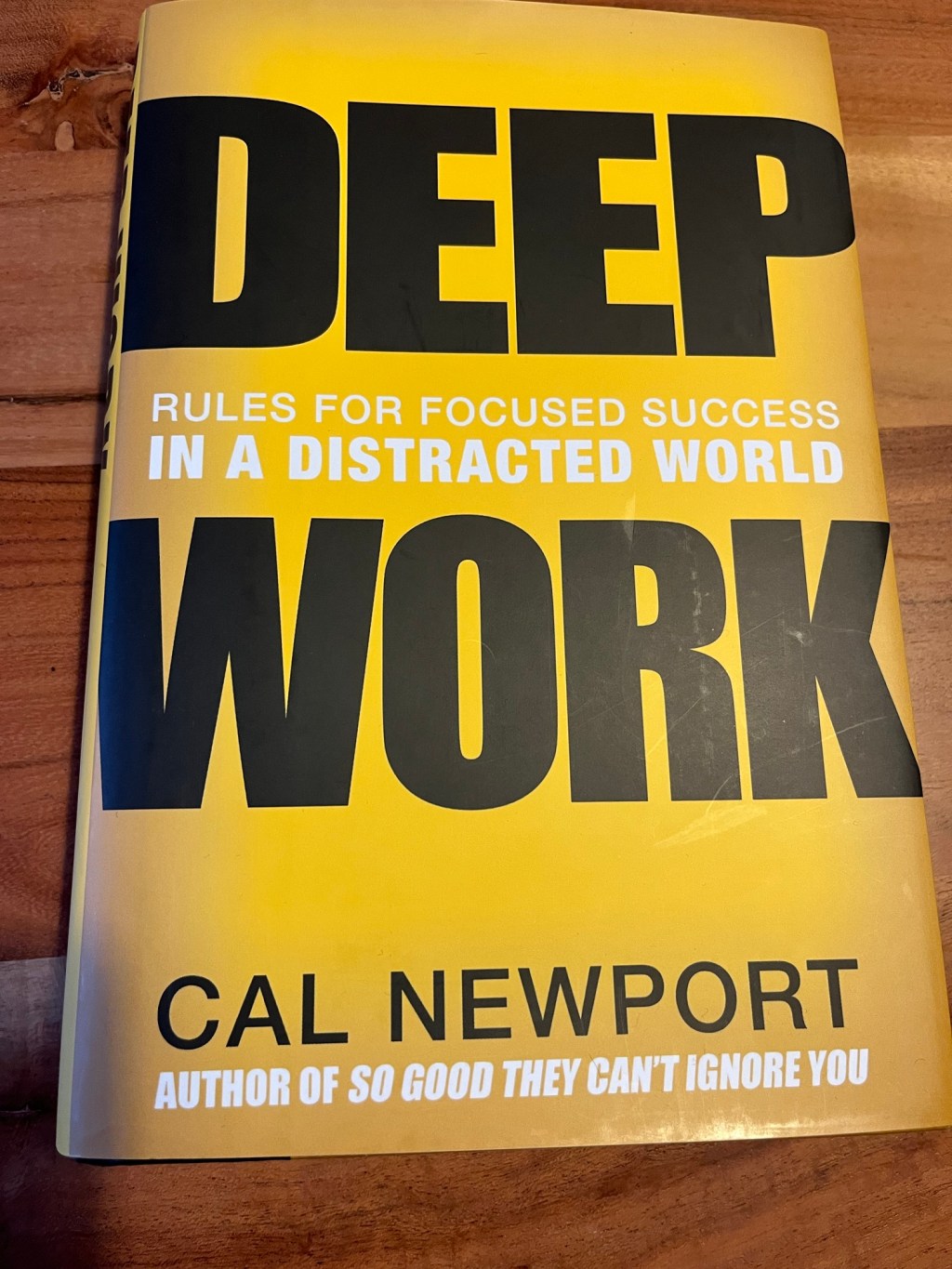
Finished: July 26, 2024
Why I read this
Recently, having some lighter work days, I decided to spend some time improving my skills by taking an online course (Connected Leadership on Coursera). In it there was a section discussing the ability to disconnect from distractions and to concentrate on work that is important if you want to get things done. After two or three interesting articles on the subject there was an link to an optional, additional reading, this book, Deep Work. Being a subject I found compelling for both improving my personal habit or writing, and trying to be more efficient with the hours I spend at work I decided to quickly pick this one up on my recent trip to the US and then to quickly read through it. Immediately this revealed a number of those classic “obvious, yet nuanced” suggestions on how someone focused on serious productivity can re-arange their normal schedules to do more. The best part about it being the author’s dedication to provide a process to do more, but in less time assuaging my fear that this book would encourage working more and more by eliminating the “low value” parts of life, something that I already have too strong of a tendency to do. To my relief (and to the probably relief of my fiancé), Newport is extremely mindful of a healthy work-life balance, and each of his suggestions was filled with caveats about how to use these ideas without becoming obsessive over it.
What I learned
It has been a strange experiment switching through so many styles of books recently, and I have to say it is remarkable how it can affect my overall attitude. The first thing I noticed about this book was how I became more energized as I read it. Science-fiction is usually an audio-book these days and is a very light multi-tasking subject, classic fiction swaps between boring yet insightful and appealing/inspiring (depending if it is something I connect with), Pulitzer prize winners often feel like homework, non-fiction (of the type I’ve picked so far) has been surprisingly informative on niche subjects (such as schizophrenia in Hidden Valley Road), and finally self-improvement is energizing (and a bit too much so). So when I swap from a fun, but bookish and artistic novel like A Visit from the Goon Squad, directly to a self-improvement book like Deep Work it is a bit like waking up early and then drinking three cups of coffee. Neither the groggy before coffee, or the jittery after coffee feelings are enjoyable in themselves, but the rapid juxtaposition between the two can hit like a truck. That is how I felt when on the plane flight home to Paris I finished the Goon Squad and started this book on concentration. I was bombarded with so many ideas that were concrete, supported (at least anecdotally), and easily applicable today that I struggled to sleep any on the overnight flight in part because I wanted so badly to start working on the suggestions.
So how could a book about concentration be so exciting? After all, work process improvement is not exactly a passionate industry, except that here it is. First of all, the author truly believes that his methodology presented will change the lives of his readers and you can see it, feel it, in his writing. Secondly, I found that many of the ideas presented built off of other ideas from influential people whose books I’ve already read (Malcolm Gladwell and Adam Grant appear referenced very early in Deep Work as using methods similar to what is being prescribed). Finally, I found that I had already begun to nibble at the edges of the discussion points in my own life before I started the book. Now, this stroked my ego some bit that various of my current habits (an accelrating fight against social media in my life, tracking of key success factors, scheduling everything, and coupling activities with places such as reading on planes or trains) were the “discoveries” of a social scientist, it encouraged me to see that I was already heading in the right direction. Instead of scaring me with the amount of disruption required to completely change your working day and schedule I was able to see how making some additional small changes in my life would improve the outcomes I am already seeing from my changing habits.
Furthermore, this book was able to help me to give me some tools to address some of the major things I want to do in my life. The author does not offer any magic tricks or miracle cures, but instead pushes the idea that by focusing your time deeply on your most meaningful subjects that you will have a better and more fulfilling life. So to anyone like me who wants to make a lasting impact on their field of study, wants to improve at their productivity, or wants to have more free time for what they love to do, this book helps you to take stock of your current habits and reflect on what you can do today, right now, to be just that much more capable of making the results that you want.
So with my glowing review of the idea behind the book, here are several of the real things I took from the book that I can apply to help me to achieve the objectives that I have.
- I can work on creating an atmosphere of deep work both at the office and at home, where I can clearly separate my deep work attention from the rest of my time. This includes things like having a door you can close so that you are not interrupted at the office, or getting noise cancelling headphones to drown out your noisey desk mate. But it can also go much further into things like for me buying a tablet dedicated solely to my habit of writing so that whenever I pick it up I’ve already associated that activity with writing.
- Deliberate practice (an idea I’ve seen before in both Outliers and Mindset) will help you to get better at just about anything, and relatively quickly. Deliberate practice also, almost always requires a high level of attention, so without an ability to work deeply you have a reduced ability to deliberately practice, and a reduced ability to improve. Thankfully enough, Newport clarifies that almost no one can perform deliberate practice on an activity for more than a few hours a day. If I want to improve my writing I need to improve my feedback loops and my ability to focus on the subject. Once those are done it is “simply” a question of dedicating time.
- Scheduling your day is important, but a special strategy is required. Organizing your day, especially your work day, into defined chucks takes a lot of your energy away from “what do I do now” and puts it towards “I do this thing that I already chose to be valuable and in line with my goals”. The large caveat being that you must maintain a flexibility with your schedule. Defining large percentages of your time (including free time) should not be a militaristic imposition that results in stress, but a fluid guideline to encourage simple decision making. Implementing this will be the hardest point for me knowing that when I make a schedule I have an almost physical reaction to not keeping up with it.
- The Craftsman Approach to Tool Selection, defined as pretty much doing a full cost-benefit analysis (including opportunity costs of time spent) to each of our network tools (microsoft applications, the news, social media, etc.), and brutally and honestly abandoning the ones that do not provide us value towards the things that we want, like how a craftsman would quickly and emotionless replace a tool that or process that was hurting their ability to produce to a certain quantity or quality. A caveat, as always, here is defining what you want to achieve is hard. Really hard. So accepting failure in advance for this activity and embracing an iterative approach is important. For example, the author suggests taking a month break from social media to see if you find it really valuable before deleting your accounts, because inevitably there will be some (if only a few) people who truly do get a lot of value out of the benefits of social media even if for most of us the tool is much too large of a drain on our time, energy, and attention to warrant its benefits (normally marginal connection with people who are physically distant from us).
- Finally, the ability to work deeply is a tool, that leveraged properly free’s up time instead of taking more of it. It is not the idea to add 2 hours of focused time to the start or end of the work day, but to remove the 2 hours of time spent by many of us at the office each day where we are distracted by low value, high annoyance tasks. As observed in the book, we have much too much of a tendancy to think of the work day as the priority of each day. that before and after are simply an epilogue or a prologue to this working day, yet that is the time in our lives where we should get the most enjoyment. If working deeply can help to guarantee the independence of these precious hours from the ever-encroaching work day, I think we all stand to value from a bit more concentration.
Ultimately I think a lot of these things will work for me in my never-ending quest for self-improvement, even if they don’t work for everyone. However, I wanted to end on the observation that time and time again I have come back to these ideas in books by a wide variety of individuals that are either in themselves successful, or describe the lives of dozens of other successful people, and I am starting to believe that there is a “right” school of thought to succeeding like these people. Understanding that success here is a subjective term, I enjoyed that Cal Newport defined success a bit differently than we normally see. Often we discuss the habits and successes of billionaires, but here we spoke more often of academia and art (writers specifically), and the rules for success were give or take the same. It could be a critique that the system we have created in Western Society values certain traits, characteristics, and actions above others, but the fact of the matter is that it is true and the majority of fields can be benefited by developing those traits above others. One of these key abilities being to produce things that matter, which is undoubtebly aided by an ability to work deeply.
What I didn’t like
I had a bit of a challenge with finding some criticism for this book beacause for many of his suggestions made, the author directly addresssed the possible critiques, and then his rebukes of the critiques which followed were well founded and convincing arguments. I believe that he was correct in stating that most critiques are going to come from the discomfort that most people have with challenging the status quo, instead of from a genuinely supported reason, such as justifying a largely tangible benefit from social media consumption. Newport does a good job of dispelling the majority of these concerns by emphasizing that most people put too much importance on almost any activity, except for steady, solid production.
However, towards the end of the book I did find one idea where I found it a bit challenging to be on board with the author. Essentially, he makes the point that we should strive to be hard to reach, emploring the reader to respond only to necessary emails, and to make it more challenging for those around us to take our attention. I agree with this to an extent, but I also believe that there is a lot of complexity around the value of being available. In many jobs being available and present can open many opportunities for both serendipity and value creation. For example, if your door is often closed at your office, you respond very slowly to emails, you never work after certain hours, and you disconnect from the internet entirely for 2 hours in the middle of the working day, I believe your manager is not going to be highly inclined to give you the most interesting and influential assignments. Those tasks will instead, likely be shifted towards the charasmatic, responsive, and ever present employee that the boss has the availability bias of knowing/seeing/hearing from frequently. It’s true that on the one hand you may get more product produced working in deep focus more often, but for many office jobs you may do yourself a disservice regarding career development and networking. Maybe this is my resisting the status quo and maybe this should not be the case, but it is well documented that the most outspoken and narcissistic people are often the most promoted in office organisations. So if you ever want to power to change the organisation from the top down, you should be sure that you stock your arsenal with more strategies than just deep working.
Questions I asked
This book was written in 2016, and the modern landscape of email, internet, and social media has clearly become more all-encompassing than ever before, especially after the forced isolation and shift to remote work due to the COVID pandemic. Would the author change any of his suggestions based on the further connectivity required in our world? Specifically, what would be his opinions related to remote working and productivity?
In my specific role, what is the right balance between productive work, and networking type activities?
What might Newport think about the strong relationships often created through online tools such as discord (a video game social platform)?
My Favorite Quote
“Clarity about what matters provides clarity about what does not.”
Cal Newport
Books I liked like this one
Mindset : Carol S. Dweck (for a shift in mindset that puts more responsibility on the reader to improve their own lives)
The Subtle Art of Not Giving a F*ck : Mark Manson (for a discussion about the importance of prioritization)

 Book Reviews for Mom