
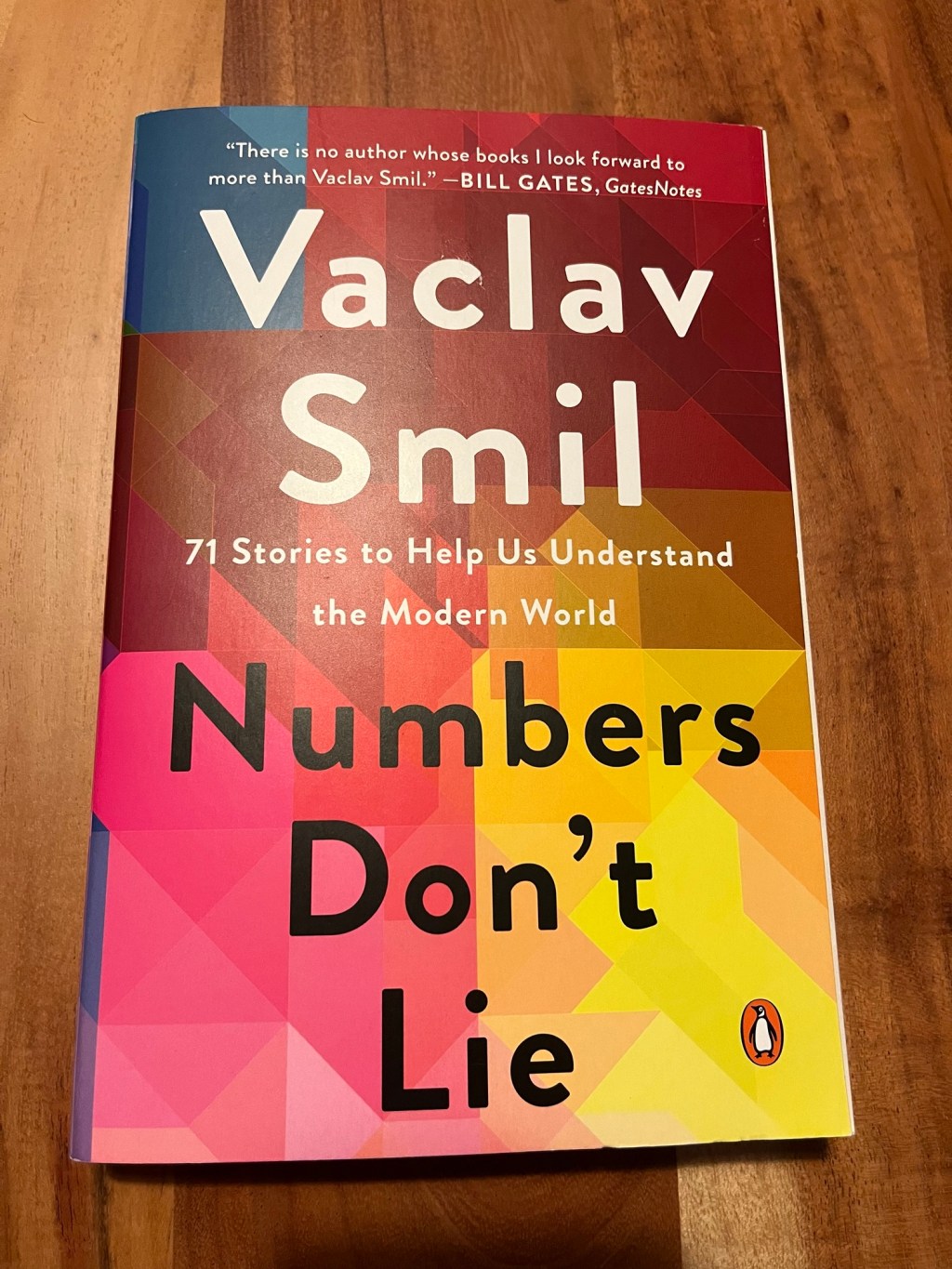
Finished: August 8, 2024
Why I read this
It has been almost two years now since I read my first book by Vaclav Smil on the suggestion of a colleague. It was How the World Really Works, and I remember devouring it in just a couple of days. His no nonsense insights into the real drivers of human society and the vast implications of changing our massive systems were hugely revealing and entertaining. No other publication I’ve interacted with has ever truly put meaningful numbers with objectives such as “net zero by 2050” in a way that Smil managed to do in this book. With that being said, I was eager to read more on the subject and see what other interesting insights of observations Smil might have made in this earlier work.
What I learned
I’m glad to have waited a few days to digest this book to begin working on the review. In a first reflection, the 71 different subjects covered in the book felt like a lot, quite possibly too much. These approximately 4 page stories often revolved around one key system or number such as what really goes into global happiness rankings, or what a rising or falling population number will likely mean for the future economics of a country. And to make matters even worse, these 71 chapters were broken down into 7 sections covering the wide variety of subjects counted in, People, Countries, Machines Designs and Devices, Fuels and Electricity, Transportation, Food, and the Environment. I’m not sure about you, but to me that is an ambitious array of subjects to discuss in a 5-6 hour read. However, the more I’ve thought about the book since reading it, the more I realized that a surprising amount of the information I read in it has stuck with me. I feel more equipped to handle discussions on broad topics, and can already see more and more problems in some buzzwords media subjects when looking at the news. Just like How the World Really Works, Numbers Don’t Lie gives its readers a broad, yet scientifically backed understand of the realities associated with the major systems of human society.
Over the past few days I’ve also noticed that related to many subjects I’ve a fact now ready to launch. I’ve got to be careful to not come across as annoying as A.J. Jacobs noticed he became in The Know It All where he reads the entire encyclopedia and is all of a sudden inundated with factoids to share in any context. And really, they are extremely interesting facts. For example the revealing of the world happiness ratings that we all know are dominated every year by the Nordic countries are actually really closely ranked when you see the real figures (the US in position 19 at the time of writing is only 13% lower with 6.982 than Finland in position 1 with a score of 7.769) and the grading rubric has several high margin of error or questionable methods of judging the elusive “happiness” such as a heavy weighting of GDP per capita, or a comparison of generosity or perception of corruption. Considering these things the desire to up and move to Sweden or Denmark diminishes quite a bit.
There are also several things that are observations that could help us to immediately to solve some of the worlds problems, such as where to focus our efforts. The most stark of these solutions being the humble window. Smil shows that in many developed countries the total primary energy usage of buildings is about 40% of the total. Half of which is for residential heating and cooling, so a whopping 20% of total energy usage in developed countries! To combat this effectively and efficiently simply changing single paned windows for double or triple would immediately have a material reduction in our entire global energy consumption. This doesn’t require buying expensive new cars, or modifying the energy grid, and is something everyone can do quickly. Compared to the total energy mix, where we reduced the total percentage of primary energy production produced with fossil fuels from 86.6% in 1992 to 85.1% in 2017 (only a 1.5% reduction in 25 years), we could reduce our energy consumption by 5-10% in a matter of a few years with more efficient windows. It’s these types of no nonsense observations that help us to focus on where can make a difference now, tomorrow, not in 20 years, for relatively little cost that I feel add the huge value to the research and work from those like Smil.
Beyond the deep observations of the book there is also the underlying theme of the representation of numbers. Far too often we are exposed to numbers that are supposed to mean something significant, but regularly hide many of the key points. Without explanations numbers can often tell the wrong story, or leave out so much important information that they can be near meaningless. Looking at my news page on my laptop I see references to polling numbers, price predictions for stock or cryptocurrency, Olympic medal counts, and many more figures that without proper background information can be construed in many different ways. Polling numbers can be estimated in dramatically different ways, from different populations, and in different states. Stock of cryptocurrency predictions are notoriously unreliable and founded on a variety of stats and information sources. Olympic medal counts as well don’t correct for population, or geopolitical situations such as Russia’s absence due to the invasion of Ukraine. It just goes to show that numbers may not lie, but they can definitely be construed in a purposeful way.
One such way I felt Smil did this in this book was his discussion on American Excellence. He argued that there are no empirical measures of what could be so called “American Excellence”. The US rates relatively lowly in most key metrics such as infant mortality, life expectancy, inequality (racial and social), reading and math scores, and a slew of other factors (usually the US is found somewhere between 10 and 30 on a list of developed countries for these types of figures). So Smil asks where is this excellence if there are no metrics to show that the US is exceptional? I think this is where the numbers may not lie, but they tell the story that Smil wants to tell. When looking at a total population the US doesn’t necessarily perform well (usually against European populations with a much smaller and more heterogeneous population), but that does not mean it does not have excellence. What would happen if you were to count all of the same measures for the top 10, 20, or even 50% of income earners in each country? I’m willing to bet the US would perform a lot better. It’s from this population that revolutions in modern technology, education, and health come from. Further, there was no mention of the less technical parts of society where excellence exists in the US, but cannot be empirically measured. The cultural power of film and television being a major one, or the propagation of US franchises globally (Krispy Kreme is doing surprisingly well in France). What about the publications coming from US universities? What about our global dominance in sports (winning the most medals in the last 8 consecutive summer Olympics)? The definition of excellence here should at least be re-evaluated, but ultimately, the problem is that the US has relatively high inequality, and should be rightfully criticized for the way that citizens on the poorer end of the spectrum are taken care of. It is my opinion that the US has both excellent successes and unacceptable failures, but I believe it is an unjust analysis to show the US average rankings and to argue that there is no excellence in the country. It is especially egregious being presented this way without presenting all of the facts and caveats associated with making broad comparisons such as this one.
What I didn’t like
From how much I enjoyed the first read from Smil, I was a bit disappointed with the conclusions in this one. It wasn’t that the information wasn’t revealing or interesting, it was just that the conclusions felt a bit shallow and all over the place. When you put 71 stories in 300 pages you can’t go very deeply, as opposed to How the World Really Works where many of the same facts are presented, but each to an end, a purpose, a complete chapter and thought that is fully developed and discussed with all the analysis to confirm or deny its hypotheses. In the end, Numbers Don’t Lie felt almost like the notes and research made as a first draft for the later How the World Really Works, so obviously reading the two in the reverse order makes the value of the first vastly diminished.
The amount of repeat information also just comes across as a bit of a waste, for example in Numbers Don’t Lie there are about 4 pages on the reason kerosene will remain the main fuel for aviation transportation for the foreseeable future, while in How the World Really Works there is an entire chapter discussing the pros and cons of kerosene vs. other fuels. Obviously the two are going to have a lot of overlap, but why write two separate sections on the same subject like that at all?
Questions I asked
How can the pure facts of our enormous systems be paired with optimism to actually achieve some of these goals?
Who is the target audience of this book for? How are regular people supposed to do anything with such daunting information?
Why is this information not standard learning for younger people? Do you need the experience associated with adulthood to grasp the value of these observations?
My Favorite Quote
“The Outcome was decided by US technical superiority even before it started.”
Vaclav Smil (in discussing the US vs USSR Space Race)
Books I liked like this one
How the World Really Works : Vaclav Smil (for a complete perspective of the systems that drive the world)
Thinking Fast and Slow : Daniel Kahneman (for beautifully paired scientific observations with human nature)

 Book Reviews for Mom