
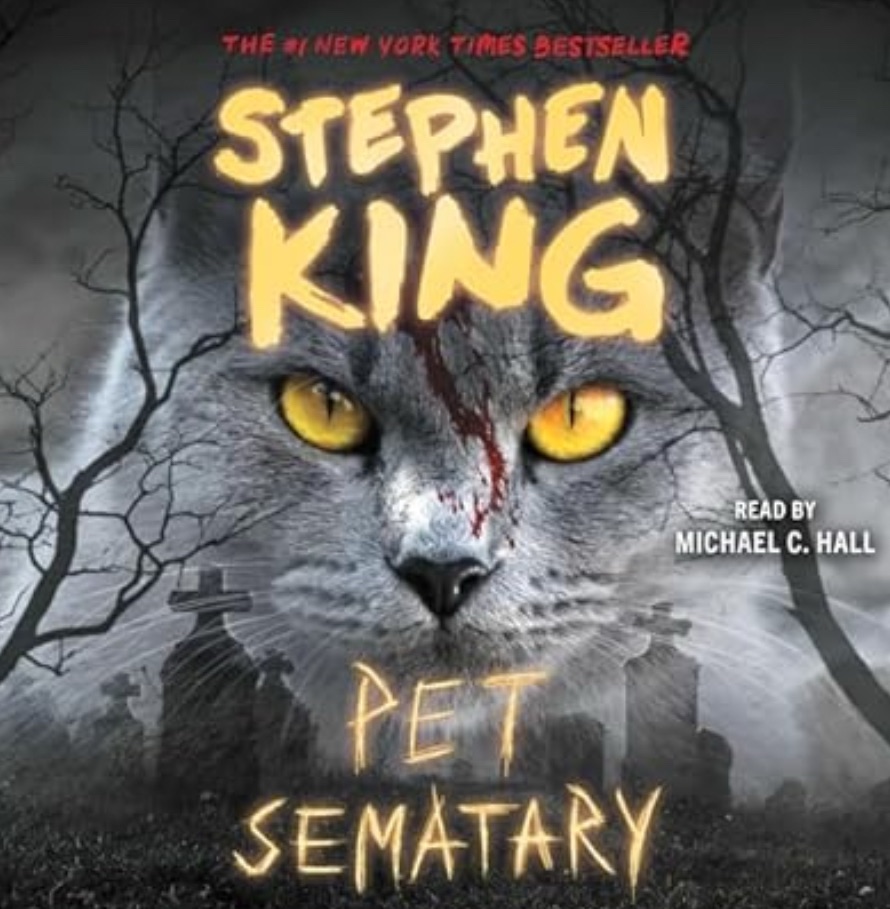
Finished: December 11, 2024
Why I read this
I’m posting this article far later than I should be, but sometimes life just gets busy and you have to play catch-up. Buying a home, moving, and handling all of the other end of the year to-do’s around the holidays had me feeling like the blog was a bit too much to keep track of. Now that things are a bit calmer, I wanted to revisit my most recent King experience.
Going into this, I expected great things. It is THE Pet Sematary after all. Whenever I tell someone I like King books this is the one they always talk about, that and The Shining. It has been one that has been on my list for ages, but the idea of an undead cat never really appealed to me. Finally, since I had an excess of audible credits I decided it was time to see if this King classic was great like Misery or just acceptable like Cujo.
What I learned
Louis Creed is a generalist doctor that moves to small town Maine to be the doctor at the University of Maine student center. He has a wonderful life, a loving family, two gorgeous kids, a satisfying career, pretty much everything you could ask for. The only problem is that he fell into the classic pitfall of buying a home near or on an old Native American burial ground. Everything that you can expect to happen, of course does, and the narrative follows the uncomfortable but predictable routes King does well. Human depravity with a slight twinge of supernatural, and you arrive at a compelling and satisfying book, although one that ends up feeling a bit more like a beach read than higher literature like some of his other pieces that I prefer (like The Stand or Misery).
Despite the more shallow storyline, there were a few points about how the characters acted that really stuck out to me. One was how Creed and his wife would have disagreements. There was one scene where Louis’ wife (Rachel) was (from the reader’s, and coincidentally Louis’ perspective) a little irrational about the subject of death. It is never a subject people love to talk about, but it is unfortunately one that comes up regularly in a normal human existence. People can avoid the subject, but to have a true aversion, or phobia of the subject is a bit more rare. Rachel here did not want to discuss the subject in the slightest, and Louis’ insistence one time instigated a huge fight that felt excessive and irrational. Later it is revealed some of the child-hood trauma Rachel experienced related to death and the aversion becomes significantly more understandable. This comes into play with most people where there are always going to be certain subjects that they cannot support. Our friends, our family, our partners, our colleagues, all of them will have those trigger points on subjects that to us will make no sense. “How on Earth could someone get so upset over that?” we might say to ourselves after an argument, yet without the whole story we will never be able to answer that. It’s like in How to Win Friends and Influence People when Dale Carnegie references a quote that goes something like “we should always understand people, because they are just what we would be if we had lived all of their experiences.”
Another, more entertaining note I wondered about related to this book was how a legal system would be able to handle a situation like what happens in Pet Sematary. If someone if killed by a ghost, ghoul, or phantom, who would be at fault? Could you be convicted of second degree murder for having summoned this paranormal creature? How might these subjects be handled in fantasy worlds (where the subject of law is rarely elaborated on)? Obviously it is quite the rabbit whole to go down, one which will never have an answer, but I amused myself throughout the book thinking about how the surviving characters might end up facing legal consequences.
A final note I had on the book was that it was strange to see how there was a vague sexism throughout the book. It was pretty stereotypical to have the man as the doctor and the woman as the stay at home mom, which doesn’t bother me much, but throughout there were several references that struck a bit of a chord and made me just a bit uncomfortable. Jud, Louis’ elderly neighbor says regularly that “the soil of a man’s heart is stonier; a man grows what he can and tends it”. Several times Rachel is displayed as irrational or excessively emotional (such as having a break-down and being completely dysfunctional at a funeral). And finally, none of the female characters play more than a supporting role in the story. It wasn’t something that ruined the story, it is just interesting to see how much further we have come, and to wonder how this book may have been received if it had been released today instead of 40 years ago.
What I didn’t like
I think what bothered me the most about this book was the pacing. I felt like the first few chapters went exceptionally well and everything was excellently done. We are introduced to main characters, we learn slowly, but effectively about magical forces surrounding the small town and specifically the animal graveyard, and there are several exceptionally terrifying scenes, such as the death of a student who is hit by a car and his final words to Lewis Creed, that very successfully gave me chills. However, as the book passes it’s first third it starts to drag. The reader has a pretty good idea of where things are going to go with some of the heavy foreshadowing done at the onset of the book, yet the climax never seems to come. Instead of moving forward to the horrible and inevitable conclusion of the book, King totters around the subject until close to the very end. He even adds a rather large section to discuss what might have happened if certain events had gone differently. This, extended “what if?” added little in my opinion to the book and just served as a further delay of the focal point of the story. Then finally, the reader is given the typical stygian horrors we are waiting for, but it all wraps so quickly that the reader can’t help but to ask, “that’s it?”
Questions I asked
If supernatural events were ever to really happen and were 100% undeniable, how would they be handled by the legal system?
If you touch on the trigger point of someone without meaning to, what responsibility do you have for that?
When books have a certain perspective on society that feels backwards in modern context, can we fault the authors for having this perspective when they wrote it?
My Favorite Quote
“He talked, but never rambled”
Louis Creed
Books I liked like this one
Salem’s Lot : Stephen King (for being King’s first novel and one of my favorites)
Lord of the Flies : William Golding (for a predictable but satisfying story)

 Book Reviews for Mom