
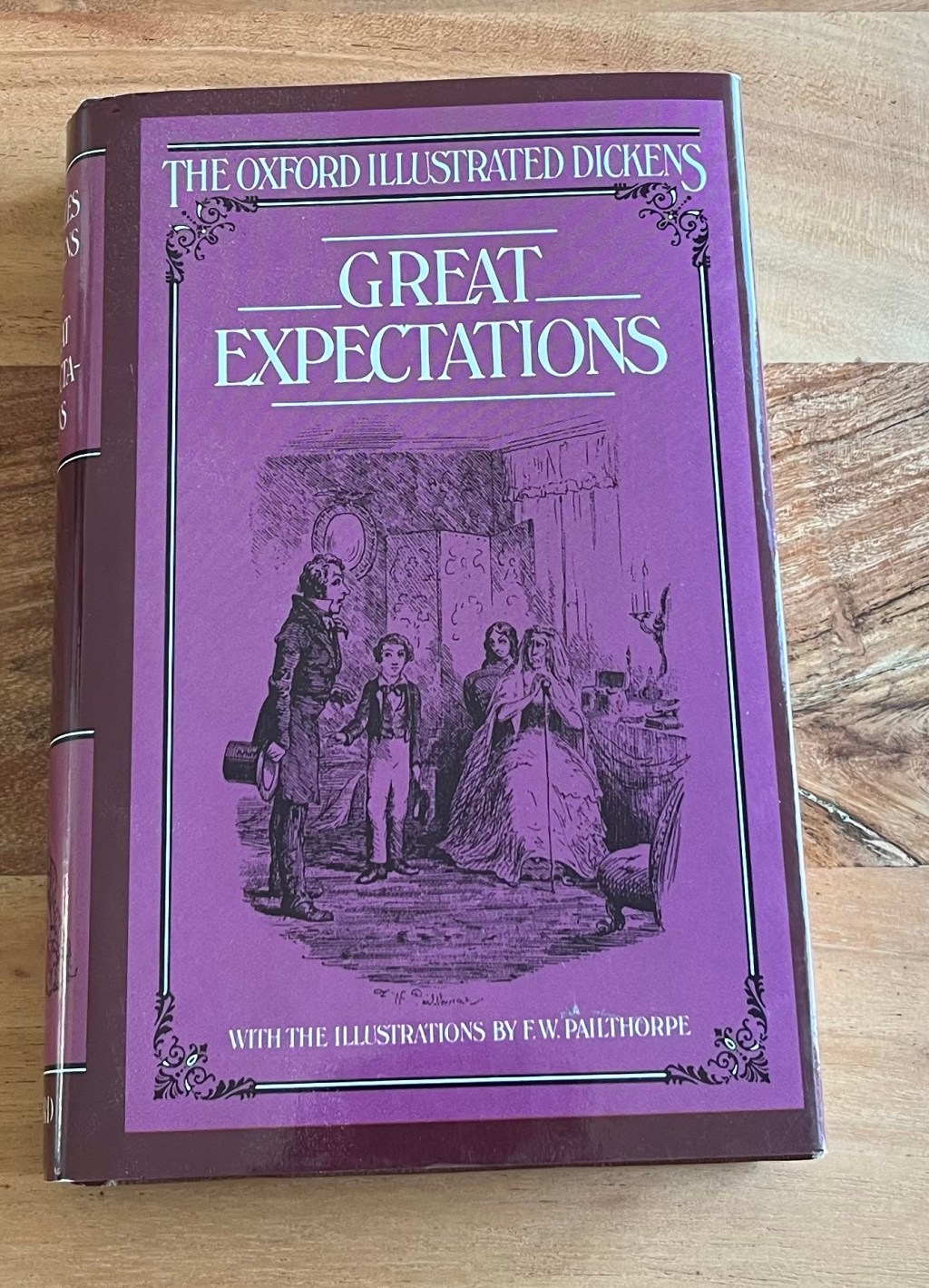
Finished: February 18, 2025
Why I read this
I recently read an article making the point that young men don’t read anymore, and when they do, it’s rarely fiction. It’s part of this hustle, productivity, start-up culture that praises the workaholic and lifelong learner while dismissing hobbies and relaxation. This was an article where I saw myself on the negative side of the argument. Where I too read often psychology, or self-improvement, or sociology and I’ve drifted further away from frequent fiction reading. Yet a part of me said that these are the books when I learn the most. Fiction is great, but it’s a pastime, not a serious activity. I was glad that I decided to plunge back into some classic fiction with Great Expectations to allow Dickens to come along and correct that thought.
What I learned
Despite the fact that this book is so common in school assignments and popular culture, I realized even as I started to read it that I didn’t know anything about the plot. The vague title of Great Expectations doesn’t help much and it’s not a story people often talk about beyond a groan about how long it was when they read it in seventh grade. Moreover, I got a copy with a removeable sleeve where all the details on the book were printed inside, and since I took this sleeve off to carry it around more easily I never ended up glancing at the summary. So I managed to attack this classic without any hints about what was to come in the story, something that I think happens rather rarely today with so much instant communication and sharing found on the internet. It was only about 50 pages in that I began to realise the relationship of the title with the story line. Only then did I put it together that it was not about the main definition of the word “expectations” meaning anticipation, but instead meaning prospects for inheritance. So this was the story of poor Pip and the changes in his life as he is unexpectedly thrust into a path with such “great expectations”.
From the beginning, I was shocked to see how well Dickens captured human nature. His ability to manipulate the English language to make the provincial accents come across through prose was already impressive, but beyond that, his characters were remarkably human. How observant Dickens must have been in his life to be able to come up with such realistic characters from all walks of life. Today we can read books on psychology and sociology and come away with many facts and figures about how most humans will act in most situations. We have tests and experiments to back up these details, yet Dickens had nothing but personal experience, and yet he created characters that are relatable and believable. Take old Pumblechook who appears to be a stingy and self-centered character, but the moment his tastes are praised by a stranger he becomes generous beyond belief with his expensive wine and port. It reminded me instantly of advice about giving praise from How to Win Friends and Influence People. That, among many other observations, and Dickens did all of this through a 1800’s life. On top of it all, it’s incredible that much of the commentary is just as relevant as ever a couple hundred years later.
Another theme of the book that I found extremely pertinent was Dickens’ observations on the relationships between those who are ignorant (or poor) and those who are educated (or rich) and how those relationships are intertwined with those who are kind and those who are intolerant. The way in which wealth and education can often change a person for the worse, making them arrogant and ungrateful, displayed the almost universal pursuits of wealth and education as unworthy and full of hubris. It was a subject I found touching knowing that I too have made large changes in my life in moving to Europe, and have adopted a different view of the world since. Have what I considered to be personal growths actually added to a prideful and condescending character? Have my views towards my mechanic or farmer friends, who in each their own ways have an education and character that far surpasses my own, changed like Pip’s lowered tolerance of his illiterate but morally infallible blacksmith guardian when he was exposed to what was considered “higher culture”?
Furthermore, I appreciated the depth at which Dickens addressed such simple themes as right and wrong. Going from the childish, yet profound perception of Pip after stealing from his family (for a good cause) where he reflects that “in a word, I had been too cowardly to do what I knew to be right, as I had been too cowardly to avoid doing what I knew to be wrong.” and arriving at the infinitely relevant, if grammatically incorrect wisdom of our caring Joe Gargery, who stated that “if you can’t get to be oncommon through going straight, you’ll never get to do it through going crooked.” Even as Pip progressed into his adult life, all of the characters he met were mostly gray, never black or white. Matthew, a kind and educated fellow who tolerated his unbearable family, Miss Havisham who despite her cruel exterior acted on several instances with extreme generosity, and even Pip’s own benefactor, who upon being revealed displays an unconventional and polarising mixture of virtue and vice, one that initially revolts Pip, but through common trials he comes to understand and appreciate. It was a wonderful moral of the book to see that most people, in almost any situation in life, can be considered to be good through a certain perspective.
A final note I wanted to share was that reading this I understood for the first time how people can consider Dickens to be funny. I remember watching Murder on the Orient Express and thinking how silly it was that the main character kept laughing while reading Dickens, but honestly this time (my other reference for Dickens is Tale of Two Cities, which is glum at best) I caught many of his plays on words or ridiculous descriptions that perfectly displayed a situation with hyperbole and irony and I really got amazing by truly masterful wordplay can be.
What I didn’t like
It may be a problem with me, or it may be a problem with the writing, but I found that often it was hard to follow some of the long and heavy winded paragraphs. The sentences that would just drag on and on with allusions and allegories and metaphors galore constantly masking the true meaning of the phrase. Sometimes it could be exceedingly clever, but other times it made the text drag, making it heavy and hard to understand. On the one hand, Dickens masters the English language and on the other he uses excessively complicated language making his work significantly less accessible.
A second, and more serious criticism I had for the book was its ending. I won’t spoil it, but I was rather disappointed with just the final few pages. The whole story was perfectly full circle, touching on a number of serious and moral themes, yet at the end Dickens chose to continue three pages longer than he should have just to add in a coincidental and unnecessary conclusion with characters that no longer mattered to the plot. The lessons Pip had learned were then weakened because of it. He was taught through incredibly hard lessons about the futile pursuit of things that are out of reach, and for a third of the book there was nothing more said of these pursuits. Yet at the very last moment without any further explanation, Dickens indulges our main character with his fairy tale ending, in my opinion weakening the values of the story. I much preferred a good and realistic ending to the presented, unrealistic happily ever after.
Questions I asked
How did Dickens learn so much about human nature?
Do women relate as much to coming of age stories (of which there are many classic examples) where the protagonist is a male?
Why include an alternative ending?
My Favorite Quote
“That was a memorable day to me, for it made great changes in me. But it is the same with any life. Imagine one selected day struck out of it, and think how different its course would have been. Pause you who read this, and think of the long chain of iron or gold, of thorns or flowers, that would never have bound you, but for the formation of the first link on one memorable day.”
Pip
Books I liked like this one
Tale of Two Cities : Charles Dickens (for a similarly gripping story from another time)
Pride and Prejudice : Jane Austen (for strong moral values hidden in a drama)

 Book Reviews for Mom