
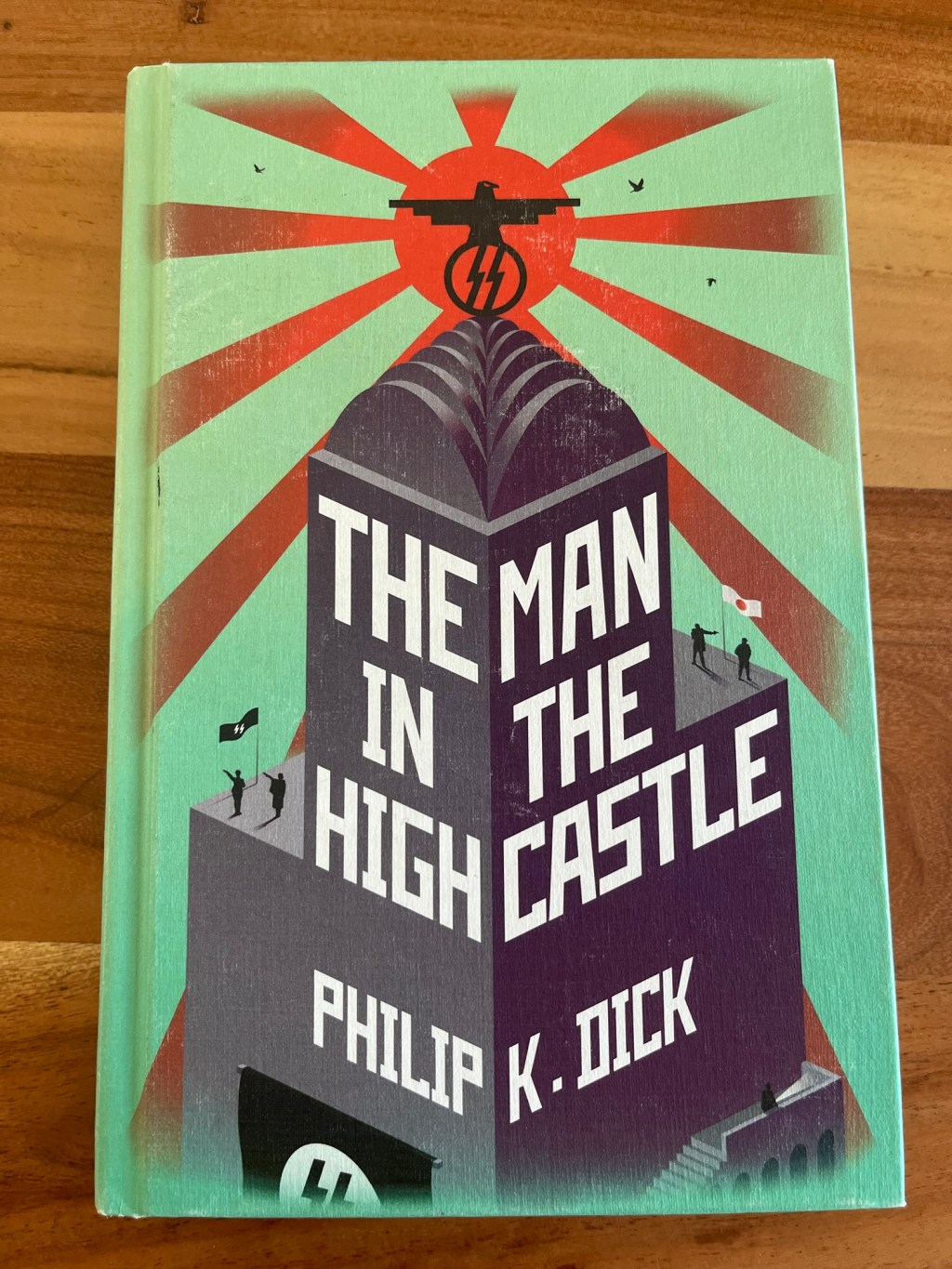
Finished: February 25, 2025
Why I read this
Every now and then I like to google what are the most well known books of all time, and often with a specific focus on Science Fiction. Although Do Androids Dream of Electric Sheep is Philip K Dick’s crowning achievement, The Man in the High Castle is never far behind on the lists. Combine this with our rather uncertain geopolitics of today, the question of “what if they had won”? becomes altogether more enticing. With the rumblings of America’s first steps towards a fascist state, or at least an oligarchy, it was an easy decision to dive into a study of what might have happened if the world’s most famous fascist state had not been defeated.
What I learned
Dick slowly introduces us to his alternate reality in which the Axis Powers won the Second World War, by introducing each character to represent another faction. We have the Japanese C-Suite businessman (Tagomi), we have the successful American entrepreneur (Childan) who has adapted to life under the Japanese, we have the American working man and his wife (Frank and Juliana Frink), and finally we have our disillusioned German aristocrat (Baynes). All of these independent stories together begin by feeling extremely disjointed. As if nothing is happening at all in the plot development. The first 50 pages we have “exciting” events such as Togami searching for a gift for a business partner, we have Frank Frink quitting his job making knock-off historical artifacts, we have Juliana Frink meeting an Italian immigrant. Nothing overtly exciting happens, yet I felt myself being dragged deeper into the world and the pages began to turn faster.
As the book rolled onwards the pieces began to slowly come together so that you could see the whole. Each individual story weaved together into a compilation significantly more impactful than any individual part. All returning to the idea that another reality existed in which America had won the war, and in which things were better for those inhabitants. That this alternative was so strong that it could transverse boundaries of space and time to impact those few sensitive enough to see the “truth”. Each event put into this context becoming meaningful. Childan growing to accept that his products of the past were no longer of value and plunging headfirst into support of new American products, or Juliana’s encounter with a famous author. All tie back together to a patriotic representation of the insuppressible American spirit.
Yet this beautiful conclusion focused on many themes that were from an American perspective. The bias was exceedingly clear as the values of the Japanese and the Germans were presented always with neutral or negative adjectives, never with a twist towards to positive. Even such excellent accomplishments such as travel to the moon or Mars by the Germans were always presented as unimportant or wasteful uses of manpower. The ideas that American ingenuity and spirit would shine through even the toughest regimes, or that had America won the war that all the science and projects and objectives of the country would have been positive. It forgets all the negatives that came from America’s victories. It forgets the oppression of Central and Southern America by the US, it forgets the segregation of the South (that was still in place at the time this book was released). It forgets the terrors of the Korean, and Vietnam wars. Taken with a longer view of history that what was available to Dick, it misses the increasing division in the American state and the potential for downfall within it. It’s true that for the American people immediately following the Second World War, being independent probably was better for them. But to put such emphasis on the correctness of the American ideal and American spirit goes to far in saying that our system, and our values, are the only right ones. That the other participants in history are the villains while America the heroes. I wonder how this book might have read if in the 1960’s it had been written by one of the members of Eastern block Germany, or Japan? Would they have also dreamed that their ideals and values had created a world more worthy of being lived in? Or is it possible they would have seen their actions as evil? Accepted the flaws of their people and mourned the loss of the allies in the war just as the Americans would have?
Moreover, a specific theme that I wanted to explore was that one character mentioned to the conquered Americans that they would have done the same as the Nazis had they been in the same situation. It goes back to an idea in How to Win Friends and Influence People that we should never be impatient with people because they act just as we would if we had lived their lives. But here Dick evokes this point on a much more serious level. It’s one thing to say that we would have a certain perspective, or feel a certain way towards various subjects based on our upbringing, it is however, a very different thing to say that we would have participated in genocide because we were raised in Nazi Germany. Although modern physics theorizes that the clockwork universe (an idea where everything happens purely based on the properties of physics as a chain reaction from the start of the universe and therefore nothing is changeable and free will does not exist) is not possible based on “truly” random particles, I’ve continued to wonder if this true randomness is just something we don’t yet understand. That if, with a future understanding of quantum mechanics we just might realize that yes, the clockwork universe is real, and that we cannot avoid who we are or what we are going to do. In this case, those committing even genocides cannot be truly held accountable for their actions, while at the same time those who react with outrage and hatred towards these murderers cannot be held accountable for their own. Even I, writing this article asking these questions cannot be held accountable for my own opinion because in a universe governed by pure laws, there is no opinion, just action and reaction.
Finally, I have a huge respect for Philip K Dick who managed to stop after writing such successful fiction. The world he introduced in this book could easily have spawned several continuations or side stories building on the same themes and setting. Instead he chose to leave the story and the world for the readers future interpretation. It shows his abilities as a writer to be able to change between topics and settings and maintain such a high quality and acclaim. Rarely these days does it feel like authors or writers want to test new ideas or search for new subjects. Most everything released is a sequel, or a prequel, or a new timeline in a familiar storyline. Even some of my favorites like Stephen King, rest often in the comfort zone with keys and points linked back to characters, places, or stories which he has already written or explored. Other famous writers, often for fantasy, create on in depth world in their life and simply produce content for that single line. Orson Scott Card with his Ender’s Game, Tolkien with his Middle Earth, George R.R. Martin with his Westeros, Frank and Brian Herbert with Dune, the list goes on. As much as I wanted to know more after closing the cover on this one, I was satisfied that for once, someone stopped at enough.
What I didn’t like
My biggest complaint for this read was the timing. Everything that happens felt realistic and possible, but the timing was off. Everything was based 15ish years after the end of the Second World War, yet things seemed to have advanced far too quickly. The idea that the Germans could be on the moon or on Mars even within 15 years, when it took the US 20 to even land on the moon and we still haven’t reached Mars, stretches the narrative too far and weakens the point that there would have been a focus on technology above humanity.
Questions I asked
Why is Nazi Germany so linked to rapidly advancing technology? Were they really that advanced?
Often it’s said we act just as anyone with our circumstances would act, is that true even for monstrous actions like the Nazis committed?
Why is it that authors can ignore grammar, and often even be applauded for it, but in our every day lives we are strictly governed (and judged) by our adherence to grammar rules?
My Favorite Quote
“Its idealism that makes him that bitter. Asking too much out of life. Always moving on, restless and griped.”
Juliana Fink
Books I liked like this one
Brave New World : Aldous Huxley (for a scientifically advanced future where people accept certain atrociously inhuman aspects of society)
Do Androids Dream of Electric Sheep : Philip K Dick (for a similar barren writing that leaves much of the interpretation to the reader)

 Book Reviews for Mom