
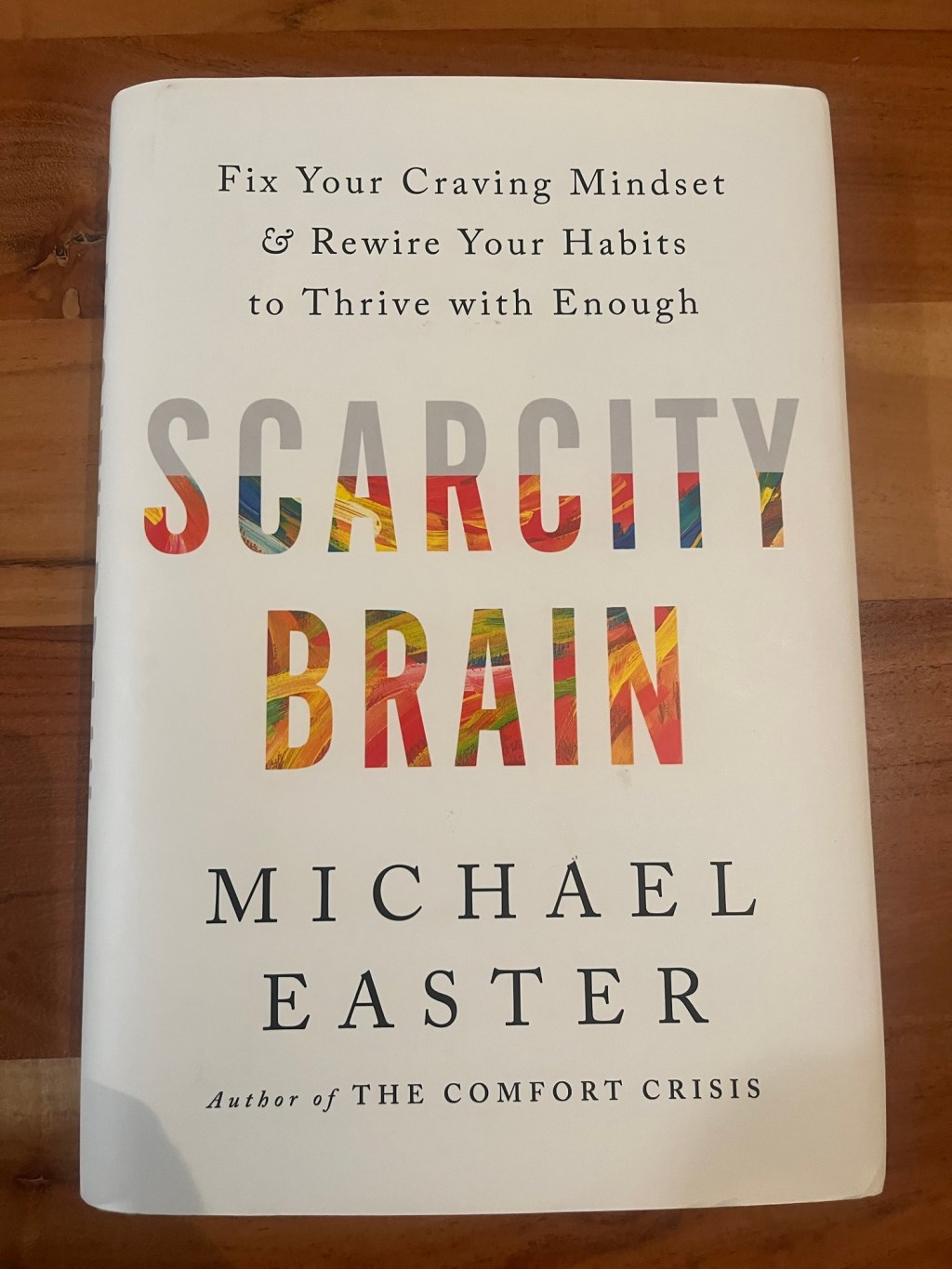
Finished (first half): March 16, 2025
Why I read this
There was a discussion in Utopia for Realists by Rutger Bregman where they discussed the idea of mental resources and the limitations of our brain which I absolutely loved. Bregman described how the brain can become overwhelmed with too much information, or stress, and that once overwhelmed (often by simple, but important, things like stressing about money) it will slow down like a computer that’s got too many things saved on it. The fact that has stuck with me from that read was a study that showed very poor people who have little financial security spend so much mental energy on these money problems that they can end up with IQ’s reduced to the level of someone who hasn’t slept in 30 hours, or is significantly inebriated and when given money, their intelligence will immediately skyrocket. It appealed so much to me that I noted it to dive into further as soon as I got a chance, and seeing the title Scarcity Brain I had to pick it up and dig right in.
Also note that here I’m going to break up a book review for the first time. Even though this isn’t a long book I wasn’t able to finish it within a weeks time, however I’d like to continue writing and posting each week. So instead of letting reading and this blog become a homework assignment I’ve decided to slow down on reading and simply reflect on what I have succeeded in reading the last week. This will be nice to tackle some of those larger books on my shelf without feeling like I’m falling behind on my goals.
What I learned
Very quickly into this read I understood that the topic of the book was not what I thought it was. I was hoping for a psychology lesson about how the brain reacts to a lack of resources, and what I got instead was journalism with a large amount of anecdotal life lessons.
Basically, Easter’s idea is that humans respond extremely strongly to what he describes as the scarcity loop. The loop is defined as having Opportunity -> Unpredictable Rewards -> Easy Reproducibility. He goes on to claim that many of the negative urges in our lives can be linked back to this cycle, which historically served as a mechanism for encouraging humans to brave long and uncertain trials in order to find food, shelter, or other rewards. Now that we live in a world of abundance (an undeniable fact when compared to the prehistoric Earth), this cerebral mechanism can often serve to manipulate us more than it helps. He cites gambling, social media, email, shopping, personal finance, television, and even health as areas of our lives where this loop has been weaponized by corporations and can cause us to spiral into undesirable outcomes and negative habits. Each chapter goes on to discuss some of the more serious areas where recognizing this scarcity loop and our reactions to it might allow us to better control our lizard brains and live more fulfilling lives.
I’ll be honest and say that so far this is not one of my favorites. I appreciate the journalism of Malcolm Gladwell more, the habit analysis of Atomic Habits I found more clear and concrete, and the motivation from Adam Grant’s Hidden Potential more inspiring. But, as with all books like this, I have found several parts so far to be extremely pertinent and if working to incorporate just a couple of these nuggets of information into our lives can provide a bit more satisfaction, I think the 10 hour read is still justified. With that said, here the first couple of ideas that I really liked in the first half of Scarcity Brain.
In the opening chapters there was already a few interesting ideas, but one that stuck out was that we, as humans, seem to heavily overlook subtraction as a method of solving problems. Easter comes to this point with a story about an engineering professor playing legos with his son, and when they make a bridge together that is uneven (one side is higher than the other) the professor’s first reaction is to add legos to raise the lower side, but his son’s first reaction was to remove some from the higher side. Being bested by a three year old this professor went on to perform several experiments where almost all of the participants systematically chose to add materials, time, processes, etc. to solve problems and ignored more simple and elegant solutions which involved subtraction. In my world of energy systems, this hit close to home. How might we be overdoing things and adding additional barriers to the systems we design which are consuming additional resources, time, and energy, that are ultimately making our projects and objectives harder to achieve? Where might I work on subtracting things from our processes to improve our functioning?
A second observation I’ve had is that there are many repeated themes from other recent literature. It makes me wonder how much we are secretly being influenced all together by popular reading to all believe the same concepts and ideas. For example I recognized ideas from The Tipping Point about how many people can be in a productive organization (150 max), or that context is extremely important (for example American GI’s returning from Vietnam had almost all been addicted to heroin in the jungles, but back home in America almost all of them got clean). I remembered a discussion on biases from Thinking Fast and Slow. Easter even makes what feels like a direct quote from Drift Into Failure when he says that “In everyday life, we must make big and small decisions based on imperfect information.” Even the discussion on our modern addiction to food (for which I found the application of the idea of scarcity brain a bit of a stretch) brings me back to a discussion of diet and risk from How the World Really Works where a comparison of vastly different Spanish and Japanese diets reveals very little difference in longevity. I can’t help but wonder if we are all moving towards a uniform way of thinking, having all of the same references, and having no time, or mental space, to accept new ideas in the future.
I’ve got several other notes that I wanted to discuss further, but being the first time doing a split review, I’ll do my best to save them for next week!
What I didn’t like
Although I have yet to finish the book, I’ve got two major complaints.
The first, and more serious, is that the supporting science is not there. The way it is written makes the book feel a bit like what you might read from Malcolm Gladwell (so I should love it right?), but the fact that there are no notes at the end of the book, or concrete references makes it feel a bit cheaper, as if it is simply fast non-fiction instead of a seriously considered idea. That the author was building on his previous book The Comfort Crisis, (which I haven’t read, but have heard good things about), and quickly produced a second theory to capitalize on his previous success (note that he released it only two years after his first book).
The second complaint is the transitional writing. The parts where he discusses science or has interviews with experts in several fields are compelling and justified, but some of the transitions are just horrendous. One of his interviews happens over breakfast at a café, and in this moment he manages to describe a croissant as both “expansive”, and as a “multiverse of calories”. I understand the desire to add a bit of humanity in between the more technical sections, but some of these end up more as cringy than endearing.
Questions I asked
What is “enough” for me? Success in work, personal health, wealth, travel, friends? How do you define “enough”?
Are best sellers on non fiction titles causing significant changes to our biases and knowledge?
Has my blog, and my focus on reading to produce something later, made my reading better or worse?
My Favorite Quote
“The much harder but more effective way is to actually go out into the world and do great things. And then status arises naturally.”
Michael Easter
Books I liked like this one
Revenge of the Tipping Point : Malcolm Gladwell (for anecdotal, yet convincing arguments about how society functions)
Hidden Potential: Adam Grant (for journalistic writing with several immediately applicable life lessons)

 Book Reviews for Mom