
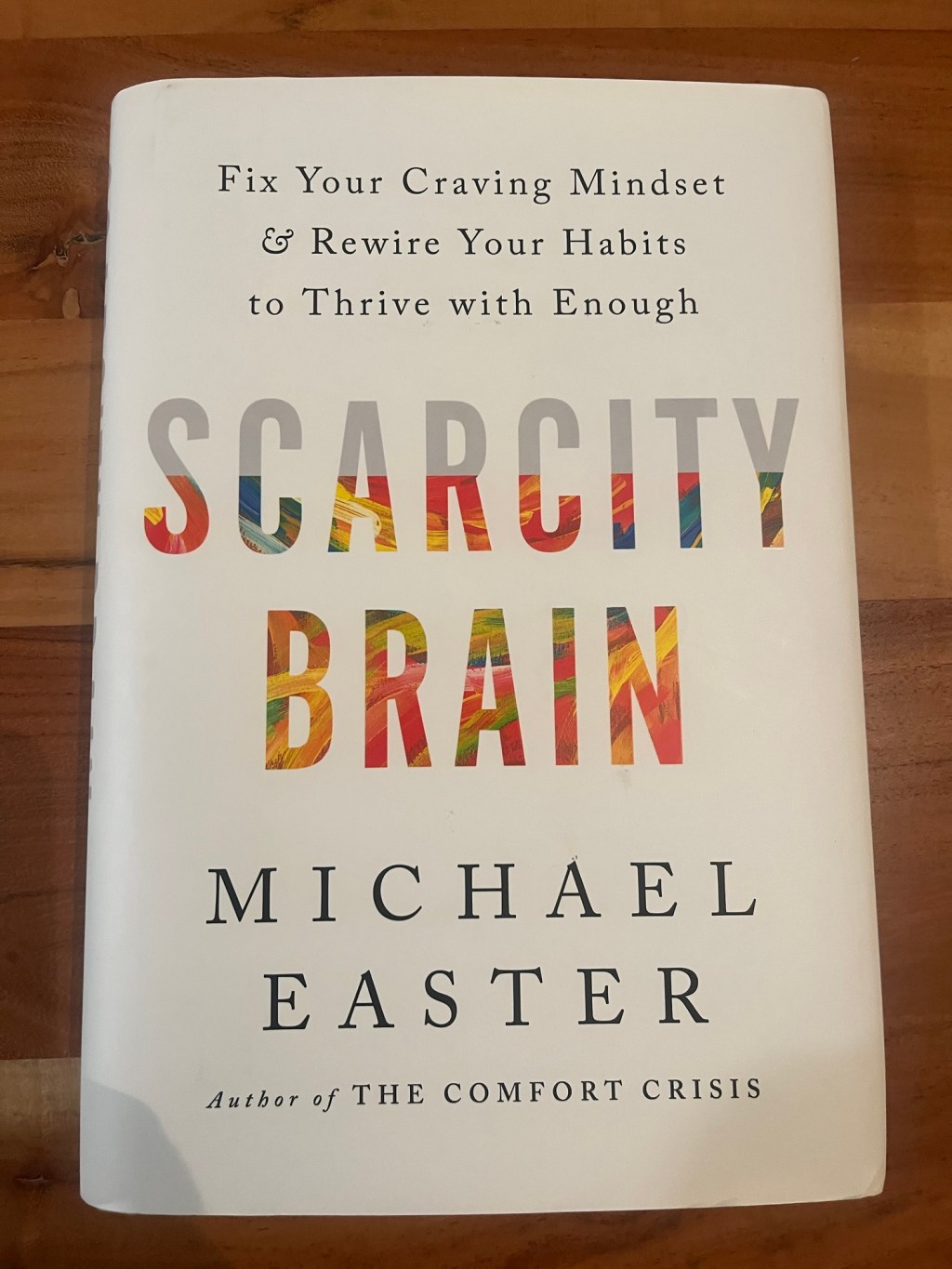
Finished: March 18, 2025
Why I read this
As I continued to read this I realized it was not the book that I thought it was, but maybe it was a book I should be reading anyways. I, like most people, have my own excessive ambitions when it comes to many of the subjects discussed in this book. Whether it was food (I have a huge challenge these days trying to eat healthier when I’m surrounded by amazing food in France), influence (at work I’m constantly thinking of what might get me ahead), stuff (whenever we walk the streets in Paris I find myself longing for new things, even though I already have more than I need), or happiness (which we are all searching for one place or another) I was always able to see where my life intersected the ideas in the book. It was nice to see that these are areas where everyone struggles to find balance and not just me.
What I learned
The first half of the book explained how this scarcity loop affects us, but the second half focused on several more specific sections I’ve already mentioned, food, stuff, influence, information, and happiness which represent areas in which humanity used to have relatively little (hence the need for the scarcity loop). Now in our modern world we have nearly unlimited access to Chinese made goods, calorie dense junk food, and an endless supply of information from the internet. So now our evolutionary loop works against us at every turn. It’s an easy explanation for why we are the way we are, why we can’t stop doing things we know are hurting us. It was a popular book because clearly the challenges he faces in his life are those subjects which almost anyone can relate to. So I won’t repeat the more obvious ideas, but instead focus on a few of his points that I found more insightful and thought provoking.
One of my favorites was when he was discussing stuff was the observation that we are more innovative when we have fewer resources. We come up with better and more creative ideas to solve problems when we have less materials, not more. It’s like the addition and subtraction concept from the first half and it supports some of the more optimistic views I have on humanity’s future. As we continue to use more resources and become more populous things like fossil fuels will become less and less available, we are going to have to innovate, and the rate of innovation will increase as things become scarcer. Just this weekend I saw a discovery of natural hydrogen in France (which could spark the adoption of hydrogen as a replacement for fossil fuels in industry) and another article describing a new technique to make kerosene in a way that is carbon neutral (an incredible step towards decarbonizing the aviation industry). These show that humans can, and will continue to be, extremely handy in a pinch. Maybe we should relax a little bit with our doom and gloom plans for the future (such as the severe objectives for climate change) and have faith that once the problems become big enough people will figure out what we need.
Easter went on to discuss that humans have actually been reducing the rate at which we extract natural resources from the Earth in recent years. It made me laugh that the next day after reading this I saw an advertisement in the metro for a book saying that we extract 3000 tons of material from the earth every minute (or second, I can’t remember), and it ominously asked “until when?”. But how many people can really appreciate that number? What does 3000 tons of raw natural resources look like? How much have we been extracting until now? What are these natural resources? Are they renewable resources like trees or water, or are we strictly talking iron, copper, aluminum, etc? The subject is so much more complicated than that fearmongering cover implies.
Secondly, in discussing food I thought it was a bit strange how he did not discuss nutrients very much. And here I mean the more complex nutrients beyond fat, carbs, and protein which many pseudo-educated fitness buffs like to think are the end-all of nutrition. Calories out, Calories in. Yet more and more people begin to discuss all the other nutrients (vitamins, minerals, fiber, etc.) that should have large impacts on our health as well. I was curious to learn more about the impacts of these things on our overall health, so I was a bit disappointed when as he continued through the section of our modern food industry he discussed only the fact that our food these days is both denser in calories and easier to eat more of. A double edge sword for eating more than we need. But even here, no mention of the quality or the nutrients in the food beyond fats, carbs, and sugars was mentioned. He even focused almost exclusively on what we eat, and very little on what we drink, missing the opportunity to discuss things like soda and alcohol which can change our diet of slight excess easily into one of 500 calorie surpluses.
A final idea that really clicked with me was a discussion about the fact that as of now, we do not know of any biological basis for sustained happiness. If we are rewarded with sustainable happiness we have no further drive to survive and we become more and more probable to be like the obese couch surfers in Wall-e or even the ignorant and childish Eloi from The Time Machine (neither are clear winners in the survival of the fittest). Without downs to appreciate the ups we have no reference and more importantly we have no drive. Without negatives to push us to action we become trapped in our own scarcity loops and descend into oblivion. Easter concluded the book with ideas I’ve seen time and time again in almost any book like this one. I’m starting to believe that they are the two most true facts of human psychology related to success and to happiness.
- That nothing worth doing comes easily to us. We have to embrace being uncomfortable to produce the things in our lives that we will value in the long run, instead of accepting every small comfort.
- That we should not spend every minute of every day working, and that short periods of intentional hard work are infinitely more effective than long periods of unconcentrated activity.
The problem is that these two ideas can be a bit contradictory. We have to work hard and be uncomfortable, but if we do it too much we burn out and become less productive. It’s a acrobatic act to achieve the right balance. It’s this balance that is the real challenge in life. Not working your hardest and always giving “110%”, but knowing exactly when to be uncomfortable and when to push hard.
What I didn’t like
Overall I really liked the message. We used to be animals, and we had certain evolutionary desires that helped us survive, but now we have advanced faster than evolution and our old mechanisms are now working against us. However, I felt that often times Easter stretched the concept. There are many reasons why we lean into junk food or hoarding things, the answer is not so simple as having certain biological desires. Otherwise we would all have the same problems. It’s not just a change of mindset that will allow you to escape these challenges either. Humans, and our drives/desires are complicated and Easter focused way too much on his scarcity loop and not enough on other factors. For example he discussed how the Tsimane (a tribe in the Bolivian Amazon) have exceptional longevity from eating very simple, one ingredient foods that are rarely processed. Since they are isolated and not highly advanced in technology they don’t have many other options. They even eat many things we think of as bad for us such as sugar, but when you have to process by hand every gram of sugar from sugar cane you think twice about adding a mountain of it to your coffee. So again, the reality of the difficulties of these things forces them to live in moderation. All of this makes sense, until you add in all the other factors that influence their heath. He mentions in one part that the members of the tribe walk on average 20,000 steps per day. Maybe, and just maybe this has a significant impact on their health and it’s not just their diet. I think he could have made his ideas more credible if he discussed a bit more other points surrounding them.
Questions I asked
How do we find the right level for self-indulgence? How do we maintain it once we have?
Why are we so bad at understanding the real state of things? Why are large numbers so hard for us to grasp?
What new habits can I make with the lessons of this book?
My Favorite Quote
“It’s rule of thumb we should all consider anytime we want to understand something deeply – constantly questioning where our information is coming from and, whenever possible, going to the source.”
Michael Easter
Books I liked like this one
Mindset : Carol S. Dweck (for the amount of influence that our mindset has on our attitudes)
How the World Really Works : Vaclav Smil (for one way of looking at numbers for complex systems)

 Book Reviews for Mom