
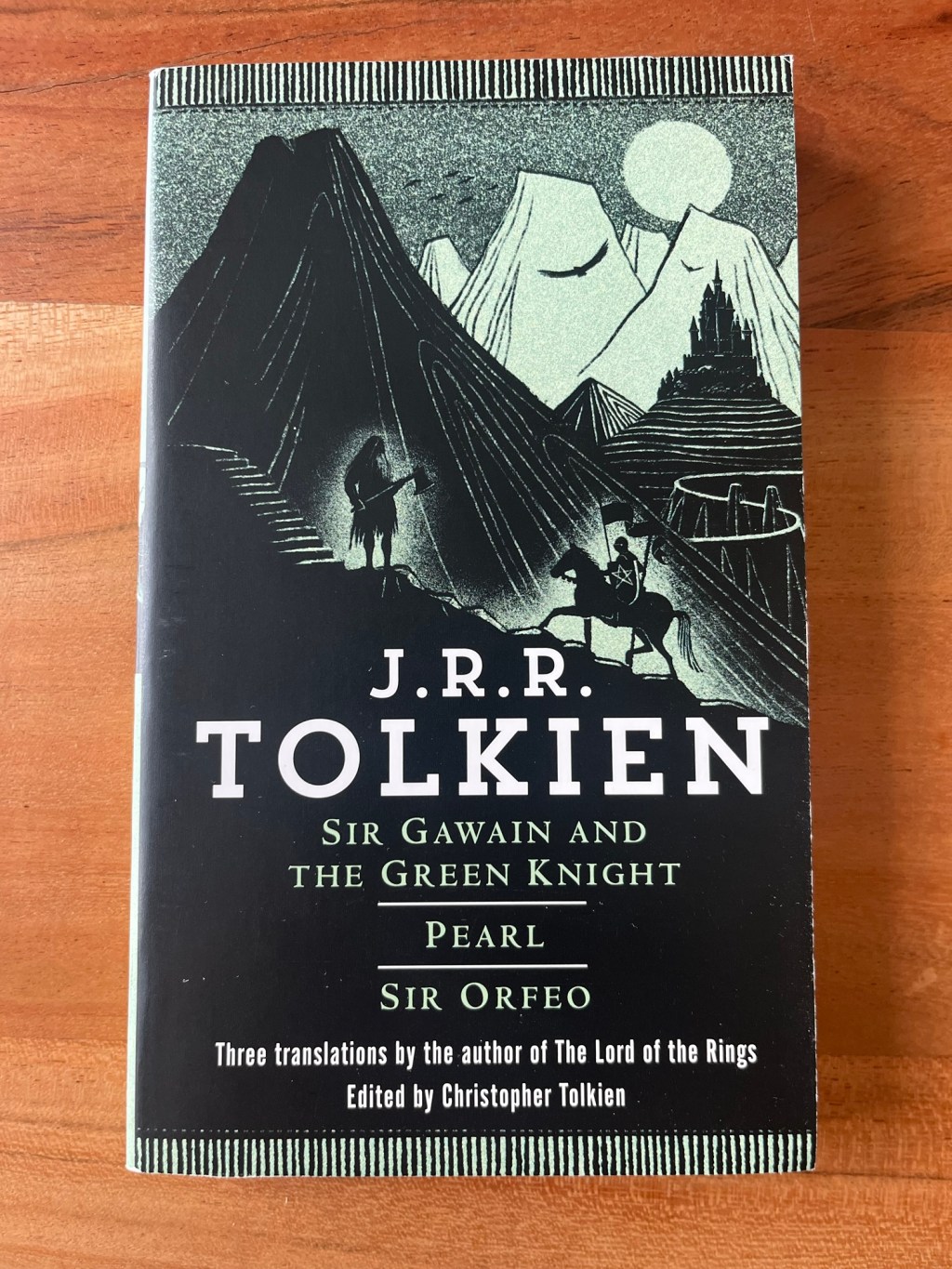
Finished: April 17, 2025
Why I read this
I have always loved the Lord of the Rings, even if that love is more influenced by the Peter Jackson films than the books of the same name. The universe J.R.R Tolkien created is balanced and engaging, with just the right amount of magic (think how Gandalf relies very lightly on magic that is vague and specific and not flinging fireballs left and right). Even the bible-like Silmarillion was interesting enough to push through and finish, explaining the deep history behind his works. Moreover, it’s a universe that you enjoy coming back to time and again, whether that’s each few months or year or two. It has enough depth for each reader to discover a little bit more of the back-ground and details of Middle Earth on each visit. It was with all of this in mind that I wanted to read Sir Gawain and the Green Knight, expecting to see more of Tom Bombadil, Balrogs, or even Ian McKellen’s Gandalf. This lead to quite the surprise on the first pages realizing that this had nothing to do with the Shire, Mordor, or the Undying Lands of the Elves…
What I learned
Learning that instead of a fantastic story of hobbits, elves, and dwarves I had signed up for a modern translation of 14th century poetry was more than a bit disappointing. I had always known that J.R.R Tolkien was a scholarly person (who else would create entire languages for his characters), yet I never quite grasped his professorial back-ground. His work in philology (a word I learned during the reading of the introduction to the poem) had never occurred to me, and impressed me greatly. Unlike our modern equivalent of George R.R. Martin, who is focused on the drama and the story telling, J.R.R Tolkien focused much more deeply on the linguistic elements of his works. Allowing him to embellish his writing with intentional constant symbolism such as the hopeful symbolism behind the Lord of the Rings which felt familiar to the style seen here in the medieval poetry, showing a clear continuity through his various pieces of prose.
Specifically regarding the language used I found it very interesting to see how many words were either directly taken from, or highly resembled, the French equivalents. France and England have had a long and turbulent history over hundreds if not thousands of years, and their development together has seen varying stages of friendship and enmity, yet their languages have grown closer together as time has passed (which I believe to be even more true today with the amount of English words that are found in French culture and every day speaking). I appreciate that I was able to understand these similarities in the translation by Tolkien because at this point I have learned quite a lot of French, but it did make me question why some other languages do not appear to be mirrored in English that would make more sense. Why, for example, are there so few similarities between English and Gaelic (maybe there are and I’m just not versed enough in Gaelic to know, but I sure had a hard time understanding anything from Gaelic when I was in Ireland as a study abroad student). I’d guess it is about the same for the Scottish Gaelic. So what was it about French that motivated the English to learn it, and to incorporate it into their own language? Is it the same idea as how in modern history economic power is held by the US, and so we all speak English instead of Cantonese? Was France in this period really that much of an economic powerhouse? At a minimum this book exposed me to a lot of realities of the history of the country that I now live in, and that was pretty cool to see. (Note that I remembered during the day as I worked on this article that only 200-300 years before the writing of this poem England was conquered by William the Conquerer, from France, so that probably has a lot to do with it as well.)
Although opaque in meaning at times (or frequently) I was able to see often the beauty in the language, which was refreshing. The plot was simple enough to follow even without the varying and frequent descriptive allusions, and the reader could focus on the flow and the feel of the words more than the content. Some of the recurring symbolism was rather satisfying as well and interesting to see how it might be different from today. Such as the extreme variety of the symbol of the 5 pointed star which is embossed on Sir Gawain’s shield as he pursues his quest of almost certain death. The symbol used to stand for perfection or humanity, yet now we associate it with the exact opposite in films of horror or otherworldly darkness.
It also amazed me that although it was written something like 650-700 years ago, the values remain rather relevant to modern society. The ideas around honor and loyalty, even chastity have persisted longer even than the language itself with which the story was written. It is a testament to how slowly we change as a society even if in certain ways we can appear to change quickly. That each of us, from brave knights of the round table, to simple office workers like me, procrastinate on tasks we do not want to do, shows a continuity of human nature that is astounding. Just this morning I was discussing with my fiancé about the falcons who live just outside our window, and how much of their lives are driven by instincts and how much is driven by consciousness. We came to the conclusion that a majority must be instincts, not like us mighty humans, but reflecting on this story and the continuity of human behavior over centuries might prove quite the contrary.
What I didn’t like
Sadly I’ll have to admit there was more I didn’t like than I liked. It wasn’t that it was bad per se, just really not my cup of tea (I’m not sure medieval poetry is the cup of tea for very many people). For an 80 page story it felt like it dragged on forever, and even for its translation much of the structure was complex and required several readings to understand the meaning. If I could add one specific criticism it would be that I would have liked to have a guide for how to read the poetic structure of the text. There were several times where I found myself in the flow of the poem which was rather agreeable, yet I’d stumble and lose it because I was not quite sure where to put the emphasis in the next phrase or sentence.
Questions I asked
What will the English language be like 1000 years from now? Will our books and information from today required translation to the future English?
Will language converge (ultimately having a single human language) or diverge over time?
If society has not changed much in the last 700 years, will it change much in the next 700?
My Favorite Quote
“Whether fate be foul or fair, Why falter I or fear? What should man do but dare?”
Sir Gawain
Books I liked like this one
Honestly, I’m not sure I’ve ever read anything like this for which to compare it to, it was a first!

 Book Reviews for Mom