
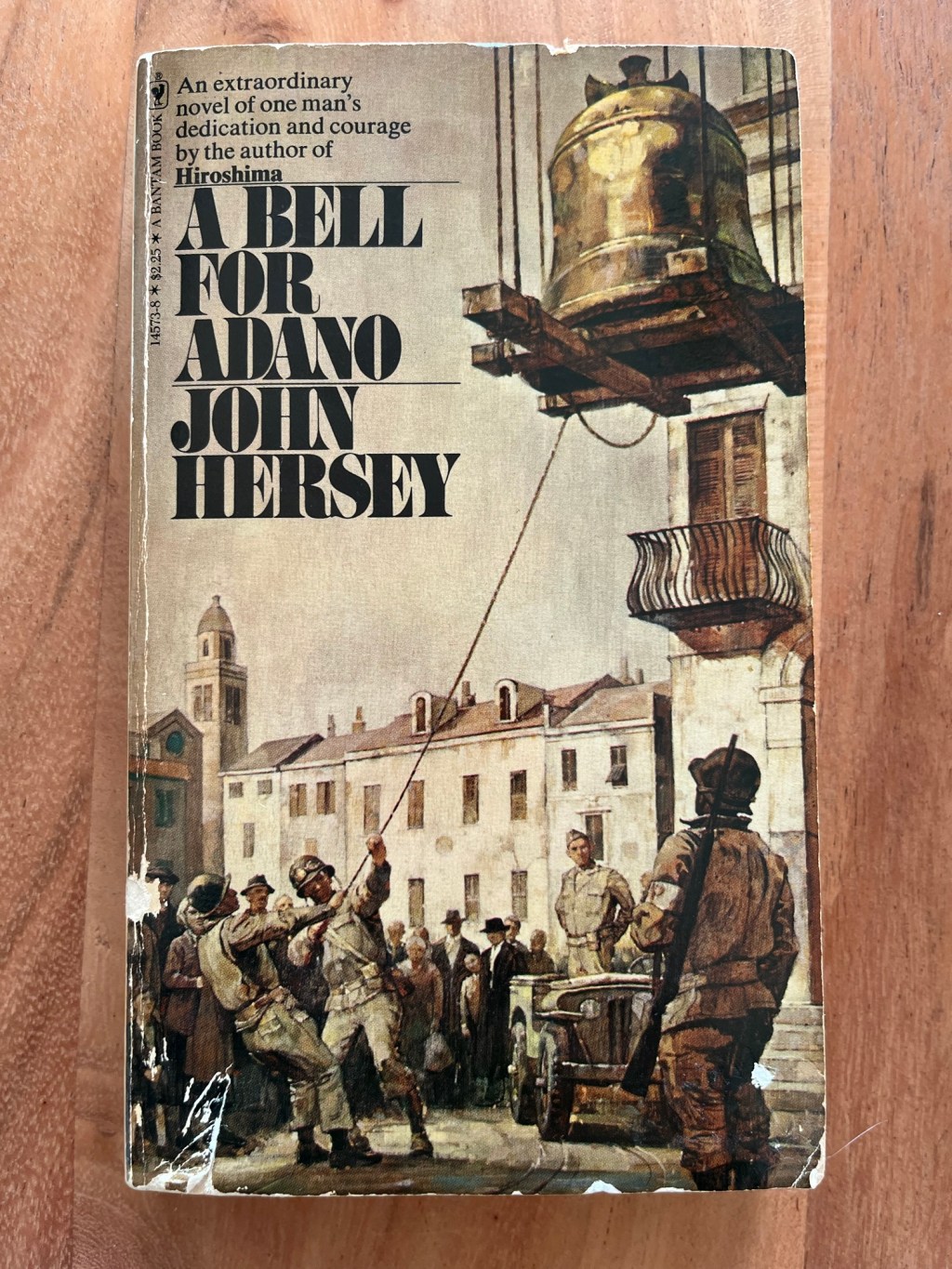
Finished: May 29, 2025
Why I read this
I couldn’t really say why I read this other than it was another on the list of Pulitzer prize novels to check off. The cover art was not exceptionally appealing, and neither were the basic intro paragraphs on the back. It felt a bit like how it feels when you go for that run when you’re tired, or it’s cold, or you’re hungover. You know it’ll be nice once you get started (Pulitzers are almost always good), but finding that initial umpf of motivation to set yourself in motion is painfully difficult. Yet, when you do realize that the dedication to the task is more important than the current comforting state of immobility and you find that little spark to break inertia, you are undoubtedly sure of the rightness of the choice. That’s how it was here. I had many other books on the shelf that I want to read, but I know I have the personal goal to one day read all the Pulitzers and if I want to achieve that, I need to keep moving even when I lack the motivation. So with A Bell for Adano, for which I had no prior desire to start reading, I was thrilled to see that as usual once the pages started to turn, they didn’t stop.
What I learned
Although the plot is exceedingly basic (a US Army Major needs to administer a small Italian town during the American invasion of Italy in World War Two) in just 250 pages Hersey manages to describe, in detail, the meaning of American excellence. The European Village setting allowed for a series of banal and recurring objectives for an administrator. Tasks which a person could easily consider unimportant, but which meant everything for the lives of the town’s people. One day needing to solve disputes about the line for the bakery, and another day managing the traffic of the donkey driven agricultural carts, Major Joppolo wins the heart of his community simply through being a good person. Being just, reasonable, and compassionate he was able to dramatically change the fortunes of his town through simple changes. Many of the principles Major Joppolo followed were the perfect reflections of those described in self-improvement books today. Even after 80 years simple advice such as being empathetic, thinking of the other person’s perspective, helping others to be helped, remain the most effective ways to work with other people. We might evolve technologically, but psychologically we are much the same as we probably have been for the past thousands of years. If evolution has anything to say about it, it will be another several thousand years before Major Joppolo’s integration into this town would have failed.
It was Hersey’s focus on the little aspects of life in Adano that to me highlighted an era of American excellence. An era in which what it meant to be a good person was relatively simply, and to many around the world America exemplified it. Helping those in need, standing up for the oppressed, being strong and fair and just. In a time where Hitler and Stalin were filling the world with genocide and war, being good was comparatively simple. Now don’t get me wrong, It is true that the America of the 1940’s had it’s problems, and I am aware that America didn’t enter WW2 for wholly unselfish reasons, yet the patriotism of the period feels different than that of today. The liberation of Europe over a few years and a grueling campaign is seen in our history as one of the greatest and most heroic actions of American history, yet the wars in Afghanistan or Iraq today (liberation from Saddam Hussein, or the Taliban) are seen as controversial and self-serving. Our same Major Joppolo who was lovable from start to finish, if transported to today would have a harder time with the distinction between pure good and bad. The competing interests of his constituents mixed with a media system which distorts and escalates even minor news into scandals, and which transports this news in five second long, out of context clips across a global social media network in hours or even minutes, makes any action susceptible to misinterpretation and outrage. Something so benign as Joppolo’s fisherman who just want to fish and feed their village could be faced with opposition from environmentalist groups. His punishment of the previous mayor may be considered morally apprehensive. Or his refusal to follow stupid orders as insubordinate.
In Joppolo’s world each action was put into perspective by the horrors of tyranny from Mussolini. When a fisherman under his watch was killed due to a floating mine the village could have been outraged with him for allowing the fisherman to patrol near unsafe waters. Instead they were understanding. They appreciated more the freedom and responsibility they were given to control their own lives, than the possibility of a safer, but more constricting rule which would be reminiscent of their recently uprooted fascists. Today, we lack the existential threat to humanity (maybe not for too long with the escalating situations with Russia and Israel/the Middle East), and so we are more critical, more wary of wrong being done. As I recently read in Abundance we have almost crippled our ability to build things or change laws for the better through the search of the perfect (for example building electric infrastructure without using eminent domain, or without impacting the environment, or while using 100% union labor, or while buying only from ethically sourced options, on and on). This idealistic perfect, is now preventing us from performing the good through the never ending red tape and lawsuits that trap anyone working towards the greater good. I would love to go back to a simpler time and try to take a step back from the big questions of life and to focus on just being good on a daily basis. Maybe that will be my key take-away from this book. If we can all just do that a little bit better every day, and stop expecting perfect from people everything will go in the right direction.
However, the simple goodness of Joppolo wouldn’t have been nearly as compelling if Hersey had not contrasted the simplicity of the town’s daily problems with the unachievable task of finding the city a new bell after theirs had been taken by the fascists for melting into war materials. It showed how any administrator/boss/or officer has two issues to always be facing at the same time. The daily grind, and the grand strategy. If you only focus on the day to day business you might meet the basic needs of a community, a company, or even your body (food, water, shelter, sleep), but if you do not also focus on the long term vision, the future planning, the psychological needs (reduction of stress, motivation, feeling of belonging) then the basic needs will never feel like enough. This is where Joppolo excelled and achieved his greatest triumph. When he heard the town’s people say their most important need was to have their bell back, it would have been easy for him to discredit it and ignore it for more clearly essential repairs (such as fixing the food supply problems of the town, as most right minded people would do), but he didn’t. He understood the higher needs of these people and did not forget the request for a bell while he completed his other urgent missions. Not wanting to spoil everything of the book I will just say that a solution was found, again through classic human relations. In helping out his comrades, giving them hearty approbation, and being lavish in his praise they found the solution to his problem before he could even ask.
It was in this duality of every day betterment balanced against a major challenge that made it such an enjoyable read. I would highly recommend it.
What I didn’t like
It’s rare enough that a book centered on the Second World War could be considered a feel good story, but this one certainly was. There was no mystery or conniving plots by ambitious subordinates. No seduction or intrigue. No murder or mutiny. Just a man doing his best to support a downtrodden and oppressed town. This part of the book I really loved. It was the fact that in the end Hersey allows our lovable Major to take a fall and prevents him from seeing the products of his work that hurt me the most. But I guess having a strong emotion about the fate of the characters is more important than loving the outcome. By contrast it is worth noting that the likability of the Major left somewhat of a hole for the other characters. His presence was so large, so commanding that I hardly remember the other characters, much less developed strong feelings for them. Being such a short book, I’m not sure that it would have suffered much from a slight increase in length to add more depth to the other characters.
Questions I asked
Could someone who had not spoken the local language succeeded in the same way as Major Joppolo?
If Europe were to find itself in another all encompassing war, would America come to its aide again today?
How can we get back to this period of American (or Human) excellence?
My Favorite Quote
“Every time I’ve done something for these people, I’ve found they did two things for me just out of thanks”
Major Joppolo
Books I liked like this one
Monsignor Quixote : Graham Greene (for eccentric characters in a Southern European setting)
The Reivers : William Faulkner (for comical characters with surprisingly deep insights of another epoch of American history)

 Book Reviews for Mom