
Finished: January 19, 2024
Why I read this
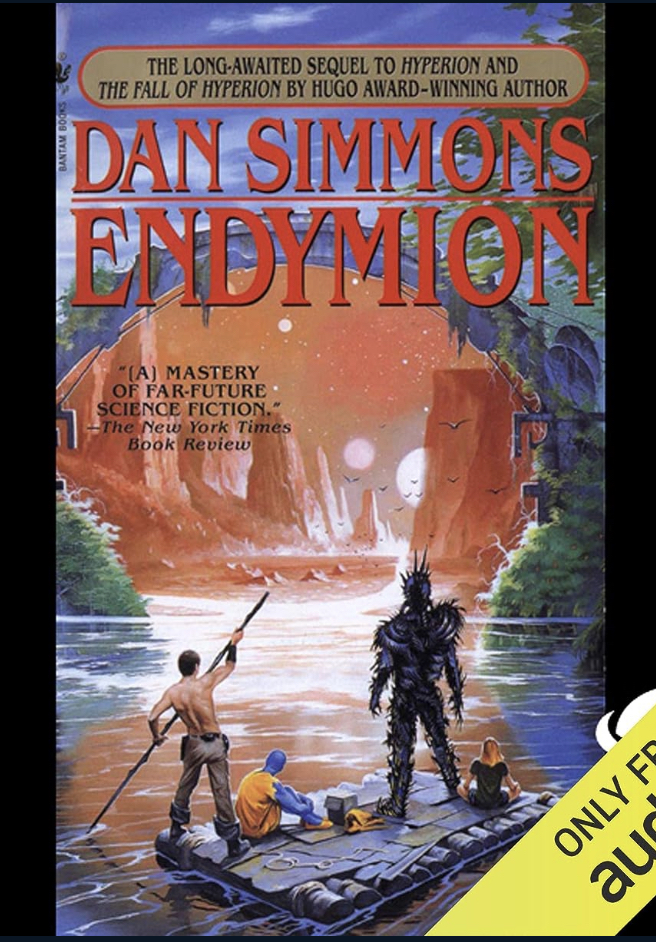
I’m not sure that I am totally capable of abandoning a story or a setting that I already know. I think the only time I can remember was recently with the Foundryside book and its sequels (I couldn’t get past how infantile it felt). That being said, it was much easier to continue in the world of Hyperion. Although the books are longer each time, and there are some parts that are definitely slow, the cohesion of the series and the rich setting makes you feel like you are accomplishing something reading these books. They have complex motives and themes beyond simple plot movement, and even though the plot of Endymion is played out with an entirely different cast, there are small nods to the first two books sprinkled throughout the text that make you feel the continuity. Regardless, I was happy to add another Dan Simmons book to my list, and I’ll continue with the final installment Rise of Endymion for sure!
What I learned
This book took me a long time to listen to. I spread it out over more than two months in 30 minute sections, and I think I see how heavily that can impact the quality of the thoughts related to the novel. However, it is funny to think that I have noted the opposite when I have tried to read other certain things, in that the content is too dense for me to appreciate when read very quickly. I think that the proper amount of time to read a book (or listen to it) is more around the range of one week to one month. I’ll have to continue making note of that in future reviews.
Getting to the thoughts of this specific story I found the continuation to be even better than the previous two books. Just how Hyperion is really a prequel for Fall of Hyperion, I think that the two books together really serve as a thorough preparation of the setting for Endymion. The story feels richer and more complete due to the fact that very little of it needs to be spent on establishing the who, the where, the what. The fact that Dan Simmons was able to draw upon such a variety of planets, biomes, climates and situations due to the established technology of the farcaster portals and the faster than light technology made each portion of the book different and unique. So as usual, science fiction, once able to explain away certain things (immortality, instantaneous movement, etc.) with technology, more interesting moral or philosophical ideas can be addressed.
At the same time though it is not to heavy with these concepts. Sometimes when I am reading something like 1984 or Invisible Man, I spend the entire read thinking about the meanings or implications behind each paragraph or even each phrase. After a short period of time it just becomes too much and I feel like my mind shuts down for a moment until some plot comes back. So without a strong plot like we see here, the morals can be lost as preachy or repetitive.
For example I loved the slow awakening of the character of Father Captain De Soya. Who starting as a ship captain has unflinching faith in his religion and the PAX but every few hours in the audio book he is faced with another, then another, then another challenge to this faith, and the moral questions along with it. Ultimately this results in a likeable and complex character to me that is better than some lightly established characters. It even echoes questions from the first two books where the Abraham question was debated, should a god be worshipped that will ask you to do things that you know to be wrong? The same is true for the Pax here, should an organization that asks you to do something that you know to be wrong be served in any way? And it is something we see in all our daily lives with our works, or our relationships. Often enough someone at work asks us to work late, or to ignore some rule, or a friend that encourages you to break your diet or smoke pot with them. At what point should you abandon someone or something that has been very good to you because they might be a bad influence, or be doing things that are overall wrong? I know it is hard to say in the small day to day items, so I can’t imagine being pushed to make the same determination for a larger question. For example, should I leave western culture because I know that some of the ideals of capitalism are wrong? I don’t even want to think about it!
What I didn’t like
As usual, sci-fi likes to stretch what is possible for a human to do to the absolute extremes. In the future we may have enormously advanced medical capabilities, so people can survive mortal wounds, or we might have exoskeletons that allow us to lift many times our body weight, we may even have simple suits that allow us to survive in vacuum. However I think we will always remain susceptible to certain things such as cold or heat, so the significant portion of this book that was spent on an completely frozen planet was a bit much. I don’t want to be “Mr. Factchecker”, but there were numerous things that Simmons could have done to make this section a bit less farfetched. For example, he starts this section with stating that there was a 100 degree Celsius drop from one portal to the next (leaving dessert Hebron for ice world Sol Draconi Septem). So that means they went from 40-50 degrees to minus 50-60. In this ice world somehow a normal human man was able to swim for 2-3 minutes in sub-zero temperature water (in a 1.7 gravity world) and get out almost scratch free. It was a good plot and I was happy with how Simmons made the story not so classic and problem free as some authors do, however, he could have lessened the extremes and made the story a bit more believable, or incorporated some other technologies or something that make up for the lack of physical possibility. Another note that on this planet the idea that two species (the human Chicthatuk, and the Ice Wraiths) could theoretically live in an ecosystem where each one just hunts the other is a bit ridiculous. You could easily add in some other life forms, plants, animals, anything to make that ecosystem just a bit more sustainable (not to mention that large creatures on a high gravity world, in bitter cold would have incredible caloric requirements just to survive). I’ll end my fact checking rant on the fact that I find that when authors make incredible situations like this, they don’t empower the characters as people who are exceptional, in my opinion they weaken the story by making it unrelatable.
Questions I asked
Do authors normally know where a story is going for the 3rd, 4th, 5th books when they write the first one? Or do they make it up as they go? What a challenge it must be to stay consistent on the later books in a series.
If something has an inevitable outcome, is it still worth doing?
Why do characters in these books rarely have any moral questions about if what they are doing is the right thing? Raul took almost no convincing to risk his life and travel through space with a small girl and leave everything he ever knew behind. Why?
My Favorite Quote
“The shortest route to courage is absolute ignorance”
Raul Endymion
Books I liked like this one
Lord of the Rings: J.R.R. Tolkien (For a slow, but constant journey towards a goal with hidden morals and questions along the way)
Do Androids Dream of Electric Sheep : Phillip K. Dick (For how much you should listen to a society that asks you to do wrong things)


