
Finished: August 28, 2024
Why I read this
In the summer of 2022 during a trip to Greece I really picked up my habit for reading again. The calm islands we visited and the several ferry trips we took left me with tons of time to read and I finished the book I brought with me within the first couple of days. I was then left at the mercy of whatever English titles were available in the small Greek stores that we visited. The limited selection led me to read what was probably my first ever non-fiction book on a subject other than self-improvement. Between romance beach reads and spy novels (one of which I picked up as well, it was terrible), I found Humankind by Rutger Bregman. I wasn’t really excited to read it, but I had so much free time that I soon cracked it open just to see what it was about. I was shocked to find out that it was interesting. Extremely interesting! I spent the rest of the trip annoying my fiancé with all of the random facts and stories I found in the book. She won’t ever need to read it because I already told her all about what’s in it. I just couldn’t help myself.
*Also a note that the past couple of months were absolutely packed and I unfortunately did not find as much time as I wanted for reading and writing. I will hopefully be getting back into it here over the next few days and catching up on some of the things I missed.*
What I learned
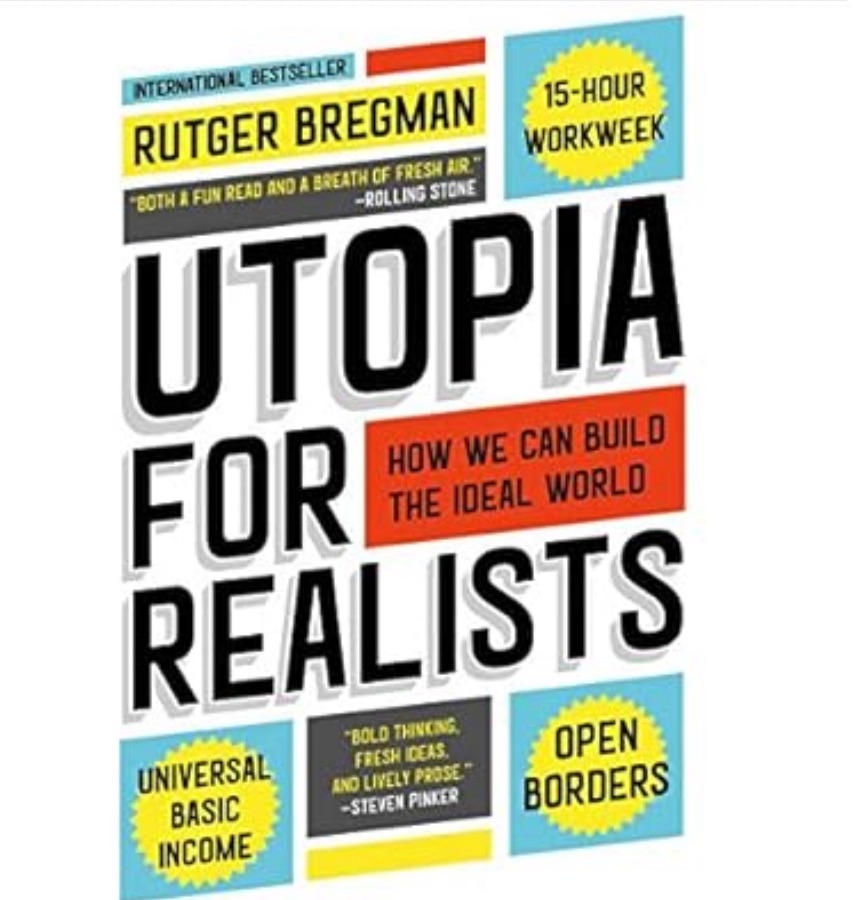
As with his other book Bregman remains an unapologetic optimist. I thought that the discussion of Utopia would be a bit more esoteric or philosophical, but instead real 21st century politics held the center stage of the content. Bregman commented that modern issues that dominate our political discussions today lack truly revolutionary thinking. Progress on subjects like poverty/homelessness, immigration, and the requirements of a modern workforce appears to have stagnated. Although it is nearly 10 years old now the discussions appear to remain equally pertinent, and the solutions proposed equally utopian. A universal basic income, a 15 hour work week, and immigration reform on any serious level appear to be nearly mythological, yet Bregman puts serious research and real case studies behind these ideas and at first glance they appear possible, even well justified. So why can’t we move towards these goals?
Starting with the subject of universal basic income to solve poverty Bregman, just like in Humankind, attempts to dispel several myths of human nature that we seem to have universally accepted. The poor are lazy, or the poor are stupid, or government organisations or NGO’s know what’s best to give poor people. He hypothesises, and supports with evidence that honestly the biggest problem with the poor is that they don’t have money. Stupid to say like that I know, but according to the data presented it’s the truth. It’s true there are always bad apples, but apparently most people who are poor will spend money given to them on practical improvements to their lives, not drugs or alcohol. The things the homeless will really spend on are things like shelter, food, medicine, etc. when given money. Worse, the bureaucratic monstrosities we have created to monitor and control complex welfare systems have ballooned to sizes where efficiency is impossible, and much of their structures could simply be done away with by giving everyone money directly, no strings attached. It sounds like fantasy, but wherever this has actually been tried it has been shown to be exceptionally positive. I even found out it had been tried during the Nixon years in the US. And we were so close to having a universal basic income that it’s hard to believe 50 years later it remains woefully out of reach.
Another scientific concept that I have seen touched on in other books was that of a scarcity mindset. It is basically the idea that our brain has a set amount of memory and capacity and when we begin to exceed that bad things start to happen. It’s the same as the idea that we can only perform deep practice on a skill about 3 hours a day, or why we cannot multitask. But here was the first time I saw someone tie this idea to a meaningful reduction in our capabilities because of it. A sociologist Bregman worked with performed several experiments and concluded that an over occupied brain (such as one of a poor person constantly subjected to the challenges of money for bills, food, savings, necessities, etc.) can be equivalent to a reduction in IQ by 14 points, which is about what you get if you haven’t slept in 30 hours or if you are drunk. If this is even remotely true, which in my personal experience it probably is (I know I make worse decisions when I am over occupied) then it explains so much about that thought we all have about a coworker, a friend, family, executives, really anyone who might make a decision we disagree with, where we think “how could they be so dumb?”. People in unfortunate situations aren’t dumb, they are just often trapped in a negative loop where they have only the mental resources to deal with the daily and cannot dedicate the necessary time or energy towards life improving activities which to those of us lucky enough to be in the middle class or better, consider to be no-brainers.
Ultimately, everything comes back to the inertia of our systems. As opposed to the physical systems discussed by Gates or Smil in my other recent books, these systems are the political and the social. Interestingly enough, although the barriers to changes are dramatically reduced for these types of systems (for example at least every 4 years in the US we could dramatically change the executive branch of our government, not something that is possible with things like heating your home) they appear to resist change even more strongly than some physical things. One such archaic system appears to be our obsession with the GDP. Time and time again I have seen in these books that GDP is a terrible measure for the success of a country. It has countless flaws to its calculation, and often times it can even increase when associated with negative events (such as how a hurricane destroys things that now must be rebuilt and these replacement objects are added to the GDP as “value” created). Why do economists, administrations, and countless other people spend inordinate amounts of time and energy to calculate a relatively meaningless and uninteresting statistic. For any question I can think of there is a better statistic. Want to know how good life is in a certain country? How about infant mortality, typical hours worked, or crime rates? Want to know how the economy is doing? How about unemployment, education, or tax revenue? Just about the only question GDP answers is generally speaking how big is the economy of country X when compared to country Y. Which might seem like an interesting question, but what do you use it for? Concretely, how are politicians, business, on citizens supposed to use the fact that the United States has a GDP per capita larger or smaller than another country? Because ultimately the statistic does not matter, it is the Why behind it that is important. GDP went up? Why did it do that? These huge numbers on the economy mean nothing without context. The GDP per capita in many gulf countries is the same or higher than the US, but the life of a person in Kuwait is absolutely not the same as one in New York, so what do we gain out of comparing these statistics?
While, each specific item addressed may have its merits or its problems the overall idea is one to be admired. We can, and should strive to do better, and if we stop limiting ourselves to the small “realistic” goals of today we will arrest our potential to progress further and faster towards Utopias that can be better for everyone.
What I didn’t like
If I had one criticism for this book, and Bregman in generally it would be that he can be too much of an idealist. For subject such as universal basic income he supported his idea extremely well and his suggestions are immediately actionable and interesting. However, on other subjects like the 15 hour work week, I felt like there were several times that I found myself thinking contradictions that weren’t really addressed. For example he suggests we continue to progress towards Utopia, but work significantly less. One of the greatest challenges of our time is to transition our energy system (a carbon free Utopia awaiting us after this energy transition), yet there is absolutely no possibility that it could be achieved with a 15 hour work week. So sure maybe people who are working in jobs that provide little real-world value could reduce their production, but many physical jobs are more stretched than ever (this goes beyond my personal profession, but includes many things like construction, doctors, sanitation, teachers, and even restaurant staff). How can we move towards Utopia on the one hand (changing things, therefore using a lot of time and energy), and benefit from a dramatically reduced productive week at the same time?
Questions I asked
What do politicians read in their spare time? The ideas presented here seem like such clearly good ideas and well supported. Are they not put in place because they are wrong, because it’s too hard to implement, or because people are simply unaware?
What is the future the left dreams of? What are the steps to get there?
If you continue with the idea for utopia over and over again for hundreds or thousands of years, where might we end up as a species? Does modern science fiction even touch on the reality?
My Favorite Quote
“Genes can’t be undone but poverty can”
Rutger Bregman
Books I liked like this one
Humankind : Rutger Bregman (for a similarly optimistic perspective on humanity)
Talking With Strangers : Malcolm Gladwell (for a frank perspective of how we act today)

 Book Reviews for Mom