
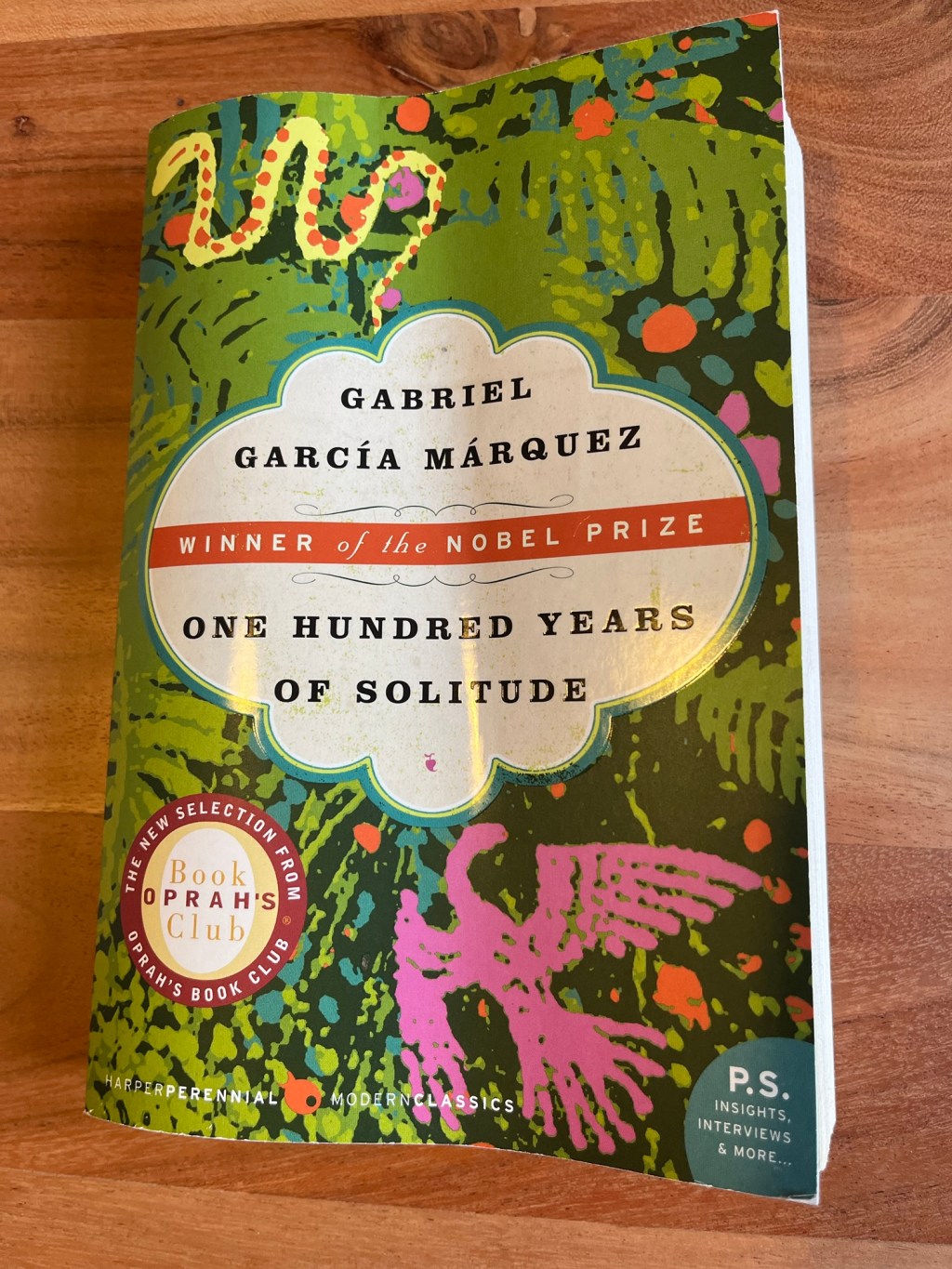
Finished: 4 October, 2024
Why I read this
This book won a Nobel Prize, it’s on the list of Great American Reads, it comes without fail heavily recommended. Even searching “greatest books of all time” ends up with 100 Years of Solitude as one of the first suggestions. So being someone who wants to read the best of the best could something so highly recommended be anything but incredible? With a battered used copy from a second hand store I began this story with such high hopes one day on my morning commute.
What I learned
100 Years was an appropriate title for this book, because it seemed to take about 100 years of my life to get through it. It had been a while since I had read anything by a Latin American author, and finishing this book after almost six weeks showed me at least in part why that is. The plot and main themes had such potential. An isolated town and a family history over a century has such potential to be dramatic and engaging (think of how successful things like The Crown have been), yet there was little engagement with the characters beyond superficial emotions. Which was a shame because the themes were profound and engaging. The role of family in our lives, the cyclical nature of history, the complex nature of right and wrong, the relationship between man and nature. Yet despite these universally interesting themes, Garcia Marquez failed to keep my attention with his rambling paragraphs and roundabout method of detailing scenes or characters.
There was however one theme that I found to be extremely interesting that Garcia Marquez came back to again and again. It was the idea that everything is important and nothing is important. Our characters had many moments throughout their lives that could be considered significant, or insignificant, from an outside perspective, but the way that they were written just about every event was given the same emotional weight. A death of a family member was given the same importance as another character performing a routine task such as cleaning the house or working in their workshops. This clicked with me because I think we as humans tend to put far too much importance on things that, in the end, don’t really matter. The universe continues to turn regardless of the events in our lives. The Earth sees events like our births, our lives, and our deaths all with the same indifference. So when a miracle happens and a certain character simply magically lifts off into the sky and disappears forever, the other characters hardly react.
Another idea that I connected with was this vice that several characters had about building things just to take them apart again. It was the case for Colonel Aureliano Buendia for his goldfishes, or for Amarantha and her funeral shroud, but I feel this is something many of us do with our daily hobbies. I remember spending hours upon hours doing this with legos when I was a kid where I would build an imaginary town and characters just to take them apart a few hours later to build a different one. As an adult I feel we do this in different ways, such as how we all like to rearrange the house every few years, or change our decorations. We spend countless hours building our nests in our homes and countless hours taking them apart again so that we can build something else. Thinking of Utopia for Realists we appear to have reached a development level where the majority of our time is spent doing things simply to occupy our time. Video games, television, the fine arts, reading, all of these activities add relatively little value to humanity, yet they are where we want to spend the majority of our time (for most of us). I remember a friend of mine at Scout Camp when I was a kid that was obsessed with the videogames where you are a train operator and you just drive a train. He would spend hours and hours playing this game where all you do it what appears to be a normal job and he loved it. I felt that my hobbies and my interests were better than his, and that he was a bit weird for liking something so boring. In reality, almost any hobby you might have has the same impact on the universe as any other, so maybe we should care a lot less about what we are doing and focus a lot more on doing what we enjoy.
What I didn’t like
I think the most simple but consistent complaint with this book was the fact that all the characters had the same names. Aureliano and Jose Antonio are used to name what must be 20+ characters. There is never a Jr. or a second, third, etc. for these characters, we are just supposed to know which they are talking about all the time. I’m sure it goes along with the idea that time is a circle and that we are doomed to repeat things over and over forever, but at the same time it simply made things really hard to follow. Mixed with the exceptionally long paragraphs filled with confusing descriptive passages (often never saying things in a clear manner) there were full pages I needed to read two or even three times before I was sure I understood what the author wanted me to. I’m no Einstein, but I like to think I am pretty well read. If it was that hard for me to follow it who on Earth are all of these people who are claiming it is the best book ever written? I think it is a classic case of critics and literature professors thinking it is revolutionary, yet for the layperson the story is unrelatable and difficult to connect with.
The second complaint I had with this book was simply the use of magical realism. It has never been a style that I have enjoyed. Usually I want a book where the world is like ours and magically elements are seen as astounding, or a book where the world is very different from ours and magically elements are quotidian. Magical realism always blurs this line and makes it difficult to understand what should be considered normal and what should be considered exceptional. I know that the book was written exactly this way to make the reader question exactly that theme, but I remember screaming inside my head reading this book whenever something absolutely incredible would happen and the characters would all just brush it off like it was every Tuesday that a character would die and then smell so strongly of gunpowder you could smell it through 6 feet of dirt, or that yellow flowers would fall from the sky wherever one person walked. If someone came into my home trailing a rain of yellow flowers I would probably freak out, at a minimum I would say that, but not the residents of Macondo!
Questions I asked
Can people be redeemable if they have certain horrible traits? For example, can anything good be said of someone who is a murderer or a rapist? Why is it that we can all say Hitler was a bad guy (clearly), but he was one of the greatest orators of all time, yet we cannot say Bill Cosby was one of the greatest comedians?
If nothing matters to the universe, should we be equally indifferent?
What aspects of our daily lives would be magical to people of 100 years ago? What aspects of the lives of my grand children, or great grandchildren, will be magical from my perspective?
My Favorite Quote
“Children inherit their parents’ madness.”
Gabriel Garcia Marquez
Books I liked like this one
The Alchemist : Paulo Coelho (for some aspects of magical realism but with a more compelling story)
Big Fish (film) : Tim Burton (Not a book, but a movie that I really enjoyed featuring many aspects of magical realism. I struggled to find other books that had this aspect that I actually enjoyed)


