
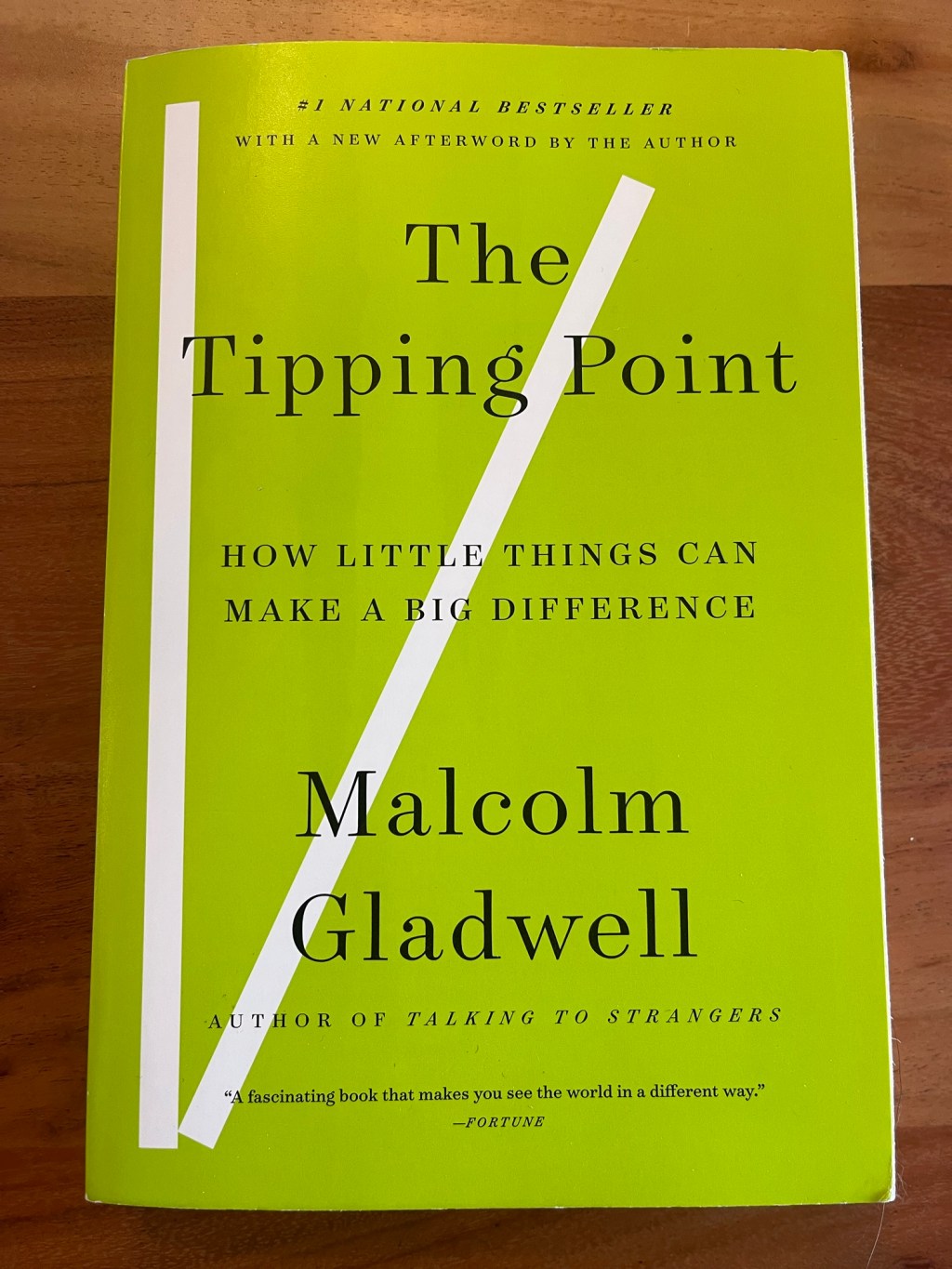
Finished: January 14, 2025
Why I read this
I’m down to a dangerous few Malcolm Gladwell books before I will have finished all of his major works. This will be both an accomplishment and a disappointment. His style of analytical journalism, covering such a vast range of topics have exposed me to so many ideas and have had a dramatic influence on how I’ve grown intellectually over the last few years. I can’t thank my mother enough for thinking to pass me a used copy of Talking with Strangers and introducing me to such engaging and relevant discourses. With that said, there was no question that one day I’d come to Gladwell’s own tipping point to test if his 25 year old ideas still hold up.
What I learned
As usual I am not exactly sure where to start with a review about a book like The Tipping Point. The idea is a simple one (that once a certain point is reached in the adoption of an idea or spread of a disease, or many other transitions, the speed at which the idea is adopted rapidly increases until almost universal adoption is reached) which at first appears very easy to understand, however as soon as you dive into details it is a subject filled with nuances and subtle complexity. For example, we all know that the news sources we watch bias us in our choice of political candidate, but does anyone have any idea how much? The answer is apparently quite a lot, and with a lot less influence required to change our opinions than one would think. This fact comes from a 1980’s study where sociologists found that the simple fact that a news anchor smiled more while saying something about a candidate (even if this something was more negative) as compared to other news anchors, the watchers of that news network would be significantly more inclined to vote for that candidate. It goes back to ideas like in Nudge where very small changes can have huge impacts on our lives. As usual, small, incremental change proves to be the recommended method of attacking almost any subject.
At the crux of Gladwell’s argument is that social phenomena follow the trends of epidemiology with the support of three types of people. Connectors, Mavens, and Salesmen. Connectors spread information far and wide to an exceptionally large network (these special people knowing orders of magnitude more people than the average person), Mavens analyze and explain data on specific and niche topics (think of consumer reports, but as a person), and salesmen show the value of the idea or topic in a way that is identifiable by the majority of the population. These profiles are not novel, and we can all conjure up immediately people from our lives that fit these descriptions. But it is not the fact that these profiles exist, but why they spread things so efficiently and the examples that were shared to support the idea that I found interesting.
A first idea that I was exposed to in (I believe) Thinking Fast and Slow was the idea of the limits of group size and proper functioning. The first time I heard this was to say that humans are psychologically only capable of supporting a certain number of genuine connections. It might be 50, it might be 100, it might be 500 people, but there is a very real number for each of us where when exposed to people past that number we are no longer able to treat those people as humans, our brains are forced to begin to treat them as objects or numbers. This explains why CEO’s can make decisions that affect their thousands of employees that at first glance appear inhuman, or can help explain why people on crowded public transport act so self absorbed. Gladwell goes on to state that in groups the number of 150 comes up again and again as an effective maximum. Anyone who is not a connector (which is most people) struggles to have real relationships with any number greater than this, and therefore any group structure that passes this magic number will be naturally unruly and divergent. You will begin to have subgroups and clicks (noting that 150 is the maximum and you very well may have differences begin to form in groups much smaller). I even see this in my job where our business is less of a traditional hierarchal structure (although there are indeed many levels of management) but instead has many smaller functional groups that are normally around 50 people. This model prevents large organizations from forming where they cannot be managed as a singular collective.
A second subject that I found extremely pertinent to my other current readings (such as Drift into Failure) was a discussion about the spread of information and rumors. Humans when discussing subjects together tend to levelize information, make it more simple and remove details that they themselves do not find important. This means that as information travels through an organization you risk to have a reduction in comprehension and an increased risk that key elements of the message have been removed. This shows that people will not make rational decisions like we might expect them to because they rarely, or never, have all of the information required to make a perfect decision. This shows just how important people like Mavens are who are able to update this information as it comes through groups and ensure that the important items are captured because they will look at things that no one else will at a level of detail far greater than the average person.
However, my favorite idea from this book was by far the idea of transactional memory. Malcolm discusses that as humans we are only able to remember a few things at a time (a fact that is proven again and again in psychological experiments and discussed in books like Thinking Fast and Slow, Deep Work, Atomic Habits, etc). People can keep in their mind an accurate list of a maximum of 4-7 things. This is why we often create reference materials (obvious idea again) such as dictionaries or phone books. The fun part is that apparently we do it with people as well. Humans have a tendency to subconsciously use the people with which they spend the most time (most studied in romantic partners) as reference material for several subjects, and can therefore empty their minds of said subjects to tackle other items. For example, if one partner in a relationship is very good at cooking, the other partner might have trouble learning to cook when this person is around because they use them like they would a cook book and when the cook book is taken away you don’t have the recipes memorized. It adds to why break-ups or divorces are so challenging (because suddenly you lose your reference for several of life’s most important subjects). It also had interesting implications for child raising. According to Gladwell, the initial greater involvement of a mother in child rearing (birth and breastfeeding) causes in the partner a subconscious tendency to use the mother as the reference for child activities. This initial involvement and reference for the child snowballs in a feedback loop resulting in the “mother is responsible for the children” situation. Something to know as we strive towards greater equality in raising of children.
Finally, Gladwell asserted that these profiles mesh with psychological ideas, but at the end of the day, the context in which you are can be significantly more powerful than almost any other factor. Take the example of whenever you are in a rush. The simple fact that you are late or behind schedule makes your behavior significantly different. We all know that we are irritable, curse more while driving, and are generally disagreeable when we are in a hurry. But a study involving priests passing by someone clearly in need showed that if you told the priest to hurry and that they were late the chances they help the person in need plummet dramatically. Another study discussing best friends showed quite simply that proximity to a person improves the chance of being friends much more rapidly than any factors such as common interests or similarities in personality. All this to say that even if there are rules and patterns in how humans behave and act, the first change we should always look for should be context. Simply telling someone that they have plenty of time to arrive at their destination can make them want to help other people. This is an idea we can all benefit from.
What I didn’t like
It wasn’t a negative about the book, but I didn’t like how it had dated. Many of the ideas such as Gladwell’s “Connectors” would be very interesting to have a modern update with the dramatically more interconnected world that we have today than existed 25 years ago. I’d love a little update or appendix to discuss how these ideas might have changed since the first editions released in the late 90’s.
Additionally, I was a bit disapointed to see that there were two experiments (or situations) that Gladwell made reference to that were in fact debunked later on. First was the infamous Stanford School Prison Experiment where Gladwell implied that context is so powerful it can completely change your personality. However, this experiment was later debunked as being unfairly biased by the instructors and a couple of bad egg students. Secondly, there is the subject of the murder of Kitty Genovese in New York where it is implied that 38 people basically watched Kitty get murdered in an ally, but in reality was a much more complicated situation. For example many of the neighbors were said to have been sleeping and when interviewed later on were not able to accurately describe the events of the evening. It goes to show that even with the people that we like to listen to, it is worth double checking the situation from several angles.
Questions I asked
What are the small changes to my life, the easy wins, that might yield disproportionate results?
How are the ideas of tipping points going to be impacted by our modern society that is dramatically more interconnected than before?
Has Gladwell been using his own rules of diffusion to increase his own success?
My Favorite Quote
“Gosh darn it… if you don’t try you’ll never succeed.”
Tom Gau
Books I liked like this one
Nudge : Richard H; Thaler, Cass R. Sunstein (for how small changes can make big differences)
Drift into Failure : Sydney Dekker (for very similar ideas almost perfectly applied to my field of work)

 Book Reviews for Mom