
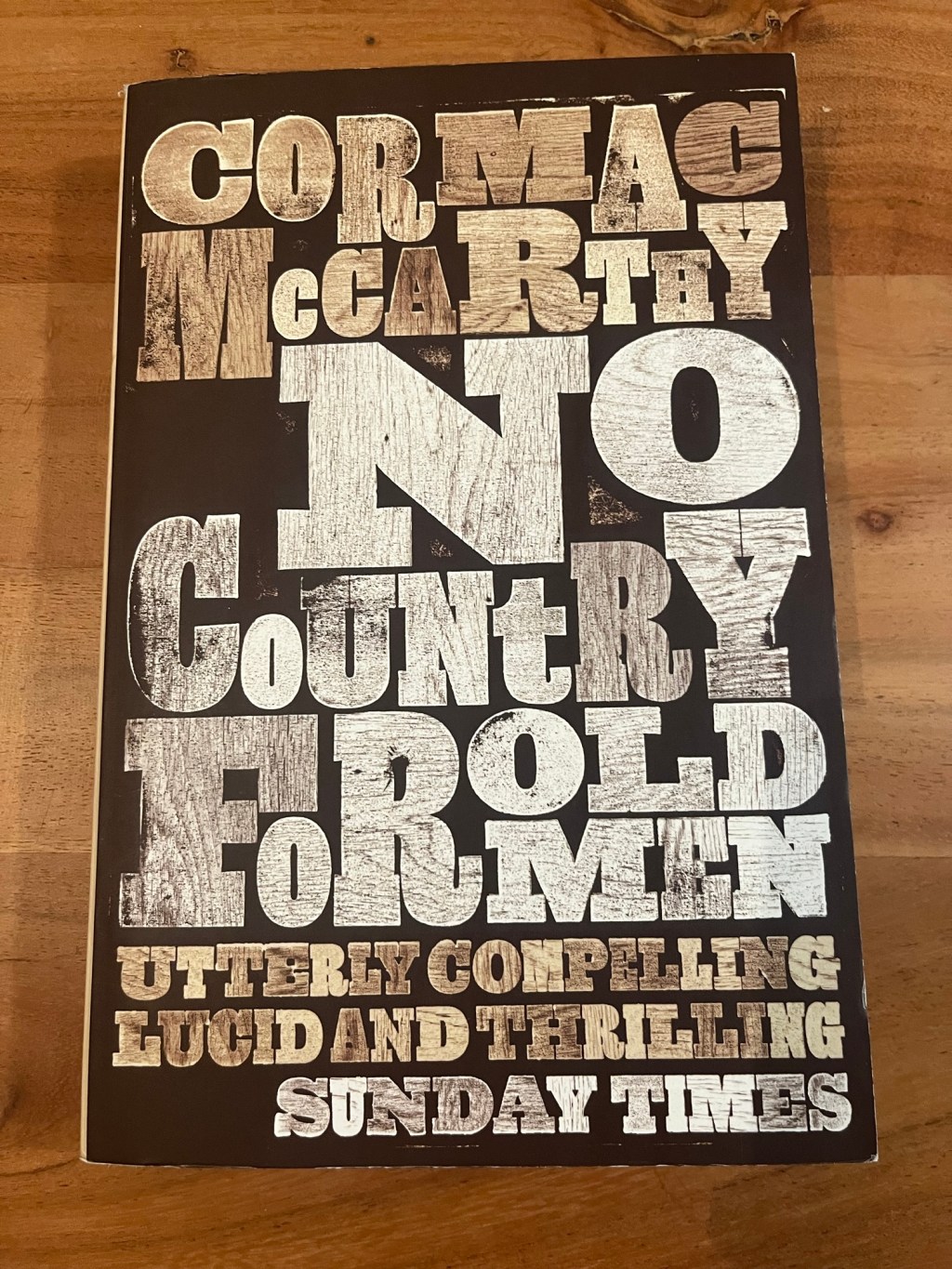
Finished: January 3, 2025
Why I read this
Even though I watched the movie probably over a year ago, I’m not sure there’s anyone I’ve seen more unique and more frightening than the eccentric villain Anton Chigurh. The mix of the strange haircut, the cold style, and the cattle gun with the air tank just made him into one of those rare and special characters, the kind that makes a movie what it is, bringing a truly real and horrifyingly accurate creature into the world. Clearly the fact that for this performance Javier Bardem won best supporting actor and overall the movie won the best film at the Oscar’s means most people would agree with me.
Growing up we had a rule in our house that we had to read the book first before we could go see the movie for anything coming out. Now that I’m an adult I tend to do it more often in reverse. I find that it’s nice, even though I may know parts of the story, to have some images already for the characters. I’m not the most creative person and I’m not sure I would have been able to better place Antony Chigurh without Javier Bardem’s example. So in the end the movie was a great way to dive back into Carnac McCarthy’s choppy writing style to revisit this story.
What I learned
First and foremost, I loved the premise. It’s a great idea to explore what might happen if someone normal (in this case a hunter named Llewelyn Moss) were to stumble upon the results of a drug deal gone bad. After all if you were to completely by chance find yourself with a bag of two million dollars what would you do? We all love to imagine what we might buy or do if we were to win the lottery. But rarely a dark lottery like this where the risks might be equal to the reward. A part of me wants to say that I wouldn’t be so stupid as to take such obviously cursed money, yet I know I’d be tempted to take it and run as well. That kind of money does strange things to people. Part of me wanted to think throughout the book that he was being ridiculous and stupid, yet I know how even a small amount of money can make people crazy, I can definitely believe that Moss would have followed the path that he did. It reminded me of a game show my mom recently told me about where people begin to do just insane things for the chance to win 5 million dollars. Obviously people are going to want very badly to win this kind of money, but there are 1,000 contestants, so even if you’re excellent your chances are almost none. Yet at the beginning the host offers each contestant to walk away with almost 20,000 dollars. According to my game theory class, each person should be rational and realize that 20,000 dollars is worth more than 1/1,000 chance to win 5 million. Yet, only 50 of the contestants chose to take it. It just goes to show that we, like the main character of No Country for Old Men, do not always act rationally, especially when it comes to money.
I also thought a lot about the theme that the world is getting worse. It’s a pretty common theme as people age to feel that everything is worse than it used to be. If you listen to about 10 minutes of any news show you’ll here innumerable references to the good old days, or how things were better in the nebulous “before”. Although I’m usually pretty opinionated, I can’t decide if it is something I agree with or not. I think it’s a psychological thing that the world seems better when we are children, yet as we age and our ideas become more rigid, forged through the experience of living we become more and more sensitive to the negative parts of life, more cognizant of anything that goes against the world view we have chosen to adopt. I think that’s what our Sheriff Bell was going through in his recollections. By almost any measure the world is safer than it was at any previous time, but those who have spent their lives seeing more and more of the worst parts of it can’t help but to think that their personal experience is representative of the whole. That everywhere things are bad because one small town happens to be struck by a disaster. That when we are children we don’t see much of the bad of the world, and therefore the places and times of our youth appear that much safer and nostalgic.
At the same time we are exposed much more frequently to the horrible events that happen all around the country or the world, instead of the focus of previous generations on local news where you might see a murder or a kidnapping every few years (depending of course on where you live or what you do) instead of every few days. I believe McCarthy would have agreed that our increased interconnection with social media and constant news reporting skews our perspective. He might have argued that it has also pushed us to think in broader terms to be pushed beyond our local spheres of influence. I know for example the Americans I know now rarely identify with their state, but instead are “American”. People also begin to care more and more about issues that do not immediately affect them. It’s true that the war in Gaza or Transgender rights impact immediately an incredibly small portion of the population in the United States. Even such controversial topics such as abortion aren’t so universal that they affect the majority of people. Yet theses issues remain in the forefront of our news and media channels and are addressed almost daily by the highest level of politicians and influential figures. Beyond social figures, looking at the crime that is possible in a group of 330 million people as opposed to a local community of course you’re going to be disgusted. Any population of that size is going to have individuals like Anton Chigurh that are capable of doing horrendous things, and just like Llewelyn Moss, no matter what we do, we will be unable to escape them. We live in a world where everything is in the open now and when something horrible happens news can and will spread. On the one hand it allows us to engage the outrage of the many to force change on injustices. On the other, it subjects us to constant stress and worry over issues that may not immediately affect us. It’s a paradox within itself on how to handle this kind of situation, but I hope we will be able to figure it out until we descend into the apocalyptic future Ed Tom Bell foresaw for us.
What I didn’t like
Honestly great book. A bit hard to read at time, but in the end the biggest problem I had with this book was the lack of conclusion. It’s very representative of the real world, we never know if the bad guys really get away with it or not, but still as the book drew to a close I wanted nothing more than to know the real end to all of the characters but of course McCarthy decided to be frustrating and to leave the reader guessing of the final results.
Questions I asked
What percentage of the population would say the world is worse today than it was when they were a kid?
Why are we drawn to such violent material?
Why are we always nostalgic of the past when by most statistics the world is better than it ever was?
My Favorite Quote
“It takes very little to govern good people…and bad people can’t be governed at all.”
Ed Tom Bell
Books I liked like this one
The Road: Cormac McCarthy (for an obviously similar writing style)
Lonesome Dove: Larry McMurty (for deep and moving characters who struggle with changing times)


