
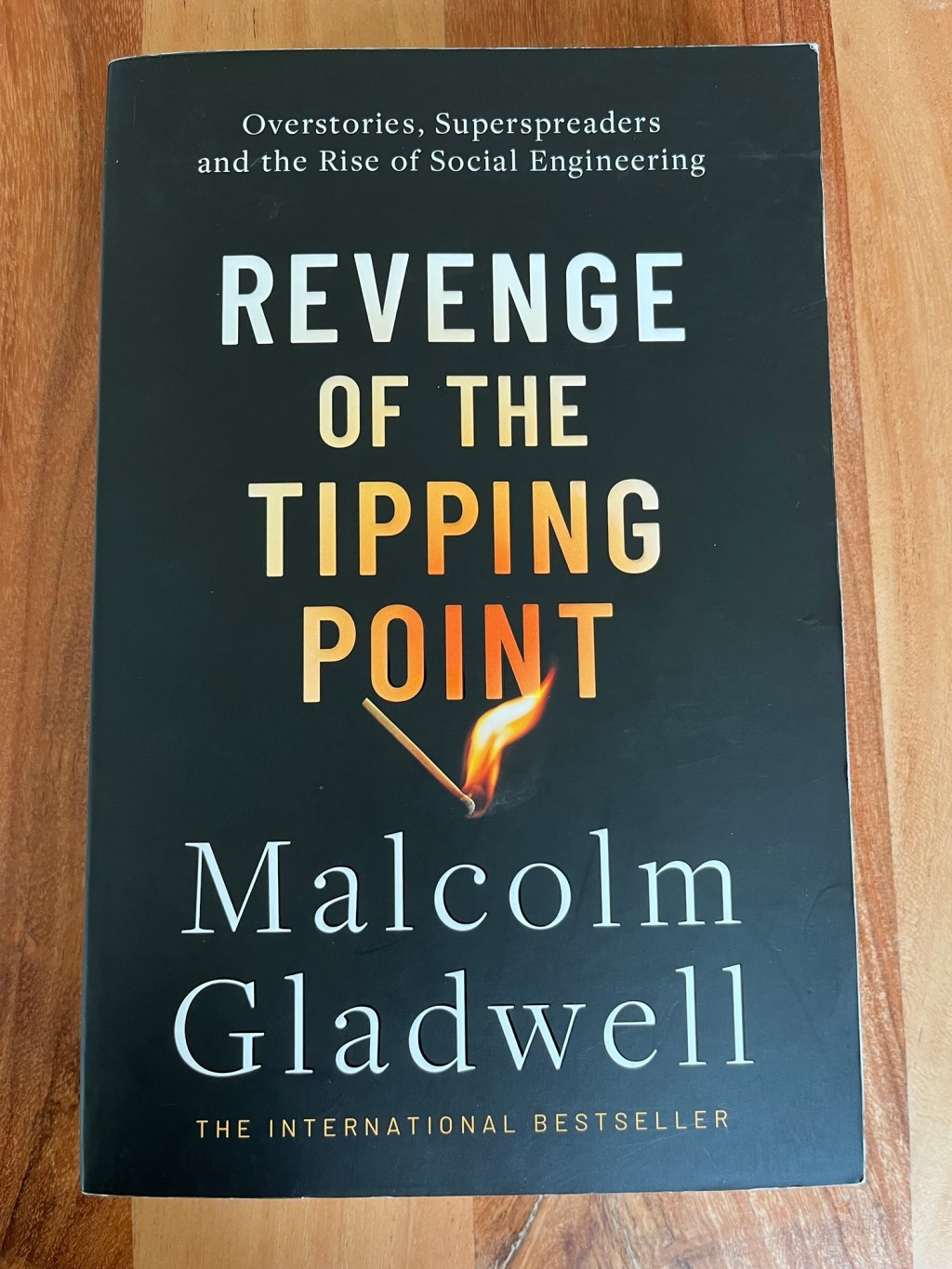
Finished: October 15, 2024
Why I read this
I actually read this book several months ago. I had the chance to find an English copy in Paris, and it being the last copy on the shelf I gladly bought it. Even though I quickly read it, I thought that it might be better to have the history of the earlier book The Tipping Point to have all of the context. I was not sure that one could truly be separated from the other, so I decided to wait to make this post until I had finished the both of them.
What I learned
Where The Tipping Point explores how social phenomenon follow the course of epidemics related to subjects like adoption of new fashion trends, or the arrival of new technology on the market, its revenge looks much more in depth at the negative side of this aspect of human nature. It explores how we are trapped by our nature to follow the patterns of epidemiology whether we like it or not
Each Malcolm Gladwell book I read there are always a few stories or facts that stick with me well beyond the reading. There is the discussion on policing specific districts as a method of optimizing resources in Talking to Strangers, there is the story of the Jewish people in New York in the 1930’s/40’s from Outliers, there is the test where a second or two or black and white soundless video of a teacher can allow people to see if that professor is good or not from Blink. It’s these stories and facts that I connect with and I find myself coming back to over and over again in normal conversations. As explained in The Tipping Point, stickiness is an important factor into the success or failure of an idea, these are the points that for me were exceptionally sticky. Now, some 4 months after finishing this book I’m able to say confidently which of the stories stuck, two of which I have found myself thinking about several times.
The first of these stories was the surprising, yet plausible connection between white flight and Harvard’s sports program. For a reminder, white flight (or equivalents) happens when a minority group passes the magic 30% of the total population. Once this proportion is reached, often times the percentage of minorities in this group skyrockets, eventually becoming a significant majority. This was an idea common to housing complexes as races became integrated in the US, but it can be applied to much broader group dynamics. In this case, Gladwell showed the example of Caltech and the percentage of minority students (specifically Asian students) that was steady around 20 percent, but slowly creeped up to 30 percent and once passing it rapidly approached 50 percent in the span of just a few years. However, when looking at Harvard’s numbers the percentages of each race stay remarkably similar over the past 30 years. Gladwell’s claim is that the Harvard athletics program is a tool being used to ensure this ratio stay the same by ensuring athletic scholarships for large number of athletes that practice obscure, yet predominately wealthy (often through the nature of the sport, for example to be good at tennis you need coaches, courts to practice on, country club memberships, ability to travel for competitions, etc.) communities, that are often predominately white. Harvard invest rather ridiculous amounts of money into scouting these students from around the world just to ensure this ratio stays the same. Why else would Harvard invest thousands (if not millions) into the scouting, training, and supporting of a varsity women’s rugby team, which is a sport that is not at all popular in the US, and provides little to no value to the student population? It might lack a bit of support, but I think this argument is a very interesting view of how certain programs can be used in a very maleficent way. It makes you wonder what other programs appear to be good, but in reality are cover ups for more malignant purposes.
The second story that stuck with me was a discussion of the COVID-19 epidemic. During the epidemic apparently the previously little known field of aerosol research came into the spotlight. This focused revealed research which showed how the particles containing the virus were spread. It was super interesting to read that despite what we might think, coughing and sneezing are not the main spreaders of sickness, but instead talking is the action that actually produces the most risk. Coughing or sneezing will produce larger particles that will fall from the air more quickly, floating less distance. However, when we speak, small strands of spit cross our vocal cords and the escaping air produces microscopic bubbles that can stay in the air much longer and travel much larger distances than those produced by coughs or sneezes. While this was surprising, what really interested me was the fact that each person has different biology which increases or decreases the amount of saliva in our vocal cords and therefore increases or decreases the amount of virulent bubbles we produce when talking. Apparently, there are even people that produce orders of magnitudes more types of virus than some others do simply because of how their bodies work. Gladwell asserts that these people were the key to super spreader events. When you stack a person who produces lots of these bubbles, with a large event, where they speak a lot (such as a conference), the potential to spread is enormous. While the scientific aspect of this is enlightening, the moral implications of this are what have stuck with me since reading. If there are people who have a biological difference in their ability to spread a virus and we have a method of determining that difference, what are the moral obligations of those people to isolate themselves more than others in the case of a pandemic? Is it fair to put additional limitations (such as wearing a mask, or speaking less) on people who have greater risk of spreading infectious diseases? Are the rights of the many more important than the rights of the few? It’s a simple concept, yet the implications are far reaching, it’s exactly these types of thoughts that make me enjoy Gladwell’s works.
What I didn’t like
I understand that a lot of what Malcolm Gladwell writes is influenced by his beliefs and supported by sociology. Obviously this is going to end up with certain ideas or claims that are more strongly justified than others, some more biased, some more solid. But, as opposed to his other books, I felt The Revenge of the Tipping Point to be significantly more skewed towards the “yea that’s plausible” range of things as opposed to the “wow that must be the reason” feeling that is usually found in his works. Correlation does not imply causation, and here I feel Gladwell pushed a little too hard to link the two on several of the topics.
Questions I asked
If some people are greater super spreaders based on their unfortunate biology do they have a social responsibility to isolate themselves more than those who are not?
What programs (such as athletics scholarships) have secret, and malignant objectives?
What makes humans so obsessed with finding out how things, especially other humans, work?
My Favorite Quote
“Social epidemics are propelled by the efforts of an exceptional few.”
Malcolm Gladwell
Books I liked like this one
The Tipping Point : Malcolm Gladwell (for obvious reasons)
Drift into Failure : Sidney Dekker (for the negative aspects associated with tipping points)

 Book Reviews for Mom